TRIPOLI: The masked men came in the night, ripped off the front door and set the bookstore on fire. They were out to punish the owner, an elderly priest, after false rumors that he had written an anti-Islamic tract.
Thousands of books that lined the walls became the latest victim of Lebanon’s sectarian tensions, which have been swelling as civil war rages in neighboring Syria.
But the blaze in the northern city of Tripoli also moved many residents, Muslims and Christians alike, to offer to help repair the 40-year-old shop, showing how some Lebanese are rising up in protest. The outpouring echoes a similar response last month after a teenager was killed in a car bombing that targeted a prominent politician in the Lebanese capital. His death ignited protests and an online campaign.
On Sunday, a day after the fire, a dozen activists gathered in an arched alleyway outside the Saeh bookstore. A music box blared the melancholy song “I Love You, Lebanon” by the country’s beloved singer Fairouz. A Lebanese army tank was parked at the end of the street, and soldiers in blue-and-khaki camouflage uniforms milled about. A young man with shaggy hair scrubbed soot off the alley’s stone floor with a broom, assisted by a middle-aged Muslim woman in a head scarf.
“Most of the people who came don’t know the bookstore,” said Mutaz Salloum, a 26-year-old volunteer. “There’s always fighting, bombs and attacks on people’s property. People are really sick of it. We can’t be quiet anymore.”
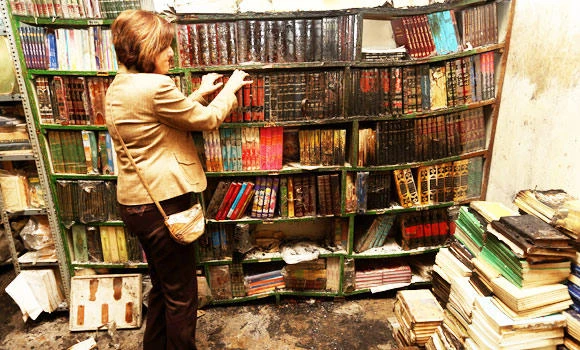
The crammed and sagging building that housed the Saeh was still pockmarked by bullets from Lebanon’s 15-year civil war that ended in 1990. A woman carried off charred books from the shop, its shelves still stuffed with works ranging from Abdul Razzaq Al-Husseini’s “Political and Contemporary History of Iraq” to a French translation of Virginia Woolf’s “Orlando.”
The shop’s most valuable items, centuries-old religious manuscripts, were mostly unharmed. They included 40 copies of the Holy Qur’an, written in delicate calligraphy, said book collector Maurice Kodeih, who was in touch with the media-shy Greek Orthodox priest who owns the shop, Ibrahim Sarrouj.
Books are latest victim of Lebanon’s violence