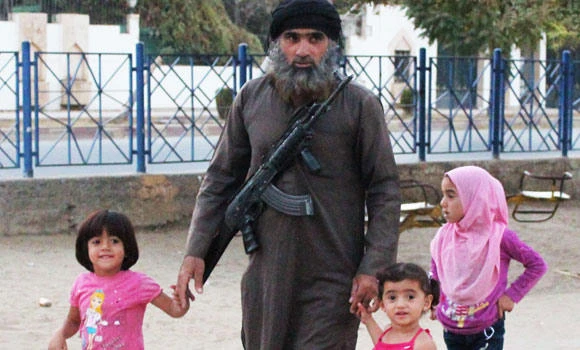
BEIRUT: The Islamic State group on Tuesday freed more than 70 Kurdish school children its fighters kidnapped in northern Syria in May, the Syrian Observatory for Human Rights said.
The Britain-based group said parents had reported the release of the children, who are believed to be aged between 13 and 15.
The group of 70 were among 153 school children, most of them boys, abducted by IS militants on May 29 in the northern province of Aleppo.
They were intercepted and taken hostage en route to their hometown of Ain Al-Arab after sitting school exams in Aleppo city.
They were kidnapped around the area of Minbej, which has been targeted in recent days in air strikes by a US-led coalition.
In the weeks after the children were abducted, five students managed to escape and another 37 were released in batches, including the 10 girls among the group, the Observatory said.
There were no immediate details on why the group decided to free the 70 additional hostages on Tuesday, and the Observatory said around 30 more children were still being held.
It said IS was refusing to hand over the 30 children because it said they had relatives in a key Kurdish party opposed to the group.
Ain Al-Arab, known to the Kurds as Kobane, is now a major battleground between Kurdish fighters and IS.
Located strategically on the Syria-Turkey border, it is the country’s third biggest Kurdish town.
IS fighters have been advancing toward it for the past two weeks, and are now just 3 km from the town in places, according to the Observatory.
The fighting has prompted a mass exodus of residents in the area, with at least 160,000 fleeing over the border into Turkey.
Meanwhile, ancient Iraqi artefacts are appearing on the black market as Islamic State militants use intermediaries to sell priceless treasures to finance their activities after sweeping through the north of the country, Iraqi and Western officials said.
The militants gained some experience of dealing in antiquities after taking control of large parts of Syria, but when they captured the northern Iraqi city of Mosul and the Nineveh province in June, they gained access to almost 2,000 of Iraq’s 12,000 registered archaeological sites.
Mesopotamia, part of modern-day Iraq, was among the earliest civilizations. Its name in Greek means “between the rivers,” a reference to the Tigris and Euphrates rivers that made it a rich center for agriculture, trade and a crossroads of civilizations.
The site of Nineveh and Babylon, whose hanging gardens were one of the seven wonders of the ancient world, the land was home to the Sumerians who gave the world cuneiform — the earliest form of Western writing — around 3100 BC.
Speaking at a conference at the UN cultural agency UNESCO in Paris to warn of the risk to Iraq’s heritage, Qais Hussein Rasheed, head of the Baghdad Museum, said organized groups were working in coordination with Islamic State.
“It’s an international artefacts’ mafia,” he told reporters. “They identify the items and say what they can sell,” he said. Since some of these items were more than 2,000 years old it was difficult to know exactly their value.
Citing local officials still in Islamic State-controlled areas, Rasheed said the biggest example of looting so far had taken place at the 9th century B.C. grand palace at Kalhu of the Assyrian King Ashurnasirpal II.
“Assyrian tablets were stolen and found in European cities,” he said. “Some of these items are cut up and sold piecemeal,” he said, referring to a tablet of a winged bull.
Another Iraqi official, who declined to give his name, said artefacts were also being dug up and neighboring states such as Jordan and Turkey needed to do more to stop such items crossing their borders.
“Things are getting across our borders and into auction houses abroad,” he said. “Unfortunately many of the proceeds of these artefacts will be used to finance terrorism.”
A Western diplomat said it was too early to assess exactly how much from Iraq had crossed the borders.
“We’ve seen hundreds of millions of dollars worth of Syrian pieces pop up after their sites were looted, so it’s not unreasonable to expect the same for Iraq,” he said.
IS frees 70 kidnapped children