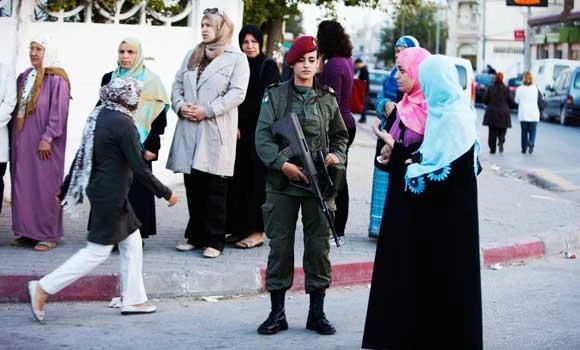
TUNIS: Tunisians voted Sunday in an election seen as pivotal to establishing democracy in the cradle of the Arab Spring uprisings, with security forces deployed heavily to avert extremist attacks.
More than five million Tunisians were eligible to elect a 217-seat Parliament, after an interim body drafted a new constitution in January as part of the country’s path to democracy.
Two hours before the polls closed at 1700 GMT, turnout had reached 50.84 percent, said Chafik Sarsar head of the ISIE body organizing the election.
Tunisia has been hailed as a beacon of hope compared with other chaos-hit countries like Libya and Yemen where regimes were also dismantled.
But its transition has been tested by militant attacks and social unrest, while poverty and unemployment which were key factors that sparked the 2011 revolt continue to be unresolved.
Officials described the vote as “historic” and a “defining moment” while voters voiced hope a new Parliament would help restore political and economic stability as well as law and order.
“The spotlight is on us and the success of this (vote) is a guarantee for the future... a glimmer of hope for this region’s young people,” said Prime Minister Mehdi Jomaa as he cast his ballot.
Jomaa had warned of possible jihadist attacks aimed at disrupting the country’s first post-revolution parliamentary election, after a deadly standoff Friday between police and suspected militants that killed a policeman and six insurgents, five of whom were women.
Authorities deployed 80,000 troops and police to protect voters but the day passed without any reports of unrest.
With vote-counting underway, results are expected by Thursday at the latest, the head of the EU’s election observer mission, Annemie Neyts-Uytterbroeck, said voting had been “more than satisfactory.”
Several parties competed for a seat in the new Parliament, some fronted by stalwarts of veteran dictator Zine El Abidine Ben Ali who was ousted in the 2011 revolt.
His exit ushered in a coalition government and interim president that won praise from the international community. But the birthplace of the Arab Spring protests flirted with disaster.
A rise in militant activity last year when two opposition lawmakers were assassinated by suspected militants — long suppressed under former rulers — threatened to derail the road to democracy.
Although they have publicly sought to distance themselves from the repression and intimidation practised under Ben Ali, many of those who took part in the revolution are angered at the prospect of former regime figures returning to Parliament.
Tight security for ‘historic’ Tunisia vote