Saudi crown prince stresses importance of applying UN principles and the rule of law

Saudi crown prince stresses importance of applying UN principles and the rule of law
1 / 8
Saudi crown prince stresses importance of applying UN principles and the rule of law
2 / 8
Saudi crown prince stresses importance of applying UN principles and the rule of law
3 / 8
Saudi crown prince stresses importance of applying UN principles and the rule of law
4 / 8
Saudi crown prince stresses importance of applying UN principles and the rule of law
5 / 8
Saudi crown prince stresses importance of applying UN principles and the rule of law
6 / 8
Saudi crown prince stresses importance of applying UN principles and the rule of law
7 / 8
Saudi crown prince stresses importance of applying UN principles and the rule of law
8 / 8
Updated 28 March 2018

Saudi crown prince stresses importance of applying UN principles and the rule of law

Saudi crown prince stresses importance of applying UN principles and the rule of law

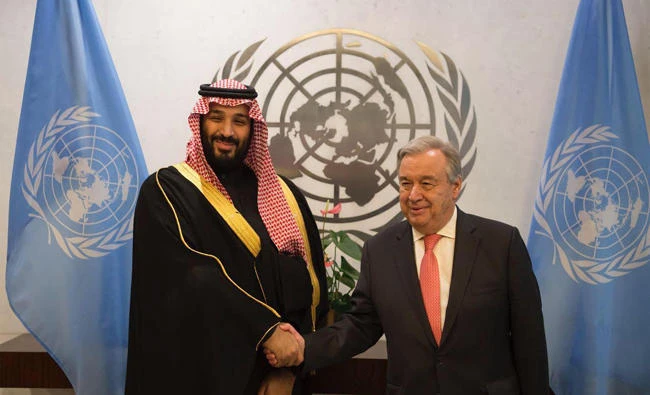
DUBAI: Saudi Arabia’s Crown Prince Mohammed bin Salman has stressed the importance of keeping in line with the principles of the United Nations and the rule of law.
He pointed out that the problems in the Middle East are due to ideologies that clash with UN principles and violate its laws and customs by interfering in the internal affairs of other states.
He made the comments in a speech after his meeting with Secretary General of the United Nations Antonio Guterres.
The crown prince said that Saudi Arabia is defending its interests and maintaining its security and is working with its allies in the Middle East to secure and stabilize the region.
He also stressed the Kingdom's keenness on finding political solutions to the Middle East's crises, in cooperation with the United Nations. He pointed out that the Kingdom is an active member and has contributed to protecting the interests of the United Nations and its laws.
UN Secretary General Antonio Guterres praised Saudi Arabia's global humanitarian efforts as he welcomed Crown Prince Mohammed bin Salman to the organization's headquarters on Tuesday.
Guterres expressed his appreciation for the humanitarian contributions in the world and to the Yemeni people, its support and funding of the humanitarian response plan in Yemen, and called on countries to contribute to this effort.
Guterres also renewed his condemnation of the targeting of ballistic missiles by the Houthi militia.
The crown prince and the secretary general attended the signing of the joint executive program between Saudi Arabia and the UN represented by the United Nations Office for the Coordination of Humanitarian Affairs for the purpose of supporting and financing the 2018 UN Humanitarian Response Plan in Yemen.
The agreement includes $1 billion from the Kingdom and the United Arab Emirates, including $930 million to UN organizations and $70 million to restore ports and roads to increase relief and commercial imports.
The crown prince, currently in New York, has traveled to several US cities and held a number of high-level meetings with politicians and top business leaders after meeting President Donald Trump last week.
Prince Mohammed's visit is the first trip to the US after he was announced as the Saudi Arabia's crown prince last year.
Saudi Pavilion at Expo 2020 Dubai gets its final touches

Saudi Pavilion at Expo 2020 Dubai gets its final touches
The Pavilion includes the Exploration center, a platform for building investment opportunities and partnerships. (Supplied)
Updated 2 min 26 sec ago

Saudi Pavilion at Expo 2020 Dubai gets its final touches

Saudi Pavilion at Expo 2020 Dubai gets its final touches
  • A 32-meter interactive digital water curtain in the Pavilion’s front garden allows visitors to choose the decorations they want based on the identity and nature of the Saudi regions

JEDDAH: The finishing touches are being made to Saudi Arabia’s pavilion at Expo 2020 Dubai for a one-of-a-kind experience that will present the Kingdom to visitors in a new light.

The global exhibition will open in October and run until March 2022. For the first time every participating country will have its own pavilion. The Saudi Pavilion will invite audiences to explore the Kingdom, learning about its past, its present and its ambitious vision for the future.

The second-largest structure at the Expo, the six-story building features 650 solar panels manufactured in the Kingdom.

Its advanced technologies have won the pavilion three Guinness World Records awards, including the most extensive interactive light floor, the longest interactive water curtain, and the largest interactive digital mirror with an area of more than 1,240 square meters.

A large screen welcoming guests displays images and videos of life in the Kingdom, with interactive side screens. A 32-meter interactive digital water curtain in the Pavilion’s front garden allows visitors to choose the decorations they want based on the identity and nature of the Saudi regions.

On their first stop, visitors take a nature walk. A large curved 68 square meter LED screen will portray the Kingdom’s diverse environment, including Wadi Al-Bardani, Farasan Island, the Empty Quarter, the Red Sea and Tabuk Mountains.

The pavilion provides a simulation of 14 Saudi cultural sites over an area of 580 square meters. Moving from one place to the next via an escalator, visitors will see UNESCO registered sites that include Al-Turaif District, Al-Hijr, downtown historical Jeddah, rock art in the Hail region and Al-Ahsa Oasis. It also features other heritage sites such as the Masmak Fortress in Riyadh, the columns of Rajajil, Omar bin Khattab Mosque in Jouf, Al-Shanana Tower in Al-Qassim, Ibrahim Palace and Al-Qaisariah souq in Al-Hofuf, Al-Aan Palace, the Emirate Palace in Najran, and Rijal Alma in Asir.

Through an electronic window topped with 2030 scenographic crystals symbolizing Saudi Vision 2030, the Pavilion displays the Kingdom’s four giga-projects that are under construction: Qiddiya, the Red Sea Development Company, NEOM and Roshn, as well as other vibrant environmentally friendly development projects such as the King Salman Park project, and the Green Saudi Arabia and Green Middle East projects.

The Saudi Pavilion has a giant hall 30m in diameter that will house an art exhibition entitled “Vision.” Its interactive floor takes visitors on a visual and audio journey around the essence of Saudi culture and is designed by Saudi artists.

The Pavilion includes the Exploration center, a platform for building investment opportunities and partnerships. It also has an interactive digital table in the form of a map of Saudi Arabia and includes data on all aspects of life in the Kingdom. The table has been classified into different categories: Art and culture, economy and investment, energy, nature and tourism, people and homeland and transformation.

The pavilion seeks, through this diverse content, to provide an enjoyable creative journey for visitors that presents the reality of the Kingdom in the light of Saudi Vision 2030, demonstrating pride in identity, history, heritage, development and the steps towards a prosperous future.


Saudi and Iraqi foreign ministers discuss boosting regional stability

Saudi Arabian Foreign Minister Prince Faisal bin Farhan meets with his Iraqi counterpart Fuad Hussein in Riyadh. (SPA)
Updated 08 August 2021

Saudi and Iraqi foreign ministers discuss boosting regional stability

Saudi Arabian Foreign Minister Prince Faisal bin Farhan meets with his Iraqi counterpart Fuad Hussein in Riyadh. (SPA)
  • They also exchanged views on several regional and international issues

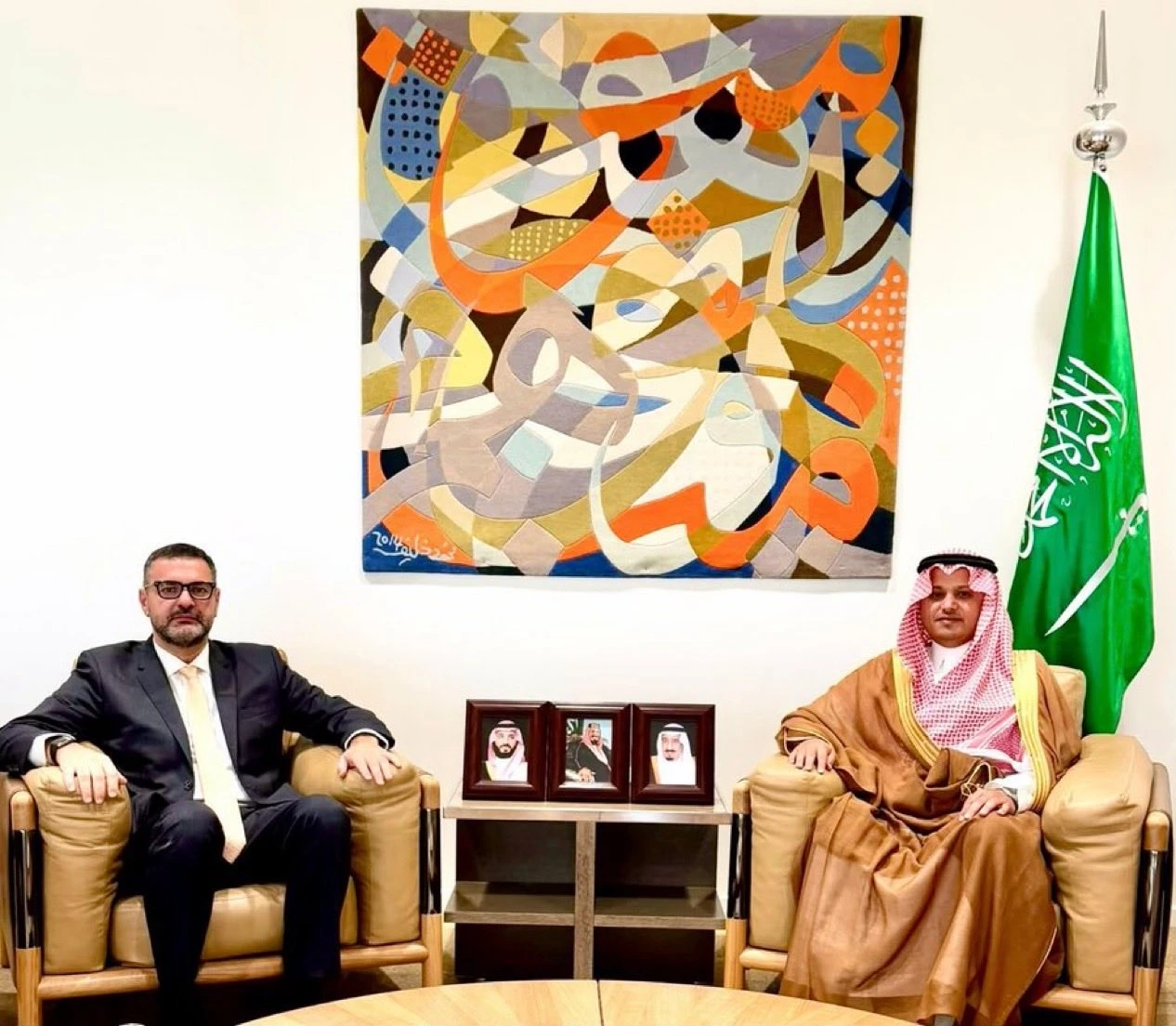
RIYADH: Saudi Arabia’s Foreign Minister Prince Faisal bin Farhan on Sunday held talks with his Iraqi counterpart Fuad Hussein in the capital, Riyadh.
During the meeting, they reviewed aspects of Saudi-Iraqi relations and ways to support and enhance them to serve the interests of the two countries. 
The two sides also discussed strengthening joint bilateral coordination to contribute to regional stability and the preservation of international peace and security.
Prince Faisal and Hussein also exchanged views on several regional and international issues, the Kingdom’s foreign ministry said.


Saudi Arabia compensates families of deceased COVID-19 health workers

Saudi Arabia compensates families of deceased COVID-19 health workers
Updated 08 August 2021

Saudi Arabia compensates families of deceased COVID-19 health workers

Saudi Arabia compensates families of deceased COVID-19 health workers
  • The move applies to workers in the government and private health sector, whether Saudi or non-Saudi

RIYADH: Saudi Arabia has started distributing SR500,000 ($133,332) in compensation to families of health workers who died from COVID-19, Saudi Press Agency reported on Sunday.
The move applies to workers in the government and private health sector, whether civilian or military, or Saudi or non-Saudi, “who gave their lives in the fight against the pandemic to preserve the health and safety of citizens and residents in the Kingdom.”
Minister of Health Dr. Tawfiq Al-Rabiah, who is also chairman of the Saudi Health Council, confirmed that the funds were being disbursing to the families. He said the ministry appreciated the great sacrifices made by workers in all the Kingdom’s health sectors, and dedication to serve and care for patients during the pandemic.
He praised the concern and unlimited support provided by King Salman, Crown Prince Mohammed bin Salman, and the government to protect public health and safety, and improve the level and quality of health services provided in the Kingdom.
Al-Rabiah said the health sectors in the Kingdom made great efforts to contain this epidemic, control the situation and prevent its spread using all scientific and practical means, while the state has allocated huge budgets to enhance the sector’s readiness.
The government has accelerated a nationwide vaccination drive as it seeks to revive tourism and other pandemic-hit sectors, such as sports competitions and entertainment.
More than 29 million does of vaccine have been administered in the country of 35 million people, the health ministry announced on Saturday.
Vaccination is mandatory for anyone wanting to enter government and private establishments, including education institutions and entertainment venues, as well as to use public transport.
Saudi Arabia has registered nearly 533,000 coronavirus cases and more than 8,300 deaths.
(With AFP)


Saudi Arabia confirms 14 COVID-19 deaths, 731 new infections

Saudi Arabia confirms 14 COVID-19 deaths, 731 new infections
Updated 08 August 2021

Saudi Arabia confirms 14 COVID-19 deaths, 731 new infections

Saudi Arabia confirms 14 COVID-19 deaths, 731 new infections
  • Health ministry spokesman slams ‘lies and fallacies’ over vaccines, says they played major role in lowering epidemiological curve
  • 3 mosques reopened in Qassim after being sterilized after 3 people tested positive for COVID-19

RIYADH: Saudi Arabia recorded 14 new COVID-19 related deaths on Sunday, raising the total number of fatalities to 8,334.
The Ministry of Health confirmed 731 new cases reported in the Kingdom in the previous 24 hours, meaning 533,516 people have now contracted the disease. 
Of the total number of cases, 10,200 remain active and 1,405 in critical condition.
According to the ministry, the highest number of cases were recorded in Makkah with 151, followed by the Eastern Province with 132, the capital Riyadh with 129, Jazan recorded 67, and Asir confirmed 60 cases.
The health ministry also announced that 620 patients had recovered from COVID-19, bringing the total number of recoveries in the Kingdom to 514,982.

Over 29.6 million doses of the coronavirus vaccine have been administered in the Kingdom to date through 587 centers.
The ministry renewed its call on the public to register to receive the vaccine, and adhere to the measures and abide by instructions.
Health Ministry spokesman Dr. Mohammed Al-Abd Al-Aly said at a weekly press conference that the country’s epidemiological curve was witnessing a noticeable decline in the number of new cases, stressing that vaccines had played a major role in this development.
He slammed claims that children had died after being jabbed. “They are lies and fallacies that have nothing to do with reality,” he said.
The country is preparing for students to return to the classroom by the end of this month, with the Health Ministry and Education Ministry encouraging people to take the vaccine and not fall victim to rumors.
“Don’t be deceived,” said Al-Abd Al-Aly. “The vaccines are safe and effective, 99 percent of those in intensive care units due to COVID-19 are not vaccinated. Experts around the world classify the current stage of the pandemic as the ‘pandemic of the unvaccinated.’”
The campaign to fully vaccinate students above the age of 12 and education staff continued apace, according to Education Ministry spokesperson Ibtisam Al-Shehri.
“The return to school is the most important factor to indicate a real return to normal life,” she told the press conference, saying that parents must ensure their children did not miss their vaccine appointments.
Fully vaccinated school students at the intermediate and secondary levels will be able to attend school from the start of the new academic year. 
But primary students will continue their education online, as will those who are at intermediate level but younger than 12.
“These measures will continue until the end of October or until we achieve herd immunity by 70 percent, whichever comes first,” Al-Shehri added.
There are 3.1 million students at the intermediate and secondary levels in Saudi Arabia and 45 percent have received one dose, 19 percent have had both, and 6 percent have recovered from COVID-19.
During monitoring inspection tours in the past week, authorities recorded 21,967 violations of precautionary regulations imposed to stem the spread of COVID-19 , according to recent statistics from the Ministry of Interior.
The statistics indicated that the region of Riyadh recorded the highest number with 7,214 violations, followed by the Eastern Province (3,022), Madinah (2,189), Qassim (2,119), Makkah (1,836), Hail (1,818), Jouf (1,331), the Northern Borders (666), Tabuk (541), Baha (334), Jazan (316), Asir (314), and Najran (267).
Jeddah Municipality closed 37 commercial establishments for violating the preventive measures, while field teams also recorded 56 violations during over 7,000 monitoring rounds carried out over the weekend.
The Ministry of Islamic Affairs reopened three mosques in the Qassim region after temporarily evacuating and sterilizing them after three people tested positive for coronavirus, bringing the total number of mosques closed and reopened after being sterilized to 1,975 within 183 days.
The coronavirus pandemic has affected over 203 million people globally and the death toll has reached around 4.30 million.


Indonesian domestic worker’s case resolved with full wages paid plus bonus and return ticket 

Indonesian domestic worker’s case resolved with full wages paid plus bonus and return ticket 
Updated 08 August 2021

Indonesian domestic worker’s case resolved with full wages paid plus bonus and return ticket 

Indonesian domestic worker’s case resolved with full wages paid plus bonus and return ticket 
  • “I am happy and nobody gets mistreated in Saudi Arabia,” Yati Kusniyawati tells Arab News
  • Indonesian media reported inaccurate, incomplete facts without comment from Saudi officials 

HAIL: For almost twelve years, Indonesian national Yati Kusniyawati has made her home in the Kingdom with a Saudi family — albeit with one unfortunate handicap, occasional delay in her payments. As she recently prepared to head back home, her case was inaccurately portrayed in some Indonesian media outlets who mistakenly reported that she was detained in the kingdom and that her employer refused to pay. 

In a recorded interview with Arab News, Yati —  who works in the Saudi city of Hail — confirmed that she has recently received all her dues, plus a bonus and a return ticket. Arab News sources also confirm that there was indeed a delay in her fees, but that was due to financial difficulties which have faced her employer. The matter was resolved swiftly and fairly at the hands of the designated government authorities who followed her case. 

There is also no truth to the claims that she was kept in Saudi against her will, however, it was her intention to stay till she collected her dues. “Yati will be back at her home in Indonesia within a day,” a Saudi official who was following Yati’s case confirmed. 

“While there was definitely a case, some Indonesian media outlets were quick to jump the gun without verifying the facts, contacting us or waiting for the verdict of the case,” he added. 

Speaking to Arab News, Yati commended the Saudi government’s treatment and that of her sponsor and his family, saying: “I have received all my dues and an additional bonus by cheque. In addition, I received plane tickets (Hail, Riyadh, Jakarta) for Sunday (today).”

“I am happy that I was working in Saudi Arabia, the state of Islam and justice, where nobody is mistreated,” she added, lauding the humane treatment she received from her sponsor and his family.
 
She explained that her only problem was that “I used to ask for my salaries and my sponsor used to assure me that he will pay them later.  SR117,800 ($31,420) remained unpaid.”

Now that amount was settled, Yati said that she’s happy and looking forward to returning to her home country and reuniting with her son after settling all of her outstanding issues and receiving her rights.  

On Aug. 4, Yari complained to the Saudi Ministry of Human Resources and Social Development’s labor committees. After hearing her case, the verdict was to grant her all her remaining rights. 

As her sponsor suffered financial hardships, he could not pay her all of her dues on time. However, thanks to some donors, the required sum was collected and eyewitnesses confirmed that Yati received a cheque for an amount totaling SR150,000 ($40.000).

Several Saudi government and civil authorities and associations work to help solve such disputes, given the new laws and regulations introduced in the Kingdom, as part of the Vision 2030 reforms which guarantee the rights of migrant workers and seek to provide them with a suitable working environment.