Jordan’s Muslim Brotherhood loses control of powerful union after 26 years

Jordan’s Muslim Brotherhood loses  control of powerful union after 26 years
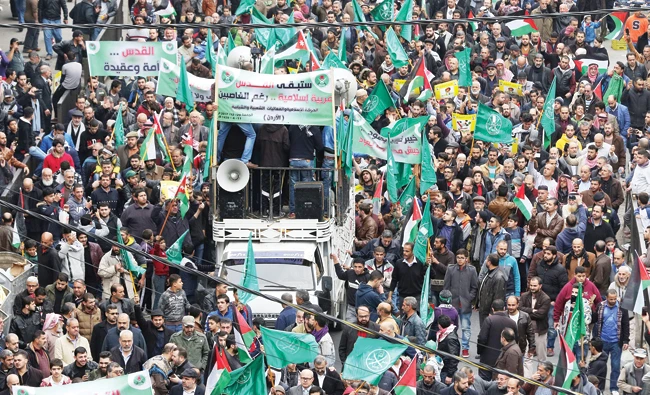
Jordanians rally against US decision to recognize Jerusalem as the capital of Israel, on Dec. 29, 2017, in Amman. (AFP)
Updated 06 May 2018

Jordan’s Muslim Brotherhood loses control of powerful union after 26 years

Jordan’s Muslim Brotherhood loses  control of powerful union after 26 years
  • Lamis Andoni, a veteran Jordanian columnist told Arab News that the results could be the beginning of a new era.
  • he importance of the union result is that it reflects a change in all governorates in Jordan.

AMMAN: The switch of control after 26 years of Brotherhood dominance of the union follows a series of losses, including control of the main teachers union and a poor showing in the student council elections. 

The Muslim Brotherhood has lost control of one of Jordan’s largest labor unions in the latest blow to the movement.

Members of the powerful Engineers Union voted for a coalition of Arab nationalists, liberals and independents instead of the Islamist list, according to the final results announced early on Saturday.

The switch of control after 26 years of Brotherhood dominance of the union follows a series of losses, including control of the main teachers union and a poor showing in the student council elections. It comes two days after Zaki Bani Irshid, a controversial senior figure in the Muslim Brotherhood, lost the leadership fight in the Islamic Action Committee, the movement’s political arm in Jordan.

Mohammad Hussayni, director of the Amman-based Hawiya (Identity) Center, told Arab News that the loss of the Engineers Union reflected the Islamists’ internal problems.

“They have been having some big internal problems and splits which have a clear reflection on their abilities to mobilize,” he said.

The Muslim Brotherhood has dominated politics and unions in Jordan for decades, where it was tolerated by the monarchy and in some cases members of Parliament served in the Cabinet.

Relations with the group deteriorated after an extremist attack on hotels in Amman in 2005 and the rise to senior positions within the movement of Irshid, a hard-liner within the group.

Things became more tense after the Arab Spring as Islamist groups in neighboring countries rose to power on the back of the chaos. In 2016, the government banned the Brotherhood and licensed another branch of the movement under a different leadership. 

Lamis Andoni, a veteran Jordanian columnist and a long-time observer of Jordanian professional unions, told Arab News that the results could be the beginning of a new era.

“It reflects the end of the domination of the Muslim Brotherhood in Jordan, which had a huge political and professional effect on local politics for years,” she said.

The importance of the union result is that it reflects a change in all governorates in Jordan and not just the capital Amman, Andoni said. The Brotherhood have traditionally performed strongest in the many conservative regional governorates.

The union results showed that the Numou (growth) list captured seven out of the ten seats, winning decisively in all major governorates including the capital. Bashar Tarawneh, a member of Numou, told Arab News that the success of the movement had to do with increasing voter participation, especially among the youth.

“We took it upon ourselves to visit every governorate in Jordan and we encouraged everyone to vote in these elections,” he said.

More than 14,000 union members voted in the election — 3,000 more than in previous rounds, Tarawneh said. Khaled Ramadan, a member of the Jordanian Parliament and a union activist, told Arab News that the change did not necessarily reflect a retraction of the Muslim Brotherhood but more that the Numou movement has energized young members on a national basis. 

“Look at the number of votes that the Islamists received this round and in previous rounds and you will see that the level of their support hasn’t changed.”

Zeid Nabulsi, an Amman-based lawyer, said the result showed that the silent majority had woken up in Jordan. 

He said that this was due to both the declining fortunes of Islamist groups in countries such as Egypt and Syria and the impact of the digital revolution on young people “which has exposed the Islamists for their real motives.”

Nabulsi, however, argued that Islamists were still a powerful political force in Jordan, particularly in their stronghold of Zarqa.

He warned that activists should not let up in their struggle against what he called “the forces of darkness.”
Lebanon’s battered economy spurs smuggling across Syrian border

Hezbollah flags flutter at the entrance of Mays Al-Jabal village in Lebanon. Hezbollah use land routes to smuggle weapons and money to the Syrian regime. (Reuters)
Updated 14 December 2020

Lebanon’s battered economy spurs smuggling across Syrian border

Lebanon’s battered economy spurs smuggling across Syrian border
  • The Information Division found that a new gang, whose members are Lebanese, had been active in Mount Lebanon and carried out several robberies

BEIRUT: The border region between Lebanon and Syria in Baalbek-Hermel in eastern Lebanon often experiences security tensions that rise and fall depending on the smuggling operations being carried out there.
On Saturday, Syrian army border guards fired at a number of young men at one of the illegal crossings, known as the Arida border crossing, in the border village of Al-Qasr, killing one Lebanese man and wounding another.
Smuggling occurs in both directions, but smuggling from Lebanon to Syria has become more common with deteriorating economic conditions in the two countries and the sanctions imposed on Syria. This includes smuggling basic goods subsidized by the Lebanese state such as flour, fuel and medicine. There are also illegal routes for smuggling stolen cars. Products smuggled to Syria also include raw materials for manufacturing and car parts.
Earlier this month these borders saw a clash between smugglers and a Syrian army patrol. Light and medium weapons were used during the chase in a Syrian area near the Lebanese border town of Hosh Al-Sayyed Ali. A Syrian army officer was killed and two personnel wounded.
The Lebanese army, in cooperation with the Intelligence Directorate, then carried out a raid in the Lebanese region to find those who fired and fled toward Lebanese territory. The Lebanese Internal Security Forces (ISF) two days ago arrested two young Syrians (19 and 23 years old), who were planning to steal cars and smuggle them into Syrian territory. One of them had previously smuggled people from Syria to Lebanon, according to the Information Division of the ISF.
The Information Division found that a new gang, whose members are Lebanese, had been active in Mount Lebanon and carried out several robberies. Two of the arrested gang members confessed to transporting the stolen cars to the Bekaa region, and from there to Syrian territory.
Last year, Lebanon’s Supreme Defense Council counted “more than 124 smuggling crossings between Lebanon and Syria.” Former Finance Minister Ali Hassan Khalil said during a discussion of the draft budget in Parliament last year that smugglers had the audacity to name crossings after specific products, persons, towns or directions. “This is one of the most prominent signs of the state dissolution in carrying out its duties,” he said.

SPEEDREAD

Since 2012, Hezbollah has been relying on a network of illegal crossings linking the Lebanese Bekaa Valley and the western Qalamoun villages in the countryside of Damascus to smuggle goods, weapons and drugs into Syria, according to the Syrian Opposition Coalition.

The Syrian Opposition Coalition provided information to the committee drafting the Caesar Act in the US administration about “land routes and tunnels used by Lebanon’s Hezbollah to smuggle weapons, money and fuel to the Syrian regime.”
It stated: “Since 2012, Hezbollah has been relying on a network of illegal crossings linking the Lebanese Bekaa Valley and the western Qalamoun villages in the countryside of Damascus to smuggle goods, weapons and drugs into Syria. Four of these routes are main roads linking the borders between the two countries, in addition to other secondary crossings.”
The information also highlighted that there are powerful people and families in the towns between the two countries who oversee the smuggling of goods from Lebanon.
Lawyer Ashraf Al-Moussawi told Arab News: “The phenomenon of car theft has escalated in a frightening manner, until the number of stolen cars exceeded 136 in one month, at a rate of four to five cars per day.”
Al-Moussawi said that cars stolen from Lebanon are found in the Al-Suwayda car market, which publishes ads on social media under the title “A Key and a Car.”
“The victim can ask about their car by calling a phone number, through which he can agree to take back the car in exchange for a sum of money, and the car will be delivered at the Lebanese-Syrian border,” he said.
People, often ex-convicts or gang members, who take stolen cars from Beirut or Mount Lebanon to the border can make up to 2 million Lebanese pounds by doing this.
A security source told Arab News: “Some of those may be Lebanese security personnel on active duty lured by quick money. They may also be retired members of the military who have joined gangs. If this person transported, for instance, four cars per month, he receives five or six times his monthly salary. When he drives the car, he does not draw the attention of the security forces. Some of them were arrested in a manner similar to a security scandal, and they are still in detention.”