
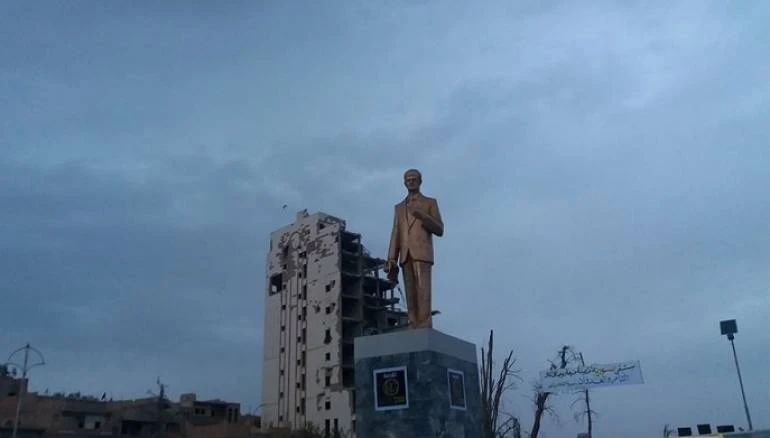

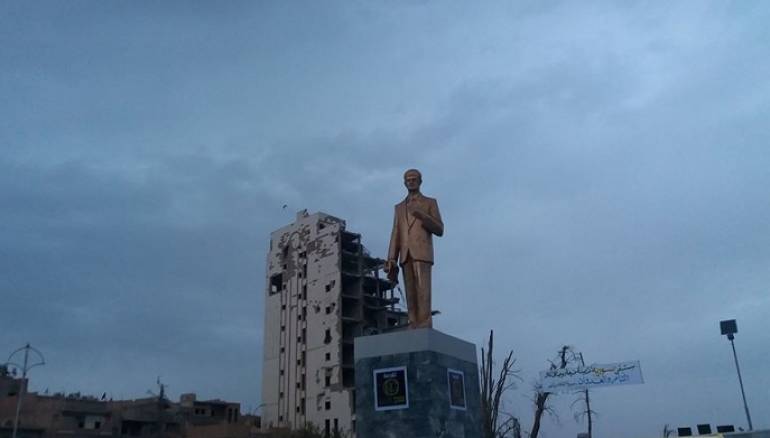
Right now, millions of Syrians are busy considering how to spend the winter in ruined cities with little infrastructure left after seven years of civil strife, and hundreds of thousands more are preparing their tents in neighboring countries to withstand yet another wet and icy season ahead. Meanwhile, the regime in Damascus seems unconcerned and is moving at a snail’s pace toward meeting international demands for starting a serious settlement process. Instead, a statue of the late Syrian leader Hafez Assad has been erected at a key intersection in the ex-rebel town of Deir Ezzor. Such an act is indicative that all the regime cares about is the symbolic return of Syria to the authority of Bashar Assad, regardless of reforms, stabilization efforts, reconciliation or rebuilding of the destroyed country to better rehouse its displaced citizens.
Forget the Geneva peace process led by the UN and its promises to arrive at a negotiated settlement that ensures the peaceful return of all Syrian refugees to their country with guarantees that they will not be arrested or persecuted. Forget too the Astana process led by Russia, Iran and Turkey and its mission to bring an end to the armed rebellion by reinvading all cities that were declared free of regime authority for years. Forget also all unilateral, bilateral or group efforts to draw up a clear road map that would end the conflict and broker an agreement for the way forward.
The statue is believed to be a symbolic statement that Ba’ath regime's authority is back and in full control of the destroyed country, regardless of what desires there are for a negotiated settlement or a new constitution.
The people of Deir Ezzor were shocked to see that the statue of Hafez Assad had been re-erected, seven years since it was removed in the late spring of 2011 to prevent its destruction by a rebellious crowd that thought non-violent change was possible. The statue’s return alludes to the return of Bashar Assad and his henchmen to controlling Syrians’ lives after the war.
The people complained that the central government rushed to erect the statue even though the square where it is mounted is totally destroyed and unsuitable for civilian living. Regime officers, civilian administrators and representatives from the loose-knit alliance of forces that have, for seven years, propped up Assad’s rule attended the ceremony. Among them were Lebanese Hezbollah militia commanders, Iranian military advisers and Russian military police. If anything, this represents a blow to all peace and reconciliation efforts called for by the international community.
The Syrian regime is likely to go on to erect many more statues to demonstrate who is back in charge in a divided and destroyed Syria in the hope that European countries and Japan will contribute to the reconstruction efforts.
Mohamed Chebaro
In Istanbul recently, the summit of France, Germany, Russia and Turkey showed the schism between what some Western countries views as the way forward in Syria and the views held by Russia, Turkey and, indirectly, the Assad regime and Iran. Everyone in Istanbul discussed the steps required for a long-term settlement, but all parties’ starting and end points differed.
Though Turkey and Russia reiterated their commitment to lowering tensions and to continuing their liaison to keep the cease-fire in the northwestern city of Idlib alive — preventing a government offensive there — Germany and France were more interested in the peaceful transition to a post-war stabilization of Syrian towns. This will mean, as President Emmanuel Macron and Chancellor Angela Merkel said in the four-way press conference, that several steps need to be taken prior to the return of all refugees and displaced people to their homes. These steps must include a real, sustainable, credible and inclusive political process to be started, culminating in constitutional reforms that will pave the way for UN-backed free and fair elections.
This political process, or its non-existence, is what will block or pave the way for regional and international efforts to put Syria back on the path to peace and help it to meet its reconstruction targets.
But the absence of such decisive will by the regime will prove to frustrate all efforts to find a negotiated closure of the Syrian crisis. Assad’s allies, Russia and Iran, who have helped him stay in power, are unlikely to champion a reform process that could check their long-term alliance. Equally, Russia and Iran are both bearing the brunt of international sanctions — the first due to its meddling and wars in Ukraine, and the second due to its nuclear and ballistic missile ambitions — which will render any contribution next to impossible.
Hence, the Syrian regime is likely to go on to erect many more statues to demonstrate who is back in charge in a divided and destroyed Syria in the hope that European countries and Japan will contribute to the reconstruction efforts. The US and its Gulf allies, meanwhile, are unlikely to discuss aid prior to there being clear political steps toward a verifiable process to put Syria on the path toward stabilization. All indicators so far are that this is a far-fetched hope for the foreseeable future.
- Mohamed Chebaro is a British-Lebanese journalist with more than 25 years’ experience covering war, terrorism, defense, current affairs and diplomacy. He is also a media consultant and trainer.


