Kuwait bars unvaccinated citizens from travel abroad from May 22

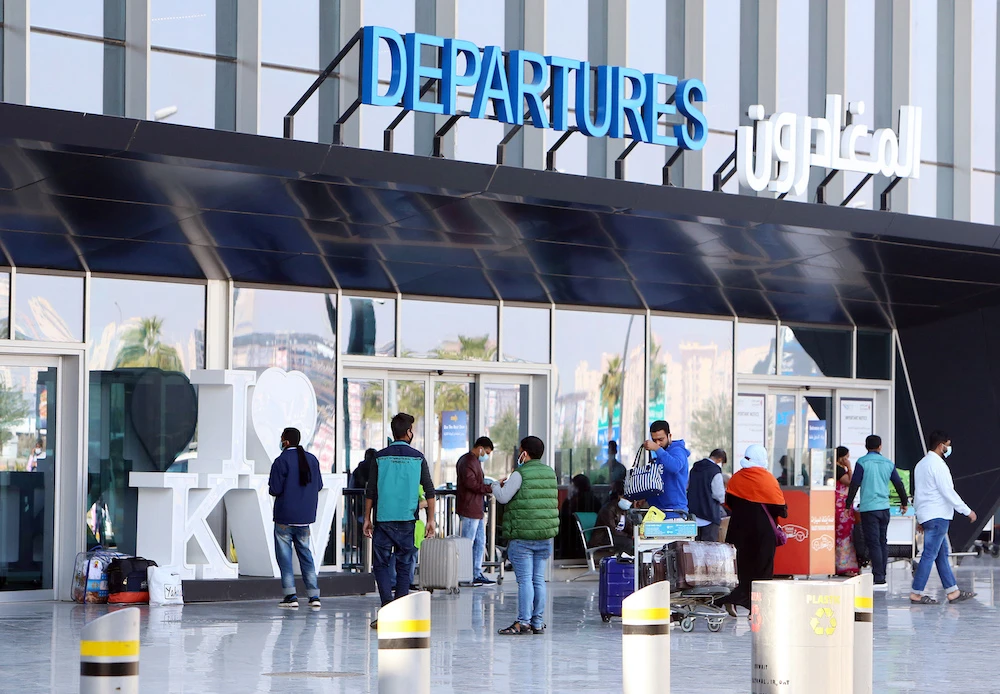
Passengers wait at the departure gate at Kuwait international airport in Kuwait City on Jan. 3, 2021, as the country reopens the airport after a 12-day closure to stem the spread of the COVID-19 pandemic. (AFP)
Short Url
Updated 04 May 2021

Kuwait bars unvaccinated citizens from travel abroad from May 22

Kuwait bars unvaccinated citizens from travel abroad from May 22
  • The ban does not include people in age groups not eligible to receive the vaccine

LONDON: Kuwaiti citizens who have not been vaccinated against COVID-19 will not be able to travel abroad from May 22, the information ministry said on Monday.
A decision was taken “not to allow citizens and their companions who are first-degree relatives and domestic workers to travel outside the country unless they have been immunized from the coronavirus,” the ministry said.
The ban does not include people in age groups not eligible to receive vaccinations against the coronavirus. A previous directive banning the entry of non-Kuwaitis into the country still stands, the statement said.

The Ministry of Health has extended the period between administering the first and second doses of the Pfizer-BioNTech vaccine due to a delay in the shipment from the manufacturer.
“This comes in light of the global competition to obtain ample quantities of vaccines,” the health ministry said, adding the decision applies to everyone who will receive the first dose of the vaccine starting Monday.
(With Reuters)
UN Security Council members do not want to resolve Renaissance Dam issue, Egypt envoy says

UN Security Council members do not want to resolve Renaissance Dam issue, Egypt envoy says
Updated 14 min 40 sec ago

UN Security Council members do not want to resolve Renaissance Dam issue, Egypt envoy says

UN Security Council members do not want to resolve Renaissance Dam issue, Egypt envoy says
  • Mohammed Idris, Egypt’s permanent representative to the UN, stated that Cairo held the Security Council accountable for its responsibilities regarding the dam crisis
  • Idris pointed out that Tunisia is implementing the draft resolution submitted by Egypt and Sudan to the Security Council regarding the dam

CAIRO: Egypt strongly reaffirmed its position during the UN Security Council session on the Grand Ethiopian Renaissance Dam negotiations, a top diplomat said. 

Mohammed Idris, Egypt’s permanent representative to the UN, stated that Cairo held the Security Council accountable for its responsibilities regarding the Renaissance Dam crisis.

The Egyptian state has engaged in intensive diplomatic moves to present the Ethiopian dam crisis to the Security Council, the ambassador announced in televised statements.

The world is full of issues that threaten security and peace, and the Security Council must play its role, the envoy added.

The members of the Security Council do not want to take a position on the dam, said the envoy. 

In previous statements, Egyptian Foreign Minister Sameh Shoukry said that the matter within the Security Council was complicated, given “political considerations and alignments,” the interaction between permanent and non-permanent members, and “overlapping interests.”

He stated that bringing the issue of the Renaissance Dam to the Security Council was an important matter in order to “hold it responsible as the main organ in the UN system concerned with maintaining peace and security.”

He added that Ethiopia’s argument during the Security Council session was “weak and did not live up to the words of Egypt and Sudan.”

Battle for the Nile
How will Egypt be impacted by Ethiopia filling its GERD reservoir ?
Enter
keywords

Egypt tightens punishment for sexual harassment

Egypt tightens punishment for sexual harassment
Updated 12 July 2021

Egypt tightens punishment for sexual harassment

Egypt tightens punishment for sexual harassment
CAIRO: The Egyptian parliament on Monday approved harsher penalties for sexual harassment and related crimes and upgraded them to felony offenses, aiming to curb sex-related assaults in a nation where women have long felt disadvantaged.
Sex crimes have been an increasing topic of conversation in recent years in the conservative, Muslim-majority nation, with several high profile court cases coming to varying conclusions.
Dozens of Egyptians began posting accounts of sexual assault on social media last year, but campaigners say there remains a deep-rooted bias in Egypt to place more blame on women for behavior deemed provocative than on men for sex crimes.
Public prosecutors in May shelved a case over a woman’s allegation that she was gang raped at a luxury hotel in Cairo in 2014 because of “insufficient evidence” against the defendants.
Referring to earlier laws passed in 2014, a parliamentary committee said in a report on Monday that “although the punishments listed were a quantum leap at the time, they did not achieve the necessary deterrence.”
In the measure approved on Monday, the penalty for sexual harassment was increased from a minimum of one year in prison to a minimum of five years, or a penalty of up to 300,000 Egyptian pounds ($19,100), up from 20,000 pounds.
In situations where a power imbalance was in place because of a professional or familial relationship, or in cases involving the use of weapons or accomplices, the penalty was increased from a minimum of two to a minimum of seven years, in addition to a 10-fold increase of the maximum fine to 500,000 Egyptian pounds.
The penalties for stalking and general harassment were also increased substantially.
In August, the parliament approved a law protecting the identity of victims of sexual harassment and assault, after a social media campaign led to the arrest of a suspected sex offender.

Sanctions-dodging Iran oil exec could be back on US financial blacklist

Ahmad Ghalebani was the chief executive of the sanctioned National Iranian Oil Company (NIOC) until he stepped down last month. (Tasnim/File Photo)
Updated 12 July 2021

Sanctions-dodging Iran oil exec could be back on US financial blacklist

Ahmad Ghalebani was the chief executive of the sanctioned National Iranian Oil Company (NIOC) until he stepped down last month. (Tasnim/File Photo)
  • Ahmad Ghalebani was head of the National Iranian Oil Company before stepping down in June
  • His positions in other enterprises working closely with Tehran could violate US sanctions

LONDON: A senior Iranian oil executive removed from US financial blacklists last month now holds senior positions in two Iranian energy firms linked to the Iranian regime, in what experts say is a potential violation of US sanctions.

Ahmad Ghalebani was the chief executive of the sanctioned National Iranian Oil Company (NIOC) until he stepped down last month, a resignation that saw his name removed from American financial blacklists due to a “verifiable change in behavior.” 

The NIOC was sanctioned by the US government for allegedly providing funding for the Islamic Republic’s weapon’s program.

Ghalebani’s removal from the sanctions list meant that financial blocks placed on his US-held assets were removed and that he was provided unfettered access to US and other foreign markets.

But now Ghalebani has been found to have roles at two other companies with direct links to the Iranian regime-backed energy firms.

Ghalebani serves as an adviser to the chief executive of Iranian oil-services firm Global Petro Tech Kish, according to a representative of the company and, in late May, was chosen as chairman of petrochemical firm AzarAb Industries, according to a filing with the Iranian stock exchange.

Iran has long faced sanctions for its perceived pursuit of nuclear weapons, as well as destabilizing behavior across the Middle East and support for global terrorism.

US sanctions place strict controls on foreign businesses and governments seeking to do business with the government of Iran and the Iranian energy sector as a whole. They also target individuals within the regime, restricting their financial freedom and access to the global economy.

Washington and Tehran are currently in the middle of talks to ease the sanctions on Iran in exchange for curbs to the country’s nascent nuclear weapons program, but Biden administration officials denied that Ghalebani’s removal from the blacklist was linked to these talks.

US officials said that it was part of a normal, law-based process after he filed a petition for removal.

The Treasury’s sanctions unit had “determined, through a rigorous, evidence-based, administrative reconsideration process, that the individuals are no longer in these positions within government of Iran entities,” a spokesperson said. 

But the department “continues to monitor for any changes in circumstances” that led to their delisting, she added.

Jason Brodsky, senior Middle East analyst at London-based Iran International TV, said that Ghalebani’s continuing activities appear to be violating sanctions, given the expansive reach of the powers authorizing punitive action against Iran.

Besides working with a company that signed a major drilling contract with NIOC last year, Brodsky said, Ghalebani is also affiliated with AzarAb Industries, which “means he is still connected to a regime-affiliated company that was sanctioned by the EU for providing manufacturing support to Iran’s nuclear program.”

His previous roles included senior positions at Azarb Industries and Global Petro Tech Kish — neither of which are on US sanctions lists, despite their connections to regime entities.

Global Petro Tech Kish works closely with sanctioned energy entities, including the NIOC, and AzarAb is owned in part by a state-owned and US-sanctioned agricultural bank.

Behnam Ben Taleblu, a senior fellow specializing in Iran and arms control at the Foundation for Defense of Democracies, said: “It’s unlikely that Iranian oil executives and sanction-busters have suddenly ditched their skill set.”

The US treasury department, which manages the implementation of US sanctions, said that it was authorized to impose sanctions against any person or entity found “to have provided material support for, or goods or services in support of the National Iranian Oil Company.”


Desperate Iranians flock to Armenia for vaccines

Iran is currently in the midst of a devastating fifth wave of COVID-19 infections, spurred in part by the delta variant. (Reuters/File Photo)
Updated 12 July 2021

Desperate Iranians flock to Armenia for vaccines

Iran is currently in the midst of a devastating fifth wave of COVID-19 infections, spurred in part by the delta variant. (Reuters/File Photo)
  • By land and by sea, Iranians are travelling in their thousands to their tiny neighbor for jabs
  • Over 85,000 people have died in Iran from COVID-19, in part due to the government’s failing vaccination campaign

LONDON: Thousands of Iranians awaiting coronavirus disease (COVID-19) vaccines have crossed into neighboring Armenia in search of jabs.

Iran is currently in the midst of a devastating fifth wave of COVID-19 infections, spurred in part by the delta variant, that has seen average daily infections spike 63 percent to 17,000.

The jump in infections has been exacerbated by Iran’s floundering vaccination campaign, which has so far seen just two percent of Iran’s 84 million people fully vaccinated, according to Oxford University’s Our World in Data project.

Western vaccines have been banned by a decree of Supreme Leader Ayatollah Khamenei, who in January this year cast doubt on the trustworthiness of British and American-made inoculations.

Unlike Iran, Armenia — with its comparatively tiny 3 million inhabitants — has more vaccine doses than people willing to take them, and has begun offering vaccines for free to foreigners without requiring registrations. 

Mobile clinics have been set up in the streets to make the jabs easily accessible to tourists and visitors. 

Critically, Armenia is one of the few countries that Iranians do not need a visa in order to enter — and the country’s capital, Yerevan, is just a seven-hour drive from the border.

Parvin Chamanpira, 53, and her husband calculated that it would be months before they qualified for a vaccine in Iran, so last week they travelled to Yerevan to receive their shots.

“This is not an ideal choice for Iranians to be forced to travel and spend a lot of money and be stressed out for getting a vaccine,” Chamanpira said. “We would not do it if we didn’t have to.”

They plan to return in a few weeks for their next dose.

Neither Armenian nor Iranian officials have said how many have travelled to the smaller country for a vaccine, but other clues point to a surge in demand from desperate Iranians.

The number of flights between Tehran and Yerevan has been increased to meet demand, and tickets have sold out until late August.

Vaccine bus trips have sprung up between the countries, and reports from the New York Times suggest many people have been chartering their own buses or vans and planning their trips independently.

In a social media group dedicated to planning vaccination trips to Armenia, Iranians at the border posted videos on Friday showing lines of cars and people stretching for miles, saying the wait was at least 13 hours.

Iran is one of the worst-hit countries in the world by COVID-19, and the worst in the Middle East. It has recorded an official death toll of 85,000, though some observers have suggested that the figure may be higher.

The government’s response to the pandemic, and its competency in rolling out the vaccines, has spurred mounting discontent among sections of the public against the regime.

“Our only weapon is immediate and fast vaccination of the public,” Dr. Saeedreza Mehrpour, the head of Shariati Hospital in Tehran, wrote on his Instagram page on Thursday, criticizing the country’s leaders for putting ideology over public health.

He added: “I wish we had better relations with the world.”

Despite the government’s fiery vaccine rhetoric, Iran has now received over two million doses of the British-made Oxford-AstraZeneca vaccine through the UN’s Covax program, which aims to provide vaccines to countries that cannot secure doses themselves.

But this has not made a dent in Iran’s pandemic, and reports suggest the elderly and vulnerable remain unable to book in a second dose of the jab.

Fahimeh Hosseini, 72, a retired banker, said she waited for four hours with dozens of other older people outside a Tehran clinic for a second dose of the vaccine, only to be told there were no more.

“They told us to keep coming back until you get lucky,” she said.


Egyptian FM calls on Israeli counterpart to resolve Palestine, Israel stalemate

Egyptian FM calls on Israeli counterpart to resolve Palestine, Israel stalemate
Updated 12 July 2021

Egyptian FM calls on Israeli counterpart to resolve Palestine, Israel stalemate

Egyptian FM calls on Israeli counterpart to resolve Palestine, Israel stalemate
  • Sameh Shoukry emphasized the importance of overcoming the stalemate with the aim of engaging in negotiations based on UN Security Council resolutions
  • Shoukry also expressed his hope that the Israeli government would not take any measures that could increase the possibilities of an escalation in the conflict

CAIRO: Egypt has stressed the urgent need to move toward breaking the deadlock in the peace process in order to re-launch peace negotiations between the Israeli and Palestinian sides.

The call came as Egyptian Foreign Minister Sameh Shoukry met his Israeli counterpart, Yair Lapid, in Brussels.

During his visit to Brussels, Shoukry delivered a letter from President Abdel Fattah El-Sisi to European Council President Charles Michel.

He also met with EU foreign ministers to discuss regional issues, especially the issue of the Grand Ethiopian Renaissance Dam.

Shoukry’s meeting with Lapid in Brussels is the first since a new multiparty coalition took power in Israel last month.

Ahmed Hafez, official spokesman for the Egyptian Foreign Ministry, said that Shoukry emphasized the importance of overcoming the stalemate between the Palestinian and Israeli sides with the aim of engaging in negotiations based on UN Security Council resolutions.

The negotiations should guarantee the establishment of a contiguous and viable Palestinian state, on the borders of June 4, 1967, with East Jerusalem as its capital, added Hafez.

This is one of the main ingredients for strengthening the pillars of security and stability in the region, said the spokesman.

According to Hafez, Shoukry stressed that Cairo would not hesitate to support all international efforts to achieve this goal.

Shoukry expressed his hope that the Israeli government would not take any measures that could increase the possibilities of an escalation in the conflict and thus undermine the chances of creating an appropriate climate for peace and stability. 

He noted the actions of Egypt in the context of reconstruction and the provision of aid to all parts of the Palestinian territories in cooperation with the Palestinian National Authority.

On May 21, Israel and Hamas, which controls the Gaza Strip, announced a ceasefire, ending a bloody escalation between the two sides that lasted for 11 days.

The clashes resulted in the deaths of 260 Palestinians, including 66 children, and 13 Israelis, including a child.