How Hezbollah has permeated the Lebanese state

How Hezbollah has permeated the Lebanese state
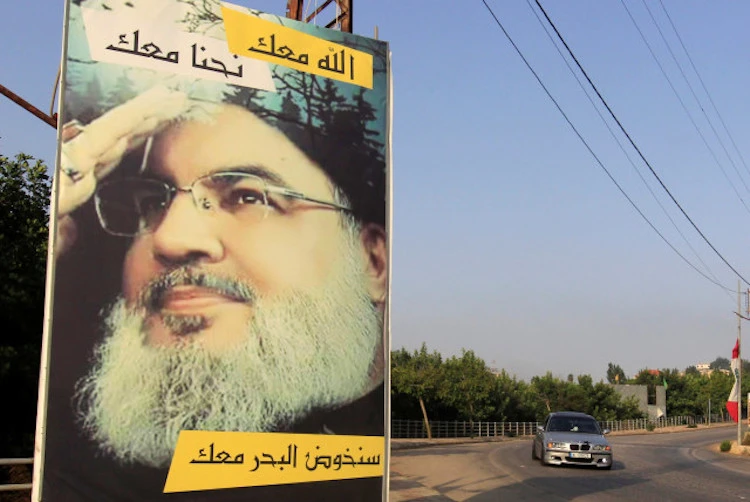
A car drives past a poster depicting Hezbollah leader Sayyed Hassan Nasrallah in Adaisseh village, near the Lebanese-Israeli border, Lebanon, July 28, 2020. (Reuters)
Short Url
Updated 08 July 2021

How Hezbollah has permeated the Lebanese state

How Hezbollah has permeated the Lebanese state
  • New paper from top UK think tank details how Iran-backed group has spread its influence
  • Hezbollah is ‘a product of the political system in Lebanon,’ author tells event attended by Arab News

LONDON: Hezbollah has used its financial backers in Iran and its significant military arsenal to “permeate the Lebanese state,” according to a paper launched this week.

The paper — authored by Lina Khatib, director of London-based think tank Chatham House’s Middle East and North Africa program, and launched at an online event on Thursday attended by Arab News — details how Hezbollah morphed from a resistance group against Israeli occupation to a hybrid power holding the Lebanese state in an ideological stranglehold.

“Hezbollah has spread its influence throughout the Lebanese state, from the presidency of the republic to representative political institutions and the civil service, as well as Lebanon’s military and security institutions,” the paper said.

“This influence is due to a number of factors: Hezbollah’s benefiting from a reliable external patron — Iran — unlike other parties in Lebanon; Hezbollah’s capacity in terms of organization, funding, physical resources and numbers of followers, which dwarfs that of other Lebanese parties.”

Other means used by Hezbollah, the paper said, include the “weakness of the Lebanese state” and the existence of “a political system based on elite pacts.”

Opinion

This section contains relevant reference points, placed in (Opinion field)

Khatib told event attendees that she urges analysts, particularly in the West, to take a “nuanced” approach to understanding the relationship between Lebanon and Hezbollah.

“While Hezbollah is a contributing factor to the weakness of the Lebanese state, it’s also a product of the political system in Lebanon,” she said.

“As long as the current political system in Lebanon continues to exist, it won’t be possible to reverse Hezbollah’s sway over the Lebanese state.”

Khatib said the characterization of Hezbollah as a “state within a state” — popular in academic and policymaking circles — is inaccurate. 

This characterization “implies that Hezbollah is operating in a way that’s completely detached from the Lebanese state at large. Instead, what I argue is that Hezbollah permeates the state in Lebanon,” she added. 

“And when we say ‘the state,’ I’m not just talking about the state institutions, I’m also talking about the state as the space for the contestation of power in Lebanon.

“This, I think, is vividly illustrated by how Hezbollah, unlike other groups in Lebanon ... has surveillance capacities. That means it’s monitoring not just what happens inside state institutions, but it’s monitoring its allies and its opponents in all kinds of arenas: Cultural, social, education, economic. This is something that gives it a huge tactical advantage.”

Khatib said other parties also take advantage of the Lebanese state for their own benefit, but “it’s Hezbollah, unlike the others, that has coercive power over both its opponents and its allies — this also gives it the edge.”

Mona Yacoubian, a senior advisor at the US Institute for Peace, said Hezbollah moved from “the crucible of resistance to Israeli occupation” at the end of the 20th century, to becoming the “praetorian guard of Lebanon’s corrupt, cronyism system.”

Hezbollah is different from other parties in the country “by virtue of its arms, and that these arms sit outside the gambit of state control,” she added.

Despite being a late arrival to the Lebanese political scene, Yacoubian said, the Shiite group has “adopted and emulated some of the most corrupt practices of Lebanon’s political class, and in a sense has become completely enmeshed with Lebanon’s political system.”

She added: “It has increasingly exploited state institutions — Parliament, ministries, the civil service — and used its influence to garner power, to spread patronage and to gain revenues.”

However, Yacoubian said this behavior has come back to bite the Iranian proxy. “What we saw in the October 2019 protests (in Lebanon) and beyond is that Hezbollah is no longer viewed as above corruption,” she added.

“We see that it has been tarnished by this behavior. Even within its own base, there’s growing disaffection.”

Lebanon is experiencing its worst financial crisis in more than 150 years, and on Wednesday Prime Minister Hassan Diab warned that the country is “days away from a social explosion.”

Yacoubian said because of this approaching explosion, her key question moving forward is: “What would be the impact of a total state collapse on Hezbollah? Because I think that’s a real possibility.”
Yemeni president creates new leadership council, moves his powers to it

Yemeni president creates new leadership council, moves his powers to it
Updated 07 April 2022

Yemeni president creates new leadership council, moves his powers to it

Yemeni president creates new leadership council, moves his powers to it
  • Vice President Ali Mohsen Al-Ahmar relieved from his position
  • Eight-member council will be led by Rashad Al-Alimi

RIYADH: Yemeni President Abed Rabbo Mansour Hadi announced a new presidential leadership council on Thursday and transferred his powers to it.

The president, in a televised address, said the council was established to complete the implementation of the transition phase and will have the authority to negotiate with the Iran-backed Houthi militia to end the yearslong conflict afflicting the nation.

The changes sought to achieve the aspirations of Yemenis, preserve the society and stop the bloodshed, Hadi said.

Vice President Ali Mohsen Al-Ahmar was removed from his position and the responsibilities of the post were reassigned to the new council.

The eight-member body, which will be headed by Rashad Al-Alimi, has the authority to manage the state politically, militarily and on the security front.

The council will be supported by a 50-member consultative body. 

Al-Alimi was a former deputy premier of Yemen under the leadership of Ali Abdullah Saleh, and had previously served as the interior minister.

The council has the ability to announce a state of emergency if needed, according to a statement by the information minister, Muammar Al-Eryani.

Yemenis are currently holding talks in Riyadh to find a way to resolve the seven-year war in the country.

The Houthi militia, who seized the capital from the government in 2014, have refused to attend the discussions, which have been arranged by the Gulf Cooperation Council.

All sides of the conflict have agreed to adhere to a two-month truce.


Easing of restrictions on Palestinians during Ramadan criticized as Israeli ruse

Easing of restrictions on Palestinians during Ramadan criticized as Israeli ruse
Updated 07 April 2022

Easing of restrictions on Palestinians during Ramadan criticized as Israeli ruse

Easing of restrictions on Palestinians during Ramadan criticized as Israeli ruse
  • Former spokesperson for the Palestinian Authority security services said the Israeli government is denying people of their rights and replacing them with ‘services in exchange for security’
  • Israeli authorities said a day earlier that all women, children 12 or younger and men 50 and over can pray at Al-Aqsa Mosque on Fridays during the holy month; men ages 40-49 need a valid permit

RAMALLAH: The Israeli government’s decision this week to ease some of the restrictions on Palestinians in the West Bank during Ramadan has met with criticism.

“This Israeli government denies Palestinians their rights and replaces it with ‘services in exchange for security,’” Adnan Al-Damiri, a retired major general a former spokesperson for the Palestinian Authority security services and member of the Fatah Revolutionary Council, told Arab News.

During the holy month, some Palestinians have been granted permission to visit Jerusalem and pray at Al-Aqsa Mosque on Fridays. The decision, announced by Prime Minister Naftali Bennett’s administration on Tuesday, was taken after a security assessment by top military officials.

Women of all ages, children up to the age of 12 and men age 50 and over will be free to enter the mosque on Fridays during Ramadan. Men between the ages of 40 and 49 will require a valid permit.

The relaxation of restrictions is linked to the security situation and will be reassessed next week, Israeli sources said.

“The Palestinian issue is not a service issue but rather a political issue based on the right to self-determination, which the government does not want to recognize but rather confines it to the issue of services,” Al-Damiri said.

He added that Bennett’s administration is the worst government Palestinians have seen during the entire history of the Palestinian-Israeli conflict. It “is based on false and empty promises,” he said, and has done nothing — whether in relation to the economy, health or improving the lives of the Palestinians — that might differentiate it from the previous authority led by Benjamin Netanyahu.

“At a time when the Israeli government kills 57 Palestinians in three months, including six children, and continues its policy of settlement expansion and settlers’ violence against the Palestinians, it comes to sell us false slogans about granting illusory facilities,” Al-Damiri said.

Meanwhile, Israeli Defense Minister Benny Gantz met Palestinian President Mahmoud Abbas and told him that Israel takes seriously recent attacks in which 11 people were killed. This time of year “is not the time for terrorism” and must pass in peace, he said.

Gantz also said that authorities will continue to act decisively to protect settlers in the West Bank and that “Israel is ready to expand its civil procedures during and after Ramadan, as long as security and stability allow that.”

Security experts criticized the Israeli attempt to call on the Palestinian Authority to calm tensions at reduce the threat of violence, pointing out that the policies of the previous and current government have weakened the PA and its security services.

The PA forces, they said, have lost their status and respect among the public and so now that the Israelis are asking them to help control the situation they are unable to do so, even if they were willing.

The Israeli decision to ease restrictions on some Palestinians during Ramadan came amid calls from some for a complete closure of the West Bank, a crackdown on protesters, the withdrawal of entry permits from relatives of those who carry out attacks against Israel, and the increased use of force against those who refuse to submit.

“The decision was taken before the wave of recent escalation but despite those events it was decided to maintain the facilities in an attempt to contain the escalation,” Israeli defense expert and analyst Eyal Alima told Arab News.

He said that the rationale behind the decision was an attempt to keep as much distance as possible between any violent clashes that break out “and the majority of the population that wants to lead a normal life.”

Government decisions that affect the lives of civilians often fuel anger and resentment among Palestinians, he added, pushing some to confront the Israeli military, and so authorities are attempting to avoid inflaming the situation as much as possible in ways that carry little political cost to them.

“Israel is trying as much as it can to improve economic conditions, allow workers to leave, and for many years it has even ignored the exit of unauthorized people through gaps in the fence,” Alima said.

“Therefore, performing prayers at Al-Aqsa serves Israeli interests in this respect because the Palestinian public, in general, wants to perform the rituals of Ramadan, celebrate and live their lives as normal without facing the Israeli occupation.

“Israel does not lose anything and can reconsider and cancel the facilities at any moment.”


Iran says it gave answers to UN atomic watchdog

Iran says it gave answers to UN atomic watchdog
Updated 07 April 2022

Iran says it gave answers to UN atomic watchdog

Iran says it gave answers to UN atomic watchdog
  • Eslami told reporters that Iran had handed over documents to the UN watchdog about the three requested sites in Iran, without elaborating

TEHRAN: Iran on Wednesday said it supplied the UN nuclear watchdog with documents explaining the discovery of suspect enriched uranium traces, state media reported, the first acknowledgement from Tehran that it had answered the agency’s long-standing demands.

The head of Iran’s civilian Atomic Energy Organization, Mohammad Eslami, said Iran sent the requested explanations on March 20 about several former undeclared sites in Iran where there was evidence of past nuclear activity.

The deadline came as part of an agreement announced last month to resolve the problem of undeclared uranium particles in Iran by June — long a source of tension between Tehran and the UN atomic watchdog.

Eslami told reporters that Iran had handed over documents to the UN watchdog about the three requested sites in Iran, without elaborating. He expected agency inspectors to visit Iran “to review the answers” and finish a report on the subject by late June, he added.

The Vienna-based IAEA declined to comment on Eslami’s remarks.

The IAEA in 2019 first discovered the traces of man-made uranium that suggested they were once connected to Iran’s nuclear program.

US intelligence agencies, Western nations and the IAEA have said Iran ran an organized nuclear weapons program until 2003.


Demand for tasty, tangy pickles increases during Ramadan in Palestine

Demand for tasty, tangy pickles increases during Ramadan in Palestine
Updated 07 April 2022

Demand for tasty, tangy pickles increases during Ramadan in Palestine

Demand for tasty, tangy pickles increases during Ramadan in Palestine

 GAZA CITY: At crossroads in the markets, scores of vendors have put up stalls offering bright, colorful pickles, popularly known as turshi, in Palestine. 

Turshi is known to have its origins in the Fatimid era. 

It is an essential and widely desired side dish in iftar during Ramadan in Palestine. 

“Since I was young, I have seen my father buying pickles during Ramadan in particular, and my mother asked me to buy some of those pickles to put on the iftar table when I’m returning home,” said 23-year-old Mahmoud Ghoneim, who bought half a kilo of pickled cucumbers, peppers and eggplant from a vendor. 

Ghoneim loves pickled cucumbers the most, which his mother used to prepare every year at home, but “the season for pickled cucumbers came late, and my mother could not prepare them in advance before Ramadan.”

Normally, some housewives prepare pickles at home throughout the year with seasonal vegetables; some only prepare and store them for Ramadan. 

Nisreen Lubbad, 50, said that she does not buy pickles from stores, but makes them at home all year round. “My family and I prefer products that can be prepared at home because I can control how they are prepared . . . the level of their salinity, unlike what is available in the market,” she said. 

The preparation of pickles is not limited to homes, but its trade flourishes during the month of Ramadan for business owners in this field.

FASTFACTS

Saeed Al-Sakka, pickle factory owner, prepares about 32 types of pickles in his factory, with demand for cucumbers, peppers, eggplants, olives, carrots, and turnip pickles and makdous increasing during Ramadan.

Some housewives prepare pickles at home throughout the year with seasonal vegetables; some only prepare and store.

Saeed Al-Sakka, the owner of one of the pickle factories, hires more workers before the start of Ramadan to meet the demand for pickles.

“The season of Ramadan is one of the best seasons in which pickles are increasingly sold in the Gaza Strip. It passes through several stages: The vegetables are picked from farms, they are then cleaned, pickled, cleaning, processed, and then packed according to different weights,” he said.

Al-Sakka prepares about 32 types of pickles in his factory, with demand for cucumbers, peppers, eggplants, olives, carrots, and turnip pickles and makdous increasing during Ramadan.

Abu Ahmed Al-Rubaie, one of the shop owners in Sheikh Radwan market north of Gaza City, said that pickles were indispensable in every home, and both the rich and poor buy them. He reasons that the “fasting person drinks a lot of water and liquids, which in turn deprives him of eating food, and pickles works as to food for its distinctive taste.”

Iman Abu Qamar, 44, who was standing in front of Al-Rubaie’s shop, prefers pickles of olives and eggplant over other varieties, and those that come with little shelf life and low salinity. A staple on her iftar table, Abu Qamar’s family consumes them as appetizers.

“In Ramadan, different types are prepared and sold, more than other months, including cauliflower, lemon with red pepper, regular small pepper, and eggplant,” she said. 

The Gaza Strip is famous for the cultivation of vegetables, which are a main source of pickles. Vendors usually buy and stock up on seasonal vegetables due to the lower prices at that time.


Recession in Lebanon curbs hospitality sector’s revival

Recession in Lebanon curbs hospitality sector’s revival
Updated 07 April 2022

Recession in Lebanon curbs hospitality sector’s revival

Recession in Lebanon curbs hospitality sector’s revival
  • The tourism sector in Lebanon tries to attract fasting people to iftar and sahoor after they were forced to stay home by lockdowns and a cold winter

BEIRUT: Worsening economic conditions in Lebanon have forced many people to adjust the fasting habits and festivities that usually accompany the month of Ramadan.

Outdoor restaurants and coffeeshops are attracting customers again as pandemic-related restrictions are eased and warmer weather arrives after a long, cold winter.

However, not many people can afford to go out — the owners of hotels and restaurants say their customers “do not exceed 8 percent of the Lebanese people, and they are the same ones who frequent entertainment places on a weekly basis in light of the absence of the Arab and foreign tourists in Lebanon.”

The month of Ramadan, through the iftars (after sunset meals) and sahoors (before dawn meal) in restaurants, is an important source of income for the tourism sector every year. However, the market has been hit by the increase in the price of food, transport and generators’ bills, the emigration of staff and the closing down of many tourist institutions due to the deterioration of the Lebanese pound.

The head of the Syndicate of Owners of Restaurants, Cafes and Restaurants, Tony Ramy, said that “people want to entertain themselves by going out from home after a period of confinement due to the winter season, and we want to provide these people with a breathing space to have their iftar meals in restaurants and to restore the Ramadan atmosphere to forget about the tense and sad situation.”

Arab News toured a number of restaurants and cafes in and outside Beirut. Managers spoke about offering a range of options to customers from a full iftar meal that might exceed the minimum wage in Lebanon, which is LBP675,000, and to a salad, soup, and a plate of French fries for around LBP100,000.

Naeem, an employee at one of Beirut’s restaurants, said that the increase in food prices was caused by the rise in the cost of cooking gas and generator bills, because electricity comes only for one hour per day “while we have to provide the generator’s electricity and pay in dollars.”

At many cafes, cellphone and laptop chargers stand next to coffee or tea cups.

Ramy said: “During the first week of the month of Ramadan people prefer to have family iftars at home, and might prefer to frequent cafes instead of restaurants to save expenses.”

In early 2019, the syndicate counted 8,500 outlets in Lebanon in the beverages, food, entertainment, snacks, and Arab sweets sectors. The number fell by 550 in 2020, and due to the lockdown in the first 6 months of 2021 the sector lost another 1,000 outlets.

Ramy said: “We are trying to survive through crisis management in our establishments and to be resilient because we love Lebanon.”

“The sales of this sector had reached $9.7 billion in 2010 and created 200,000 jobs and it gave a push to all other productive sectors, because tourism activates the agricultural and industrial sectors, and the food industry provides jobs and many investments.”

The head of the Federation of Tourism Syndicates and Hotel Owners Syndicate, Pierre Al-Ashkar, said that the main problem in the hotel sector was to secure diesel oil, the price of which was skyrocketing: “We cannot ration our generators for we need electricity 24/7 and this is an exorbitant cost.”

Al-Ashkar played down any sign of recovery for the sector during Easter and iftar, but pointed out that some hotel owners in high mountainous areas with snow were able to achieve profit.