Egypt appeals to UNSC after Ethiopia starts Renaissance Dam operations

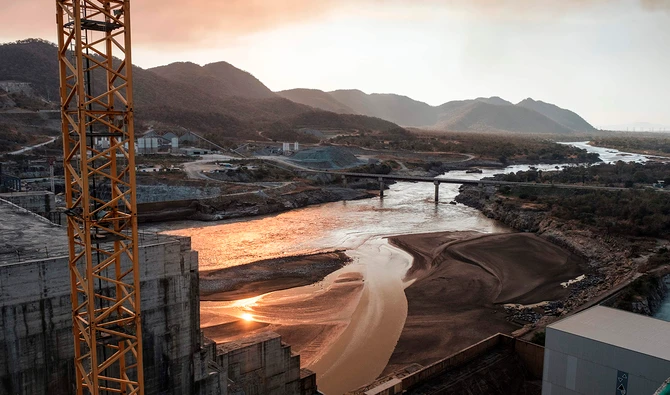
The Grand Ethiopian Renaissance Dam (GERD) on the Blue Nile River, Benishangul-Gumuz Region, Ethiopia. (AFP/File Photo)
Short Url
Updated 26 February 2022

Egypt appeals to UNSC after Ethiopia starts Renaissance Dam operations

The Grand Ethiopian Renaissance Dam (GERD) on the Blue Nile River, Benishangul-Gumuz Region, Ethiopia. (AFP/File Photo)
  • On Feb. 25, Egypt’s permanent representative to the UN demanded that the letter be circulated as a document of the Security Council under the “Peace and Security in Africa” title

CAIRO: Egypt has sent a letter to the UN Security Council after Ethiopia announced the operation of the first low turbine in its Renaissance Dam, warning that it was another “fundamental breach” of the Declaration of Principles agreement.

On Feb. 25, Egypt’s permanent representative to the UN demanded that the letter be circulated as a document of the Security Council under the “Peace and Security in Africa” title.

The Egyptian letter said: “The Ethiopian declaration is a unilateral measure that comes on top of the unilateral filling operations for the years 2020 and 2021, and is another fundamental breach of the Declaration of Principles agreement concluded in March 2015, which clearly and unambiguously requires Ethiopia to reach a legally binding agreement on the rules to fill and operate the Renaissance Dam before the start of the filling and operation process.”

The Declaration of Principle agreement between Egypt, Ethiopia and Sudan was signed in Khartoum in March 2015 at a tripartite summit that included the heads of the three countries.

The meeting was also attended by a World Bank representative. The declaration aimed to promote mutual understanding and goodwill, and uphold the principles of international law and cooperation.

However, in its letter to the Security Council, Egypt warned: “Ethiopia has refrained from conducting the required studies on the hydrological, social, economic and environmental impacts of the construction of the Renaissance Dam, and from consulting in advance with other countries on the river, in accordance with Ethiopia’s stable obligations under customary international law.”

Cairo said that “these practices, in addition to continuing to fill the Renaissance Dam reservoir and operate it unilaterally, are a violation of the Declaration of Principles agreement, and will have direct negative effects on Egypt’s rights and interests as a riparian state, and will threaten to cause great harm to it.”

And on Sept. 15 last year, the letter added, the Security Council had issued a presidential statement calling on the three countries to move forward in a “constructive and cooperative manner” in the negotiating process to reach a binding agreement.

As a result of Ethiopia moving ahead with dam operations, it had violated an “indispensable condition for compliance with the presidential statement issued by the Security Council,” Egypt warned.

The letter added that Cairo “categorically rejects Ethiopia’s beginning to operate the dam unilaterally.

“It bears full responsibility for violating the obligations entrusted to it in accordance with the rules of international law and the Declaration of Principles agreement, and for any damage caused to Egypt as a result of that violation.”
Egypt, Cyprus, Greece look to step up military cooperation

Egypt, Cyprus, Greece look to step up military cooperation
Updated 21 June 2022

Egypt, Cyprus, Greece look to step up military cooperation

Egypt, Cyprus, Greece look to step up military cooperation
  • Exchange of skills, joint exercises among plans to face security challenges
  • Mutual efforts aimed at ‘regional peace and stability,’ defense minsters say

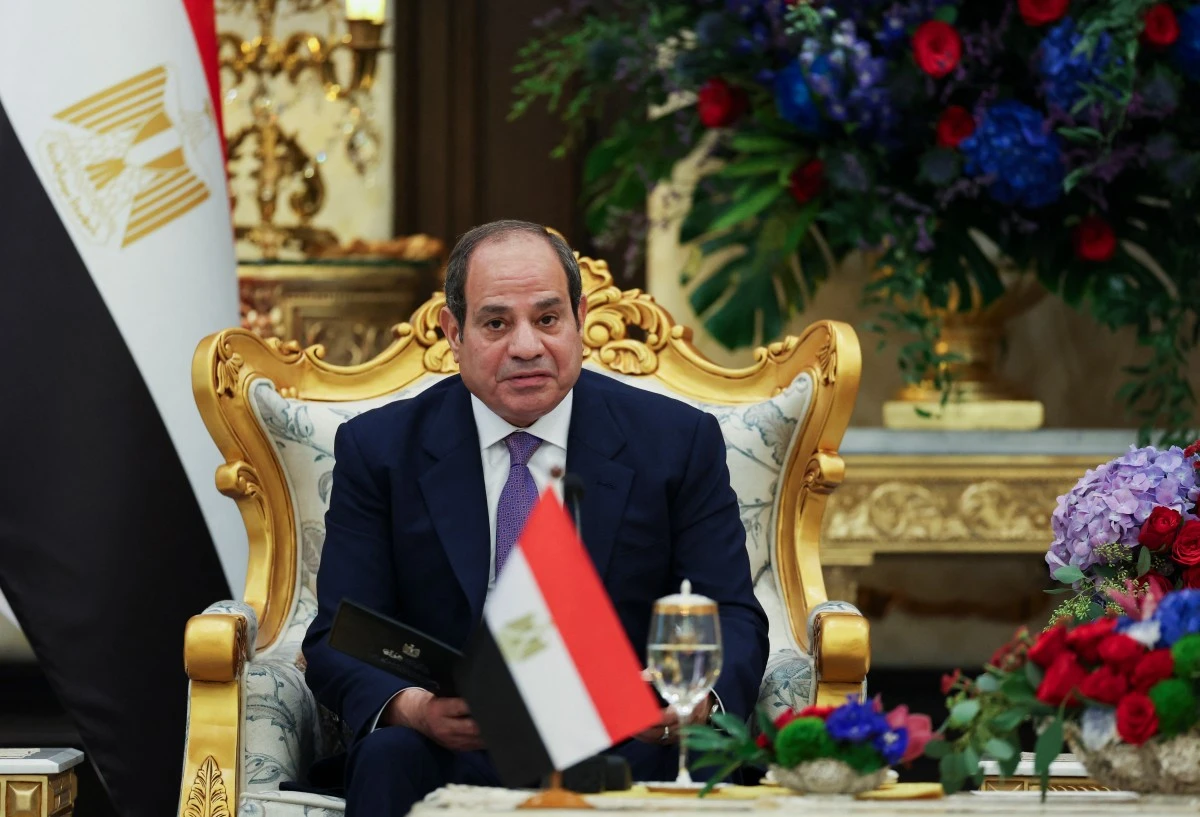
CAIRO: Egypt, Cyprus and Greece have discussed strengthening joint military cooperation to face security challenges and threats.

This came during Egypt’s hosting of the fifth meeting of the defense ministers, as well as leaders of the armed forces, of the three countries.

Egyptian military spokesman Col. Arkan Harb Gharib Abdel Hafez said in a statement that the meeting dealt with a number of topics and issues related to defense cooperation.

Lt. Gen. Mohamed Zaki, commander-in-chief of Egypt’s armed forces, and minister of defense and military production, held a bilateral meeting with the Cypriot Defense Minister Charalambos Petrides to discuss the transfer and exchange of information and skills between the armed forces of both countries.

Zaki also held talks with Nikolaos Panagiotopoulos, Greek minister of defense, to review the regional and international defense situation and its implications for security and stability in the Middle East and the Eastern Mediterranean.

In his opening address, Zaki highlighted “the importance of supporting means of cooperation and partnership between Egypt, Cyprus and Greece, which contributes to achieving security and stability in the Middle East and the Eastern Mediterranean region, praising the fruitful cooperation the Egyptian-Cypriot-Greek relations are witnessing during recent times.”

The Cypriot defense minister supported extended partnership and cooperation, especially with joint exercises and the exchange of experiences between the armed forces.

The Greek defense minister expressed his appreciation for Egypt’s influential and active role to achieve security and stability in the Middle East and Eastern Mediterranean.

At the conclusion of the discussions, a joint statement was signed within the framework of the efforts of the Egyptian, Cypriot and Greek armed forces to support cooperation in defense and security in order to confront challenges and threats, and support peace and stability in the eastern Mediterranean.


US Navy, Iran have tense encounter in Strait of Hormuz

US Navy, Iran have tense encounter in Strait of Hormuz
Updated 21 June 2022

US Navy, Iran have tense encounter in Strait of Hormuz

US Navy, Iran have tense encounter in Strait of Hormuz
  • US Navy: One of three of the Guard fast crafts raced head-on at the Sirocco before changing course

DUBAI: The US Navy said Tuesday its forces had a tense encounter with Iran’s paramilitary Revolutionary Guard in the strategic Strait of Hormuz.
The Navy’s Mideast-based 5th Fleet said three Guard vessels had an “unsafe and unprofessional” encounter as the USS Sirocco and USNS Choctaw County transited Monday through the strait, the narrow mouth of the Arabian Gulf.
The Navy said one of three of the Guard fast crafts raced head-on at the Sirocco before changing course. The Navy said the Sirocco fired a warning flare during the encounter as well.
A short video released by the Navy showed the encounter.
Iran did not immediately acknowledge the incident in the strait, through which a fifth of all oil traded passes.
It comes as tensions remain high in the region as Iran’s nuclear deal with world powers remains in tatters as negotiations over the accord are stalled. Meanwhile, Tehran’s atomic program enriches uranium at its closest levels to weapons-grade yet.


Iran prepares enrichment escalation at Fordow plant, IAEA report shows

Iran prepares enrichment escalation at Fordow plant, IAEA report shows
Updated 21 June 2022

Iran prepares enrichment escalation at Fordow plant, IAEA report shows

Iran prepares enrichment escalation at Fordow plant, IAEA report shows

VIENNA: Iran is escalating its uranium enrichment further by preparing to use advanced IR-6 centrifuges at its underground Fordow site that can more easily switch between enrichment levels, a United Nations nuclear watchdog report seen by Reuters on Monday showed.
The move is the latest of several steps Iran had long threatened to take but held off carrying out until 30 of the 35 countries on the International Atomic Energy Agency’s Board of Governors backed a resolution this month criticizing it for failing to explain uranium traces found at undeclared sites.
With indirect US-Iran talks on reviving the 2015 Iran nuclear deal long stalled, any further escalation in Tehran’s standoff with the West risks killing off hopes of reining in the Islamic republic’s nuclear advances and lifting US sanctions against it.
IAEA inspectors verified on Saturday that Iran was ready to feed uranium hexafluoride (UF6) gas, the material centrifuges enrich, into the second of two cascades, or clusters, of IR-6 centrifuges installed at Fordow, a site dug into mountain, the confidential IAEA report to member states said.
Iran informed the IAEA on Monday that passivation of the cascade, a process that precedes enrichment and also involves feeding UF6 into the machines, had begun on Sunday.
Importantly, the 166-machine cascade is the only one to have so-called “modified sub-headers,” which make it easier to switch to enriching to other purity levels. Western diplomats have long pointed to that equipment as a source of concern since it could enable Iran to quickly enrich to higher levels.

AWAITING CLARIFICATION
Iran has also not told the agency clearly what purity the cascade will enrich to after passivation. Iran had previously informed the IAEA that the two IR-6 cascades could be used to enrich to 5 percent or 20 percent purity.
“The Agency has yet to receive clarification from Iran as to which mode of production it intends to implement for the aforementioned cascade, following the completion of passivation,” the report said, which the IAEA confirmed.
At a different site, Iran is already enriching to up to 60 percent, close to the roughly 90 percent of weapons-grade and far above the 2015 deal’s cap of 3.67 percent. Iran has breached many of the deal’s limits in response to the US withdrawal from the deal in 2018 and its reimposition of sanctions. Iran denies seeking nuclear weapons.
In response to the Board of Governors’ resolution, Iran has ordered the removal of IAEA cameras installed under the 2015 deal and pressed ahead with the installation of IR-6 centrifuges at an underground plant at Natanz where the deal lets it enrich but only with far less efficient IR-1 machines.
The 2015 deal does not allow uranium enrichment at Fordow.


Lebanon committed to reform in exchange for a viable program

Lebanon committed to reform in exchange for a viable program
Updated 20 June 2022

Lebanon committed to reform in exchange for a viable program

Lebanon committed to reform in exchange for a viable program
  • Mikati tells world: Repatriate Syrian refugees or we will deport them

BEIRUT: Lebanese President Michel Aoun stressed on Monday that Lebanon is “committed to carrying out the required reforms,” but said the country “needs the IMF’s program within the limits of its applicability in Lebanon.”

Aoun’s stance coincided with a warning by caretaker Prime Minister Najib Mikati for “the international community to cooperate with Lebanon to secure the return of Syrian refugees to their country, or else Lebanon will work to get Syrians out through legal means and the firm application of Lebanese law.”

Aoun met with the newly appointed representative of the International Monetary Fund in Beirut, Federico Lima, who called for a speedy adoption of reforms, including capital controls, banking secrecy and other measures related to restructuring the financial sector.

In April, Lebanon and the IMF signed a staff-level agreement, a mutual declaration of intent between the IMF mission and the Lebanese negotiating delegation. However, before the signing, Lebanon needs to meet all the conditions set by the IMF.

Lebanon is politically divided over the adoption of the required reforms, particularly the economic recovery plan, the establishment of the independence of the judiciary and the development of a credible plan for the electricity sector, keeping the sector away from brokerage and quotas, distribution and service projects.

The country has failed to implement the IMF’s terms for the past two years, since the start of talks. Conditions include, for example, the consolidation of the Banque du Liban’s exchange rates, the development of a clear strategy for restructuring public debt in the medium and long term, the development of an agreed strategy for restructuring the banking sector, and an audit of the bank’s budgets, which determine its financial position and its remaining liquidity in foreign currencies, so as to develop transparency.

Meanwhile, the Ministry of Social Affairs on Monday launched an appeal on behalf of the government “to obtain $3.2 billion to address the continuing effects of the Syrian crisis by providing vital assistance to people in need, and supporting the infrastructure of public institutions, services and the local economy in Lebanon.”

Mikati warned during the launch of the Lebanon Crisis Response Plan that “Lebanon has been hosting displaced Syrians now for more than 11 years. As resources are further stretched by the economic crisis, increased support to the displaced and for the Lebanese host communities remains a top priority for the government of Lebanon and its partners.

“We urge you to stand by Lebanon, its people and government, and by the displaced to respond to their urgent needs, and work together to overcome obstacles to their safe return to their homeland,” Mikati told the international community, adding: “Our current situation is radically different from what it was before, because we are now going through one of the most severe economic, financial, social and political crises in the world.

“As a result, about 85 percent of Lebanese now live below the poverty line. About one-third of Lebanon’s population is now displaced and suffering from poverty, which means that 11 years after the start of the Syrian crisis, Lebanon no longer has the capacity to bear all this burden, especially under the current circumstances.

“Lebanon is now counting on you to help us maintain security, economic and social stability,” he added.

“The Lebanon Crisis Response Plan brings together more than 126 partners to assist 3.2 million people in need living in Lebanon. It aims to provide support to 1.5 million Lebanese, 1.5 million displaced Syrians, and more than 209,000 Palestinian refugees,” the Ministry of Social Affairs said, adding that “$9 billion assistance provided through the Lebanon Crisis Response Plan since 2015 has shown tangible results for the host population and displaced persons.”

It added people across Lebanon were falling deeper into poverty due to currency depreciation, high inflation, rising prices and loss of income. Gaps in supply chains including fuel, wheat and electricity continue to impact the operational environment for LCRP partners, while they simultaneously face an increase in pressure from local authorities and communities to provide assistance amidst escalating needs.

Najat Rochdi, humanitarian coordinator for Lebanon, said that “nine out of ten Syrians in Lebanon are living in poverty.”

She pointed out that poverty levels have also risen substantially for Lebanese, migrants and Palestinians. These circumstances are driving families to send children to work instead of enrolling them in schools, skip meals and incur debt.

Canada’s Ambassador to Lebanon Chantal Chastenay, speaking on behalf of donor countries, said: “About $4.1 billion was pledged to Syrian refugees at the Brussels conference.”

She reaffirmed the commitment to a political solution to the Syrian crisis, focusing on the recovery process inside Syria and promising to support host countries, as well as supporting Lebanon to address the long-term displacement through development and funding.


Tunisia president receives draft constitution

Tunisia president receives draft constitution
Updated 20 June 2022

Tunisia president receives draft constitution

Tunisia president receives draft constitution
  • The new constitution is the centrepiece of reform plans by Saied which is set to go to referendum on July 25

TUNIS: A legal expert charged with writing a new constitution presented a draft to Tunisian President Kais Saied Monday, less than a month before a referendum on the document.
The planned referendum is set for July 25, the one year anniversary of a power grab by Saied that saw him sack the government and suspend an elected parliament.
Sadeq Belaid, the legal expert appointed to head a committee drafting the new document, handed the draft to the president at his palace in the coastal Tunis district of Carthage.
“We hope (it) will satisfy the president,” Belaid said in a video published by the presidency following their meeting.
In a statement, Saied said the draft “is not final, and some sections may be revised or given further thought.”
Under his own timeline, Saied has until June 30 to approve or edit the draft constitution, which has not yet been disclosed in any form to the public.
The constitution for a “new republic” is at the center of Saied’s program for rebuilding Tunisia’s political system, more than a decade after the revolution that sparked the Arab Spring uprisings.
Saied this year consolidated his power grab by dissolving parliament, moving to rule by decree and seizing control of the judiciary.
His moves have been welcomed by some Tunisians tired of their dysfunctional post-revolution democracy, but others have warned he is returning the country to autocracy, little more than a decade after the ouster of dictator Zine El Abidine Ben Ali.
Saied wants to replace the current constitution, the product of a hard-won 2014 compromise between bitter political rivals that enshrined a mixed parliamentary-presidential system that often produced deadlock.
Tunisian Bar president Ibrahim Bouderbala, who headed a committee taking part in Saied’s “national dialogue” over the constitution, told AFP that under the draft, “the president of the republic will control the executive.”
The draft also “takes particular interest in economic questions,” he said.
Belaid had told AFP in an interview earlier this month that he would remove all reference to Islam from the new document in order to challenge Islamist parties, a reference to Ennahdha, which has dominated Tunisian politics since 2011.