



KARACHI: Aquila Ismail, the sister of slain Pakistani architect and activist Parween Rahman, on Thursday said her life had come “full circle in a bad way” last month when all five suspects in her murder were acquitted by a high court.
Rahman, an architect who was the director of the Orangi Pilot Project (OPP), was on her way home in 2013 when she was gunned down in Karachi by gunmen on a motorcycle. She was struck four times in the chest and neck and died on the way to the hospital, police said.
Rahman was an architect who left private practice early in her career to help the poor.
The (OPP) operated in the squatter slums that make up a huge part of Karachi. The innovative project, started in the 1980s, helped residents of those poor communities build their own sewer and water systems.
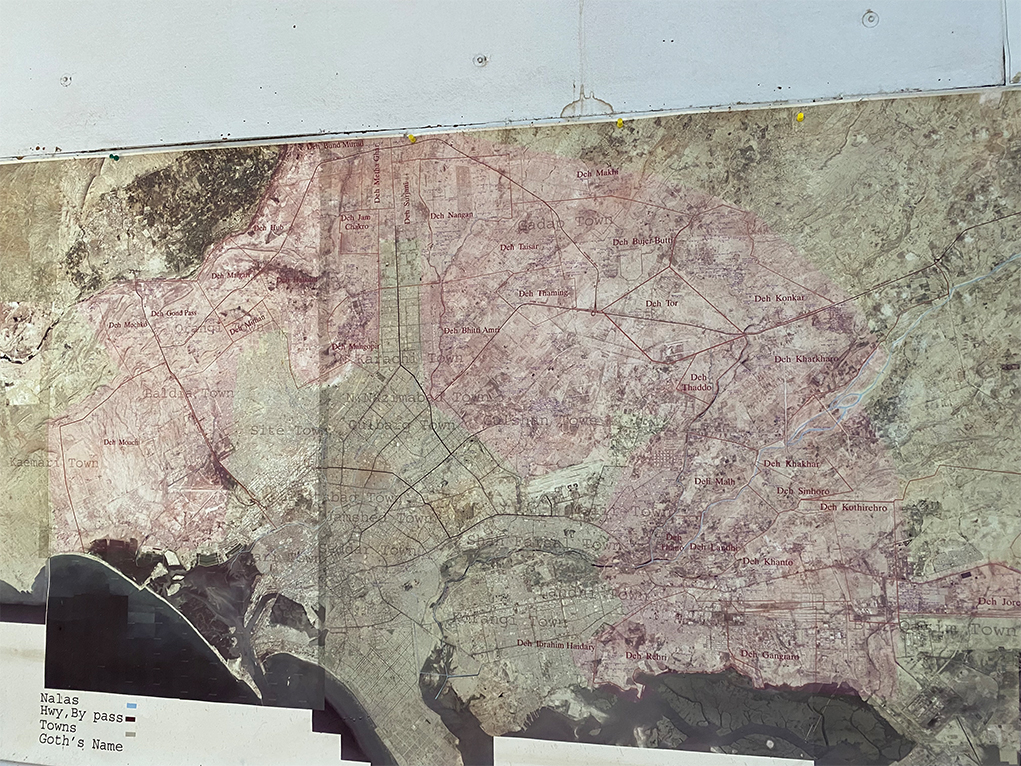
A map by Parween Rahman marking the land of Karachi’s goths (villages). Photograph was taken on December 15, 2022. (AN Photo)
A Karachi police closed the case a day after Rahman’s murder, announcing that they had killed the alleged hitman Qari Bilal, a member of the Pakistani Taliban, who police said murdered the activist.
Rahman’s family didn’t believe the police and moved the apex court in January 2014. The Supreme Court called for the case to be investigated again.
After a trial of nearly nine years, an anti-terrorism court sentenced the accused to life imprisonment on two counts. However, the Sindh High Court (SHC) overturned the decision last month, citing lack of evidence as the reason and ordered all five suspects to be released.
For Ismail, it was “unprecedented” to watch the men go scot-free after murdering her sister a day after the verdict was announced.
“The verdict was on Monday [November 21, 2022], and Tuesday evening, they were all released,” Ismail told Arab News at her OPP office. “And they were back in their homes and the celebrations began”, she added.

A poster inscribing the quote ‘Learn, understand, make others understand’ by Parween Rahman hangs at the Orangi Pilot Project’s office in Karachi, Pakistan, on December 15, 2022. (AN Photo)
For Ismail, it was nothing sort of reliving the trauma of her sister’s murder.
“I felt that you know, it seems that Parween has been killed again,” she said.
Ismail said when the suspects were behind bars, she and the OPP staff felt threatened. However, seeing the men released felt like “a nightmare.”
“They have been released personally now, in spite of there being so much evidence on the contrary,” she said. “So, for us, it was like a nightmare. We couldn’t believe it. But it happened.”
Ismail said her family had gotten some form of retribution after the innocent blood of her family had been spilt. However, she said it felt like it had all gone back to square one with the court’s decision.
“Our life has come full circle in a very bad way,” she said.
Rahman’s family has moved the Supreme Court of Pakistan against the SHC’s decision to acquit the suspects.
Ismail said the prime accused in Rahman’s murder was a “landgrabber” and the owner of an illegal water hydrant. She said the suspect was also upset that of all the people to oppose the occupation of the OPP land, it was a woman who had stood up to him.
“He [Raheem Swati] said that she had betrayed his honor, that she had somehow hurt his honor by not doing what he wanted to do,” Ismail said. “He said, ‘This woman, how dare she, how dare she challenge us,’” she said, adding that Swati repeated these words during several hearings of the case.
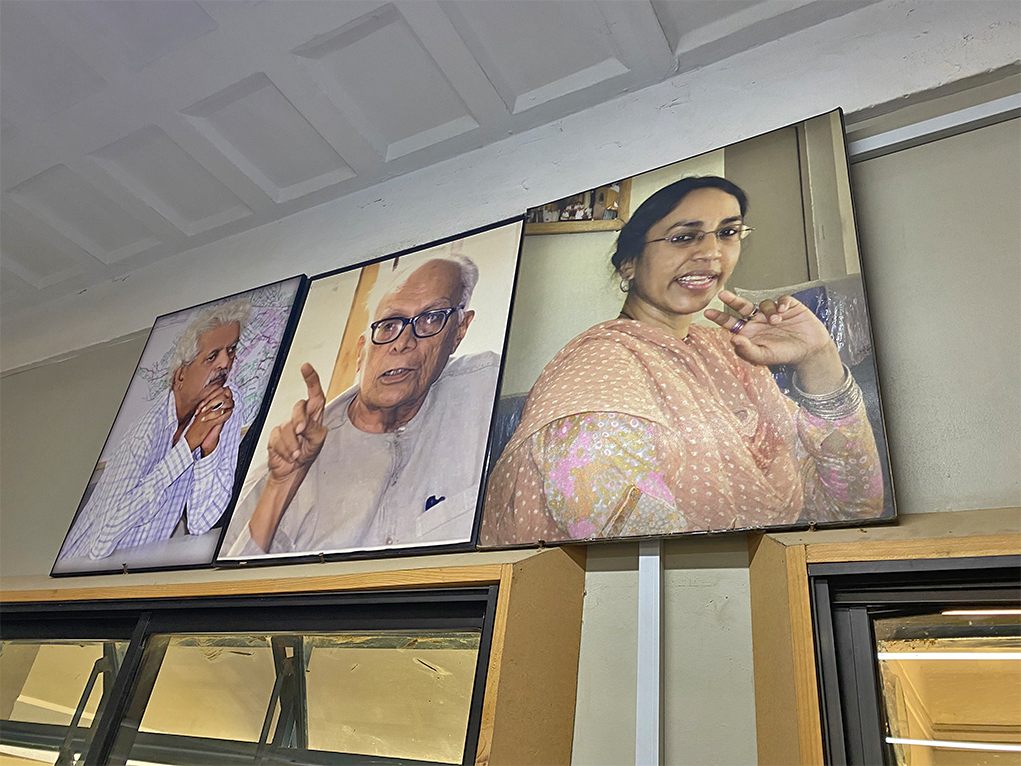
A portrait of Parween Rahman (right) hangs on a wall in the office of the Orangi Pilot Project in Karachi, Pakistan on December 15, 2022. (AN Photo)
Ismail said Rahman’s own experience of being displaced from her home in then East Pakistan after it became Bangladesh in 1971 caused her to fight for the poor to have land of their own.
In 1971, East Pakistan seceded from West Pakistan after a bloody war and became present-day Bangladesh. Many families from Bangladesh migrated and settled in Pakistan after the conflict ended.
“She knew what it felt like. I mean, we had been dispossessed, we were thrown out of our homes, and we landed up in Karachi, after much struggle,” Ismail said.
Driven by a strong sense of empathy, Ismail said as the head of the OPP, Rahman worked tirelessly to map lands and protect people from being displaced. She thought people had a right to all the natural resources that nature gave them, Ismail said.
Ismail recalled how Rahman, four weeks before her assassination, picked up an injured dog while coming to work and brought her to work. She cleaned the animal’s wounds.
“She bandaged the poor little puppy up and kept him here,” she said, referring to the OPP. Ismail said the OPP served as a home to a number of cats and dogs that Rahman had rescued.
Ismail recalled another incident from Rahman’s childhood, when she ran with a baby parrot in her hand while a boy, claiming to be its owner, followed her close behind.
“She said they took it from the nest because it’s a parrot and they want to teach it to talk, I will not allow it”, Ismail recalled her sister saying.
Rahman, according to Ismail, not only fought for the rights of humans but also for animals.
“There were about six cats, two in the house, four in the garden, and they were all black cats,” she recalled.
“She used to love them. She said that people think they are bad luck. And they discard them. I can’t do that,” Ismail recalled her sister as saying.





