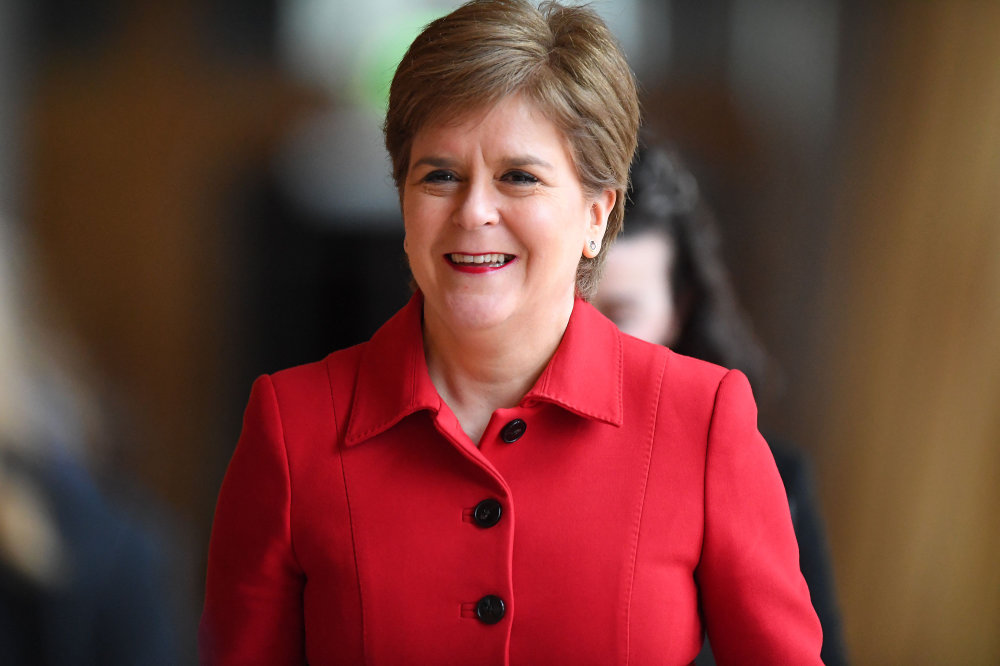

Scottish National Party leader Nicola Sturgeon is gearing up for a big conference in March to prepare for the next steps on her mission to deliver her nation’s secession from the UK, despite the political and economic black hole this would likely lead it into.
In recent months, Sturgeon has been on the political back foot after more than a decade of the SNP running the devolved administration in Scotland. Firstly, the UK Supreme Court ruled last autumn that the Holyrood legislature does not have the authority to declare a new independence referendum in the absence of consent from the UK government.
In addition, Sturgeon’s previously impregnable position at the top of the SNP is facing new challenges. One indication of this was the disagreements over who should lead the SNP’s MPs in the Westminster legislature, with Sturgeon’s long-standing ally Ian Blackford last month deposed in favor of Stephen Flynn.
More fundamentally, there is clear tension within the SNP over Sturgeon’s approach to seeking independence. Since the last referendum in 2014, she has repeatedly sought new ways to push the debate in her favored direction, but almost a decade later there is relatively little to show for this in tangible terms.
This is largely why Sturgeon has called the independence conference in March to discuss the next steps amid much tumult in the party. Her approach now appears to be to either use a potentially good result at the next UK general election — which must be held by January 2025 — to pressure London into letting her hold another referendum, or trying to make the next Scottish election, due in 2026, into a de facto vote on independence.
Yet, while Sturgeon is currently going through a tough time, she has proven herself in recent years to be one of the most formidable politicians in Scotland and she cannot be counted out. This is particularly true given the unpopularity in Scotland of the Conservative-led UK government.
The other factor Sturgeon is seeking to capitalize on is the unpopularity of Brexit in Scotland, whose populace voted in the 2016 referendum to remain in the EU by 62 percent to 32 percent. She argues that Brexit is a material change since the last independence referendum in 2014 and that the Scottish people should therefore be given a new chance to vote on the issue.
There are huge uncertainties over whether Scotland would significantly benefit from independence.
Andrew Hammond
In this shifting sands political context, it is increasingly possible that the 2020s could yet witness the unraveling of the UK, one of the world’s longest and most successful political unions. This would see Scotland, along with the wider UK, being led into a potential political and economic black hole that would probably weaken all parties.
For Scotland, there are huge uncertainties over whether it would significantly benefit from independence. This is not least given the deficit between tax revenues and public spending in the country, which it can better stomach as part of the union with England, Wales and Northern Ireland.
Moreover, Brussels has confirmed that an independent Scotland would not have an automatic right to join the EU. So such an accession may require complex, protracted negotiations, especially as membership technically requires countries to run a deficit below 3 percent of gross domestic product.
Further, there is also a significant possibility of a harder border between England and Scotland if the latter joined the EU post-independence. This is because the country would be required to embrace European-style freedom of movement and thus have a different immigration policy to the rest of the post-Brexit UK.
It is also widely accepted that the rest of the UK would be damaged by Scottish independence, including its ability to punch above its weight on the world stage. For instance, a UK parliamentary committee has warned that losing the Scottish tax base, especially at a time of fiscal challenge, could lead to further budgetary cuts to the armed forces. Moreover, the UK’s large overseas aid budget and extensive network of diplomatic and trade missions would also be impacted.
Scottish independence would also erode the UK’s voice in international forums, such as the UN, G7, G20 and NATO. Perhaps, most prominently, it could be seized upon by some nonpermanent members of the UN Security Council and/or other UN members as a way to catalyze a review of the UK’s permanent membership of the UNSC. To be sure, reform of the council is overdue. However, Scottish independence could see this issue being decided on less favorable terms for the UK than may otherwise be the case.
With continuing political risk over the integrity of the union, the case needs to be made again as to why the future for Scotland and the rest of the UK is better together. There are significant uncertainties for Scotland from independence, while the costs to the UK of diminished international influence are clear.
• Andrew Hammond is an associate at LSE IDEAS at the London School of Economics.