



ISLAMABAD: In the early hours of Aug. 14, 1947, hundreds gathered on the lawn of the Shakargarh tehsil headquarters, waiting for history to be made.
As a German-made Grundig radio crackled to life with the announcement of Pakistan’s independence, headmasters, scholars, businesspeople and children erupted in joy. Among them was seven-year-old Muhammad Arshad.
Now 85, Arshad has spent more than five decades in journalism, witnessing both Pakistan’s turbulent history and the transformation of its news media.

An undated file photo of veteran Pakistani journalist, Muhammad Arshad on his graduationJournalism from Punjab University in 1961. (Photo courtesy: Muhammad Arshad)
The British partition of the subcontinent created two states on the basis of religion, with Muslim-majority areas allocated to Pakistan and Hindu-majority to India. The process triggered the largest mass migration in human history, with an estimated one million people killed in communal violence.
Arshad’s hometown of Shakargarh, then part of Gurdaspur district in present-day Indian Punjab, was allocated to Pakistan, while Gurdaspur itself went to India. The tehsil became a hub for Muslim migrants fleeing violence, many of them wounded and destitute.
“All the people who arrived were injured, cut up or wounded,” Arshad recalled. “And they came into Shakargarh city, where there was only one government dispensary.”
Arshad moved to Lahore in the 1950s for higher education, earning a Master’s degree in Journalism from Punjab University in 1961 as part of its first graduating class in the subject. He began his career that year as a sub-editor at Daily Kohistan, later working for several newspapers before joining state broadcaster Pakistan Television (PTV) in 1983, where he served until 2000.
After retirement, he continued contributing to newspapers and television until 2010, and taught journalism at Pakistani universities until 2023.
His career has given Arshad a unique vantage point to comment on Pakistan’s media landscape, whose ethos he says has changed fundamentally.
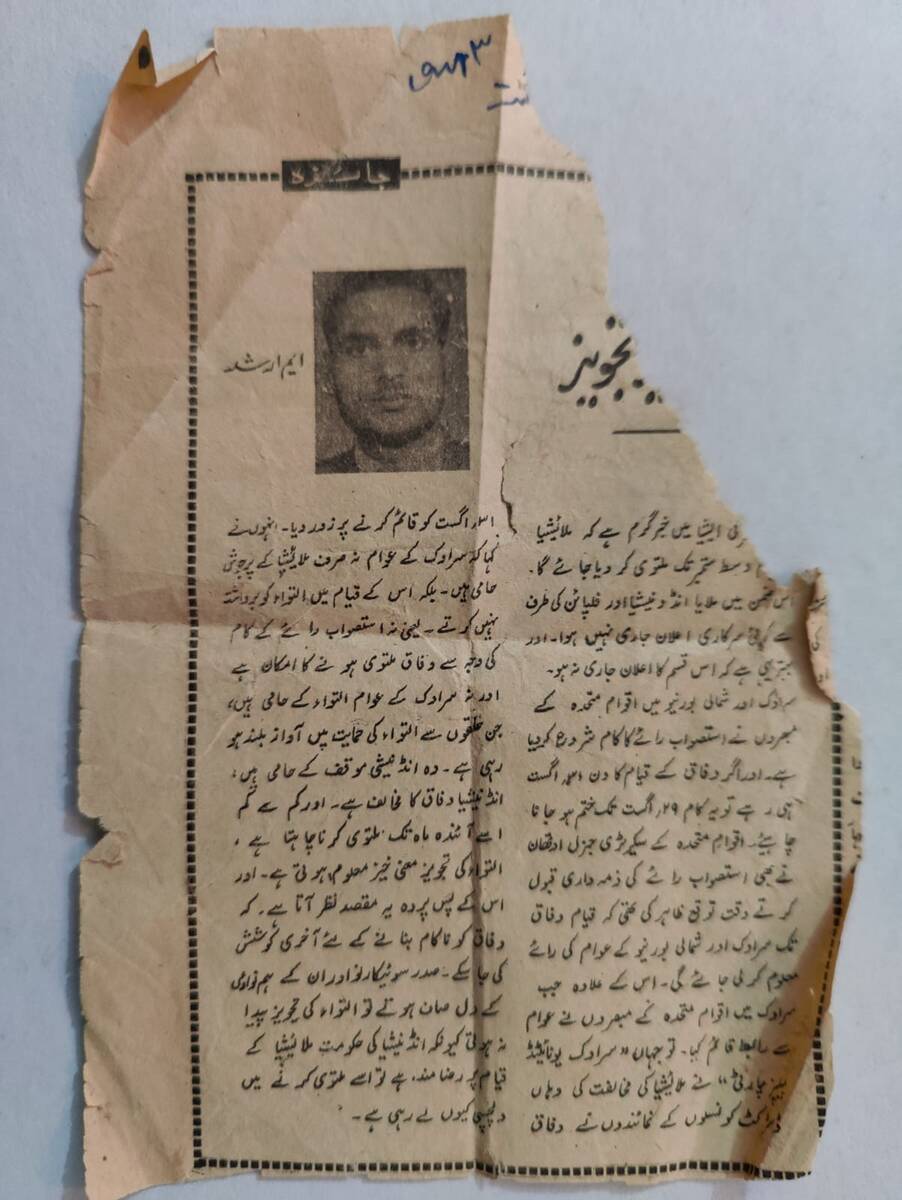
An undated file photo of a news paper clipping shows a coloumn written by veteran Pakistani journalist, Muhammad Arshad. (Photo coutresy: Muhammad Arshad)
“In earlier times, journalism meant serving the nation’s existence, not one’s own, like I am no one,” he said. “And now, there is no preference to the nation, and I am on the forefront.”
Indeed, Pakistan’s news media, particularly its private television channels and digital outlets, regularly face criticism for political bias, sensationalism and spreading misinformation.
Arshad contrasted current practices with his early years in the profession.
“During my career, news outlets gathered facts from the field like a sacred trust and reported them honestly,” he said. “Now everyone wants to put himself and personal gains at the forefront and the public is behind somewhere.”
He also lamented what he sees as a weakening command of the Urdu language among journalists, anchors and newscasters, urging them to refine their delivery and avoid mixing words.
“If we revive that spirit of truth and integrity, the profession can still guide Pakistan to a better future,” Arshad said.

An undated file photo of veteran Pakistani journalist, Muhammad Arshad (left) with fellow journalists. (Photo courtesy: Muhammad Arshad)
Indeed, at the end of the day, the veteran media man still remains hopeful — for the future of the media and Pakistan.
“There is no need for despair because it will be fine. How will it be fine? There is no argument for this except one,” he said.
“When Pakistan came into being, it did not even have a needle. Now, it is an atomic power.”





