Gaza aid flotilla carrying Greta Thunberg departs Tunisia

Gaza aid flotilla carrying Greta Thunberg departs Tunisia
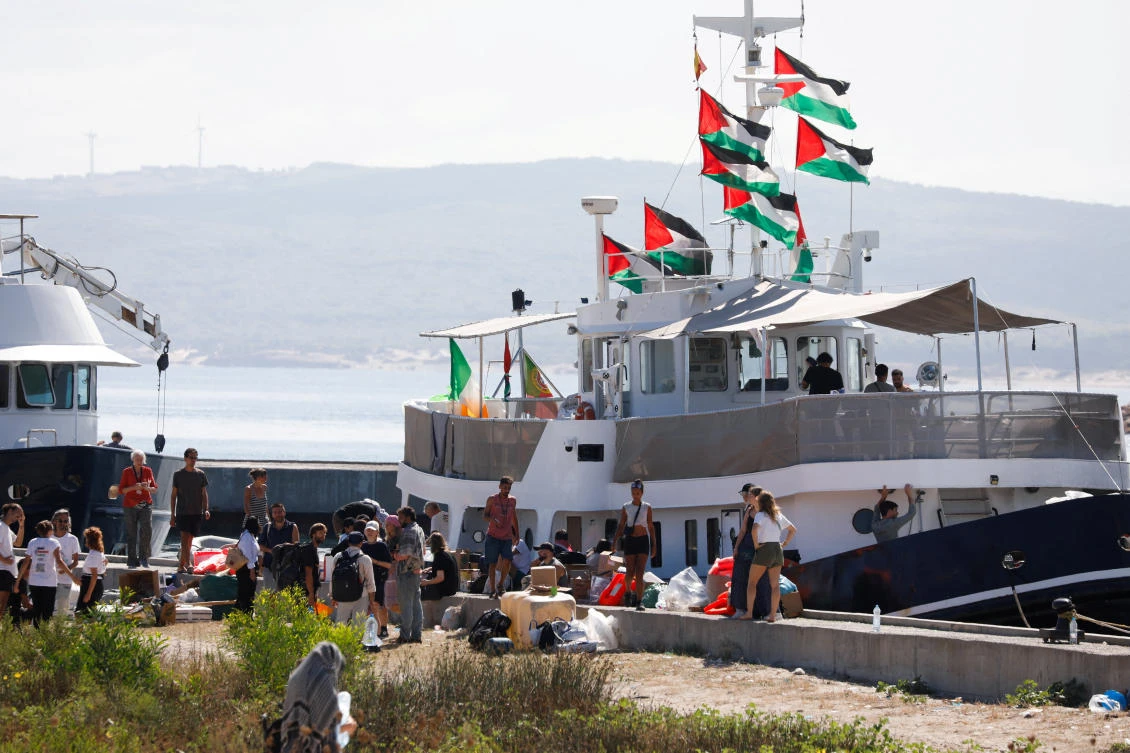
Participants of the Global Sumud Flotilla wait to set sail towards Gaza, with other boats from Tunisia, September 13, 2025. (REUTERS)
Short Url
Updated 15 September 2025
Follow

Gaza aid flotilla carrying Greta Thunberg departs Tunisia

Gaza aid flotilla carrying Greta Thunberg departs Tunisia
  • Around 20 boats that had sailed from Barcelona converged in Bizerte
  • The Global Sumud Flotilla said two of its boats were targeted by drone attacks on consecutive nights last week

BIZERTE: A flotilla bound for Gaza carrying aid and pro-Palestinian activists set sail Monday from Tunisia after repeated delays, aiming to break Israel's blockade and establish a humanitarian corridor to the Palestinian territory.
"We are also trying to send a message to the people of Gaza that the world has not forgotten about you," Swedish climate activist Greta Thunberg said before boarding in the northern port of Bizerte.
"When our governments are failing to step up then we have no choice but to take matters into our own hands," she told AFP.
Around 20 boats that had sailed from Barcelona converged in Bizerte, with the last vessels leaving at dawn, an AFP journalist reported.
Yasemin Acar, who helps coordinate the flotilla from the Maghreb, posted images on Instagram of boats also departing in the early hours.
"The blockade of Gaza must end" and "We are leaving for solidarity, dignity and justice", the caption said.
The vessels had transferred to Bizerte after a turbulent stay in Sidi Bou Said near Tunis.
The Global Sumud Flotilla said two of its boats were targeted by drone attacks on consecutive nights last week.
After the second incident, Tunisian authorities denounced what they called a "premeditated aggression" and announced an investigation.
European Parliament member Rima Hassan, who like Thunberg was detained aboard the Madleen sailboat during an attempt to reach Gaza in June, said she feared further attacks.
"We are preparing for different scenarios," she said, noting the most prominent figures had been split between the two largest coordinating boats "to balance things out and avoid concentrating all the visible personalities on a single vessel".
The departure had been repeatedly postponed due to security concerns, delays in preparing some of the boats and weather conditions.
The flotilla, which also includes vessels that left in recent days from Corsica, Sicily and Greece, had originally planned to reach Gaza by mid-September, after two earlier attempts were blocked by Israel in June and July.
Drenched and displaced: Gazans living in tents face winter downpours

Drenched and displaced: Gazans living in tents face winter downpours
Updated 15 November 2025
Follow

Drenched and displaced: Gazans living in tents face winter downpours

Drenched and displaced: Gazans living in tents face winter downpours
  • Mahmud Bassal, spokesman for Gaza’s civil defense agency, warned on Friday that the water had overwhelmed thousands of tents erected to cope with the mass displacement caused by the war

GAZA CITY, Palestinian Territories: A barefoot Niven Abu Zreina swept an incessant stream of water away from her tent, as the season’s first big rain hit her makeshift displacement camp in Gaza City.
“I’ve been trying since morning to sweep away the rainwater that flooded our tent,” the Palestinian told AFP, her wet hijab sticking to her face.
“The scene speaks for itself. Rainwater soaked our clothes and mattress,” she said, while next to her a relative kept sweeping away the rain, also barefoot.
Mahmud Bassal, spokesman for Gaza’s civil defense agency, warned on Friday that the water had overwhelmed thousands of tents erected to cope with the mass displacement caused by the war.
“Since dawn today, we have received hundreds of appeals from displaced citizens whose homes and tents have been flooded by the rain,” Bassal said, adding that there were not enough tents to begin with.

- ‘What am I supposed to do?’ -

Located between the Sinai and the Negev desert on one side, and the Mediterranean Sea on the other, the tiny Gaza Strip receives almost all of its precipitation via strong rain in the late autumn and winter.
But with strict Israeli restrictions on the entry of goods and humanitarian aid, displaced Gazans have erected tents and makeshift shelters that are inadequate for downpours.
Last month’s truce between Hamas and Israel has eased part of the restrictions, but with about 92 percent of residential buildings damaged or destroyed during the war according to the UN, needs vastly supersede what little can enter on trucks.
A humanitarian source told AFP that restrictions on many materials required for building shelters, such as certain types of tent poles, were still not being allowed into Gaza.
Elsewhere in the camp bordering the Mediterranean Sea, a man used a broom handle to dislodge water accumulating in the center of a tarp he had set up as an awning for his tent.
In the camps’ low-lying areas, water pooled and accumulated before it could stream away toward the sea, leaving some children wading ankle deep in water.
Enaam Al-Batrikhi, an activist at the displacement camp, said she felt powerless when women came to her for help.
“How could I possibly help them?” she asked, adding that her own tent was flooded.
Nura Abu el-Kass, another displaced woman from the camp, said she found her mattress, blankets and clothes all soaked.
“My son sent me this tent, but it doesn’t protect us (from rainwater). What am I supposed to do?“

- ‘Not safe to live’ -

In the south Gaza city of Khan Yunis, Mohammed Shabat and his wife and five children were also struggling because of the weather, as cold drafts have been seeping through their tent’s openings.
“We live in a cemetery, and I have a baby. This tent does not protect us from the cold or the rain,” said Shabat, sitting on the sand between graves.
“Soon winter will come, and it will be very difficult,” he added.
Sitting by a stove built out of stacked concrete blocks, Shabat’s wife Alaa was preoccupied with the coming cold.
“A tent is not a safe place to live with young children. The cold wind penetrates the tent in the evening and the temperature is very low.”
The temperature in Gaza falls to between 15 and 20 degrees Celsius (59 and 68 degrees Fahrenheit) at night, but any dip in temperature brings added suffering to Gazans already struggling with inadequate shelters and lack of proper nutrition.