Taliban blocks fiber-optic internet ‘to prevent immoral activities’

Taliban blocks fiber-optic internet ‘to prevent immoral activities’
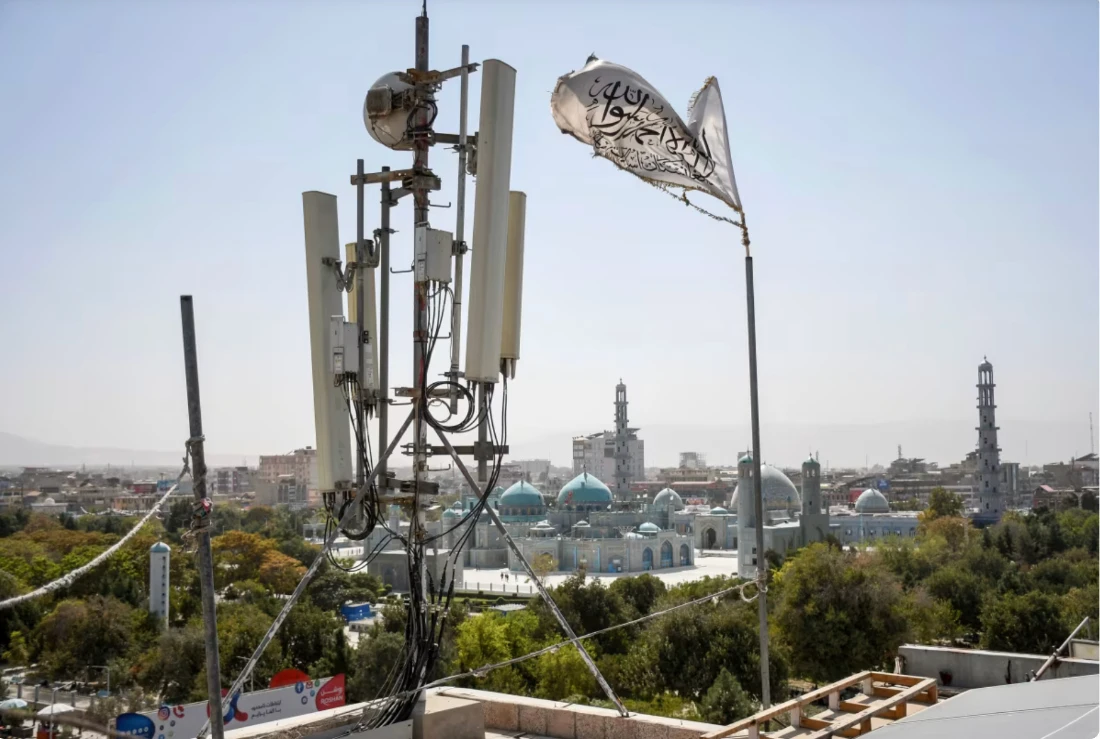
Taliban flag flutters near telecom equipment installed over a rooftop providing internet services overlooking Hazrat-e-Ali Shrine, or Blue Mosque, in Mazar-i-Sharif as the Taliban administration banned fibre-optic internet in Balkh province. (AFP)
Short Url
Updated 19 September 2025
Follow

Taliban blocks fiber-optic internet ‘to prevent immoral activities’

Taliban blocks fiber-optic internet ‘to prevent immoral activities’
  • Government offices, businesses, public institutions, and homes have been left without internet access
  • Rights groups warn of catastrophic, far-reaching consequences for Afghan society, economic crisis

LONDON: Taliban authorities have blocked fiber-optic internet across northern provinces of Afghanistan, claiming the move was necessary “to prevent immoral activities.”

Local media report that as many as 10 provinces — including Kunduz, Badakhshan, Baghlan, Takhar, and Balkh — have been affected, leaving government offices, businesses, public institutions, and homes without fiber-optic access.

The ban applies only to connections via fiber-optic cable, while mobile internet remains available, according to officials.

“The measure was taken to prevent immorality, and an alternative will be developed inside the country for essential needs,” said Haji Attaullah Zaid, a Taliban provincial spokesman.

He added that the ban was ordered by Afghanistan’s Supreme Leader Hibatullah Akhundzada.

No explanation was given for why Balkh was among the first provinces targeted, or for how long the restrictions would remain in place.

Local news outlet Afghanistan International reports that the fiber-optic ban could be extended nationwide, with further provinces such as Kandahar, Uruzgan, Helmand, and Nimroz already experiencing disruptions.

Rights groups have expressed alarm, urging the Taliban to reverse the block due to far-reaching consequences for Afghan society.

Many nongovernmental organizations say the measure has especially affected women and girls, who rely on online education following Taliban bans on school and university attendance.

Fiber-optic internet is a vital resource for companies, banks, and government agencies, and its loss risks deepening the country’s existing economic crisis.

Beh Lih Yi, regional director at the Committee to Protect Journalists, called the blockade “an unprecedented escalation of censorship that will undermine journalists’ work and the public’s right to information.”

YouTube to roll out AI video generation model Veo 3 on Shorts in MENA

YouTube to roll out AI video generation model Veo 3 on Shorts in MENA
Updated 07 November 2025
Follow

YouTube to roll out AI video generation model Veo 3 on Shorts in MENA

YouTube to roll out AI video generation model Veo 3 on Shorts in MENA
  • Veo 3 on Shorts can create high-definition videos in English, but platform said it is looking to expand to more languages and creators
  • According to YouTube’s own figures, 61 percent of Saudi YouTube Shorts users reported that they do not use Instagram Reels

LONDON: YouTube announced on Thursday that it will begin rolling out Veo 3, Google’s most advanced AI video generation model, on YouTube Shorts — free of charge to selected countries in the MENA region — over the coming weeks.

The announcement came during YouTube’s flagship advertiser event, Brandcast, marking the platform’s renewed push into AI as it seeks to solidify its regional presence against competitors TikTok and Meta’s Instagram.

“YouTube has been the launchpad for the creator economy across MENA for over a decade,” said Tarek Amin, YouTube’s regional director for the Middle East, Turkiye & Africa.

“By combining the authentic trust of our creators with powerful AI models like Veo 3, we are offering brands in the region an unmatched ability to drive culture and commerce with audiences they can’t find anywhere else,” he said.

YouTube marked its 20th anniversary since the upload of the historic video, “Me at the zoo,” on April 23, 2005, and has been operating in MENA for more than a decade.

The platform boasts high penetration rates — 94 percent in the UAE and 89 percent in Saudi Arabia — making it the dominant video-sharing platform in the region.

According to YouTube’s data, which it described as “significant and unique,” 61 percent of Saudi YouTube Shorts users and 54 percent of UAE users reported that they do not use Instagram Reels.

YouTube reiterated its commitment to regional growth, stating that the introduction of new features reflects its dedication to creators in MENA.

Among these is Veo 3 on Shorts, which can create high-definition videos. Initially, it will be English-first but plans exist to expand to more languages and creators in the future.

The Google-owned platform also plans to broaden the reach of its auto-dubbing feature, currently available to about 51,000 Egyptian creators translating Egyptian Arabic to English — an AI-powered translation tool enabling creators to reach global audiences.

Additionally, YouTube will launch its “Creator Partnerships Hub and Open Call” in 2026 across MENA to help brands streamline collaborations with creators and identify the best fit for their campaigns.

Key consumer trends were also highlighted, including a notable shift in viewer behavior.

A Kantar survey revealed that viewers in Saudi Arabia and the UAE rank YouTube as their top platform for researching, vetting or making decisions about brands, products or services — outperforming Facebook, Instagram, TikTok, X (Twitter) and Snapchat.

Sixty percent of surveyed Gen Z viewers in Saudi Arabia and the UAE indicated that they prefer watching video product reviews over reading written content or listening to audio reviews.

“We’re building the future of streaming, commerce and entertainment on YouTube,” Amin said. “MENA is a global force in content creation, and we are just getting started.”