Once overlooked, K-halal gains traction in Korea’s mainstream

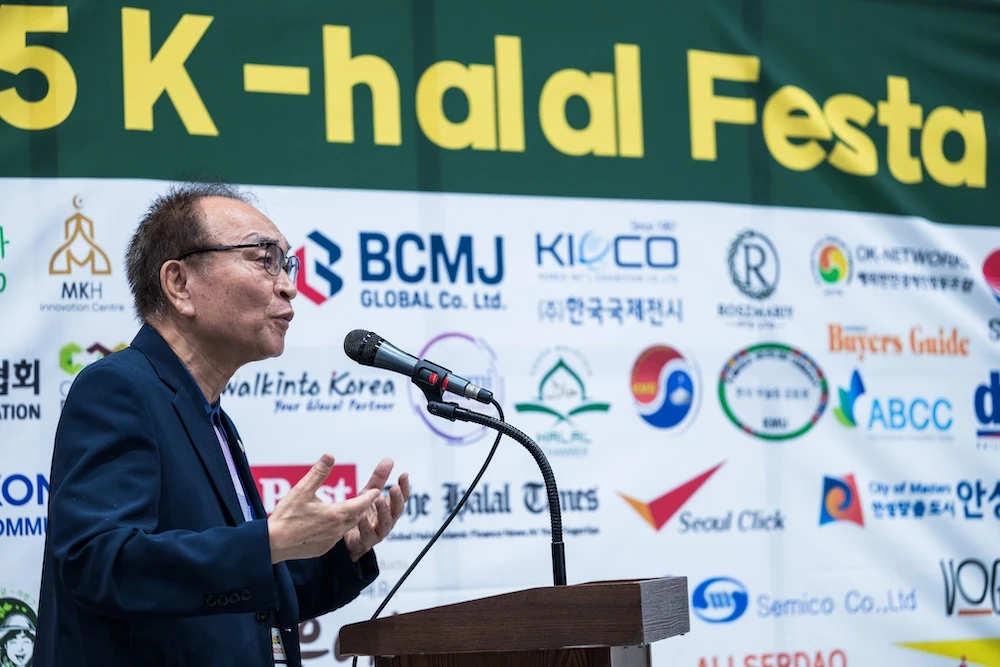
Special Kim Jin-woo, CEO of Halal Korea, gives a speech during the opening ceremony of the 2025 K-Halal Food Fest at Coex Magok, Seoul, Aug. 29, 2025. (Kim Jung-yeop)
Kim Jin-woo, CEO of Halal Korea, gives a speech during the opening ceremony of the 2025 K-Halal Food Fest at Coex Magok, Seoul, Aug. 29, 2025. (Kim Jung-yeop)
Short Url
Updated 22 September 2025
Follow

Once overlooked, K-halal gains traction in Korea’s mainstream

Once overlooked, K-halal gains traction in Korea’s mainstream
  • Kim Jin-woo has been spearheading halal industry in South Korea for 20 years
  • Halal footprint is steadily increasing in a country where only 0.2% are Muslim

SEOUL: It was in 2006 when Kim Jin-woo saw an opportunity where few others in South Korea were looking: the global halal industry. Nearly two decades later, he stands at the forefront of the country’s growing K-halal scene, introducing new trends in lifestyle, fashion, and food.

The idea to enter a niche market in a country where the Muslim population is less than 0.2 percent came to Kim while he was living in Malaysia and understood the industry’s scale.

“Halal is not just about food. It is a lifestyle that includes fashion, beauty, culture and how we live every day. The magnitude of this economy is about $3 trillion and affects about 1.9 billion people’s lives,” he told Arab News.

“I saw Malaysia doing that and thought Korea could definitely engage in the halal economy too.”

It took years of trials and various initiatives — from modest fashion shows to advising Korean firms on halal certification and exports — before Kim’s efforts bore fruit in bridging Muslim consumers and Korean businesses closer together.

Returning to Korea in 2015, Kim faced skepticism. “Eight out of 10 people asked me why I was working on halal,” he recalled. “I (even) got phone calls from the police.” But he believed Korea, with its booming food, beauty, and cultural exports, could not afford to ignore the Muslim market.

He started linking Korean employers with a growing Muslim migrant community. In 2015, he partnered with the Ministry of Oceans and Fisheries to host a halal expo, and later with the Seoul Business Agency to provide halal industry training for thousands of workers.

“The reason why the halal economy is not working here, and what makes my work difficult, is that 96 percent of Koreans do not even know the meaning of halal. So, there is a lot of effort put into raising awareness,” Kim said.

“Halal is about inclusion. Halal is a lifestyle. So, Koreans should be naturally exposed to it, and that is what I am trying to do.”

The CEO of Halal Korea and chair of the Overseas Korean Entrepreneurs’ Cooperative, he spearheaded last month the K-Halal Food Festa in Seoul’s Coex Magok Exhibition Hall.

Over 100 booths from across Korea and abroad drew not only industry buyers, but also students curious about halal cuisine, and families eager to try something new.

They left the venue with bags full of halal-certified ramen, sauces, and iconic K-beauty items.

The halal footprint is steadily increasing in South Korea. In the food sector alone, halal products accounted for 11.1 percent of the country’s total agri-food exports in 2023 — up 1.7 percentage points from 9.4 percent in 2022, according to data released by the Korea Food Research Institute.

In January this year, Seoul expanded its halal certification institutions from four to six, in a bid to support companies seeking entry into Muslim-majority markets.

“I think people now have opened their eyes a bit to the fact that halal is not only about food but that it is about the economy. So, that is a positive change,” Kim said, forecasting that in the years to come, South Korea’s halal exports will grow 10 percent year-on-year.

However, the expansion of the halal industry has also seen its fair share of backlash. In the late 2010s, talks were underway to build a halal food factory cluster in Iksan, a city 170 km south of Seoul, to supply both exports and domestic demand. Yet the plan has faced protests and still has not materialized.

Kim acknowledges the challenges but sees opportunity in sending Koreans to Muslim countries to learn and create joint ventures.

He foresees a Korea-Saudi Arabia halal cluster or a Korea-UAE halal cluster, “where Korean corporations foray there to produce the goods, and their local partners take care of the marketing and halal certifications.”

Another strategy would be to follow in the footsteps of Japan, which attracts about 6 to 7 million Muslim tourists each year.

In Korea, the number is roughly half that.

“If we create the right environment — halal food, halal cosmetics, halal fashion — we can make Korea not just a K-pop destination for teenagers, but also a welcoming place for Muslim families with real purchasing power,” Kim said.

“When more Muslims come to Korea, there will be an increase in demand for halal beauty products, fashion products ... So, naturally, the halal market will thrive.”
Truckers defy death to supply militant-hit Mali with fuel

Truckers defy death to supply militant-hit Mali with fuel
Updated 3 sec ago
Follow

Truckers defy death to supply militant-hit Mali with fuel

Truckers defy death to supply militant-hit Mali with fuel
TENGRELA: Tanker driver Baba steeled himself for yet another perilous journey from Ivory Coast to Mali loaded up with desperately needed fuel — and fear.
“You never know if you’ll come back alive,” he said.
Even before they hit the road, the mere mention of a four-letter acronym is enough to scare Baba and his fellow drivers.
JNIM, the Al-Qaeda-linked Group to Support Islam and Muslims, known by its Arabic acronym, declared two months ago that no tanker would cross into Mali from any neighboring country.
Hundreds of trucks carrying goods from the Ivorian economic hub Abidjan or the Senegalese capital Dakar have since been set on fire.
The JNIM’s strategy of economic militant aims to choke off Mali’s capital Bamako and the ruling military junta, which seized power in back-to-back coups in 2020 and 2021.
The fuel blockade has made everyday life in the west African country all but impossible.
“By economically strangling the country, the JNIM is looking to win popular support by accusing the military government of incompetence,” Bakary Sambe from the Dakar-based Timbuktu Institute think tank said.
On top of that, Mali has a “structural problem of insecurity,” he added.
Despite it all, dozens of tanker truckers still brave the roads, driven on by “necessity” and “patriotism,” they say.
AFP spoke to several along the more than 300-kilometer (185-mile) road between the northern Ivorian towns of Niakaramandougou and Tengrela, the last one before the Malian border.

- Dying ‘for a good cause’ -

“We do it because we love our country,” Baba, whose name AFP has changed out of security concerns, said.
“We don’t want Malians to be without fuel,” added the 30-year-old in a Manchester United shirt.
Taking a break parked up at Niakaramandougou, five hours from the border, Mamadou Diallo, 55, is similarly minded.
“If we die, it’s for a good cause,” he confided.
Further north at Kolia, Sidiki Dembele took a quick lunch with a colleague, their trucks lined up on the roadside, engines humming.
“If the trucks stop, a whole country will be switched off,” he said, between mouthfuls of rice.
Two years ago, more than half of the oil products exported by Ivory Coast went to Mali.
Malian trucks load up at Yamoussoukro or Abidjan and then cross the border via Tengrela or Pogo, traveling under military escort once inside Mali until their arrival in Bamako.
Up to several hundred trucks can be escorted at a time, but even with the military by their side, convoys are still frequently targeted, especially on two key southern axes.
“Two months ago, I saw militants burn two trucks. The drivers died. I was just behind them. Miraculously they let me through,” Moussa, 38, in an oil-stained red polo T-shirt, said.
Bablen Sacko also narrowly escaped an ambush.
“Apprentices died right behind us,” he recalled, adding firmly: “Everyone has a role in building the country. Ours is to supply Mali with fuel. We do it out of patriotism.”


- ‘Risk premium’ -

But their pride is mixed with bitterness over their working conditions.
“No contract, no insurance, no pension. If you die, that’s that. After your burial, you’re forgotten,” Sacko said.
With monthly pay of barely 100,000 CFA francs ($175, 152 euros) and a small bonus of 50,000 CFA francs per trip, Yoro, one of the drivers, has called for a risk premium.
Growing insecurity has prompted some Ivorian transport companies to halt road travel into Mali.
In Boundiali, Broulaye Konate has grounded his 45-strong fleet.
“I asked a driver to deliver fertilizer to Mali. He refused. The truck is still parked in Abidjan,” he said.
Ivorian trucker Souleymane Traore has been driving to Mali for seven years but said lately “you take to the road with fear in your heart.”
He recently counted 52 burnt-out tankers on his way back to Ivory Coast and another six on a further stretch of road.
Malian Prime Minister Abdoulaye Maiga has referred to the fuel that manages to get through as “human blood,” in recognition of the soldiers and drivers killed on the roads.
Analyst Charlie Werb from Aldebaran Threat Consultants said he did not anticipate the fuel situation easing in the coming days but said the political climate was more uncertain.
“I do not believe JNIM possesses the capability or intent to take Bamako at this time, though the threat it now poses to the city is unprecedented,” he added.