Palestinian mission in UK celebrates statehood recognition, raises flag in London

Palestinian mission in UK celebrates statehood recognition, raises flag in London
Head of the Palestine Mission to the UK, Husam Zomlot, holds a plaque with the words ‘Embassy of the State of Palestine’ during a flag-raising ceremony outside their Mission in London. (AFP)
Short Url
Updated 22 September 2025
Follow

Palestinian mission in UK celebrates statehood recognition, raises flag in London

Palestinian mission in UK celebrates statehood recognition, raises flag in London
  • Palestinian ambassador says British recognition comes at a time of ‘unimaginable pain and suffering’ for Palestinians in the Gaza Strip and the West Bank
  • First Minister of Scotland John Swinney attended the event along with former Labour leader Jeremy Corbyn
  • Palestine, a former British colony for nearly 30 years, was never recognized when the mandate ended, despite the UK’s recognition of the fledgling State of Israel in 1950

LONDON: Palestinians marked the announcement of the UK government’s formal recognition of the State of Palestine with a flag-hoisting ceremony attended by senior UK officials, members of Parliament, ambassadors, and members of the Palestinian community on Monday.

The official ceremony in the London borough of Hammersmith featured a speech by Husam Zomlot, the Palestinian ambassador, outside the Palestine Mission to the UK, soon to be upgraded into an embassy.

“In the same capital of the Balfour Declaration, after more than a century of ongoing denial, dispossession and erasure, the UK government has finally taken the long overdue step of recognizing the State of Palestine,” Zomlot began his speech.

Palestine, a former British colony for nearly 30 years, was never recognized when the mandate ended, despite the UK’s recognition of the fledgling State of Israel in 1950, an entity that was envisioned in the Balfour Declaration of 1917, which promised to establish a homeland for the Jewish people in Palestine.

This moment stands as a defiant act of truth, a refusal to let genocide be the final word; a refusal to accept that occupation is permanent

Husam Zomlot, Palestinian ambassador

The historic and long-awaited decision was announced on Sunday by Prime Minister Keir Starmer, who described it as “a pledge to the Palestinian and Israeli people that there can be a better future.”

It marks a shift in policy in the UK and some European countries, which have long stated that recognizing Palestine will occur only at the conclusion of peace negotiations. Hamas attacks in October 2023, followed by an ongoing campaign of vengeance by Israeli forces in the Gaza Strip, signaled to Starmer that “the hope for a two-state solution is fading.”

Zomlot said that British recognition comes at a critical time of “unimaginable pain and suffering” for Palestinians, a population of 5.5 million in Gaza and the occupied West Bank.

Since August, Israeli forces have conducted a demolition campaign targeting high-rise buildings in Gaza City, continuing nearly two years of assaults on the coastal enclave, where over 65,000 people have been killed. Officials from the UN and the EU, along with the mayor of London, have recently described Israeli actions in Gaza as genocide. In the West Bank, the Israeli government announced its approval of the E1 settlement, which would divide the territory in half and severely undermine any hope for a Palestinian state.
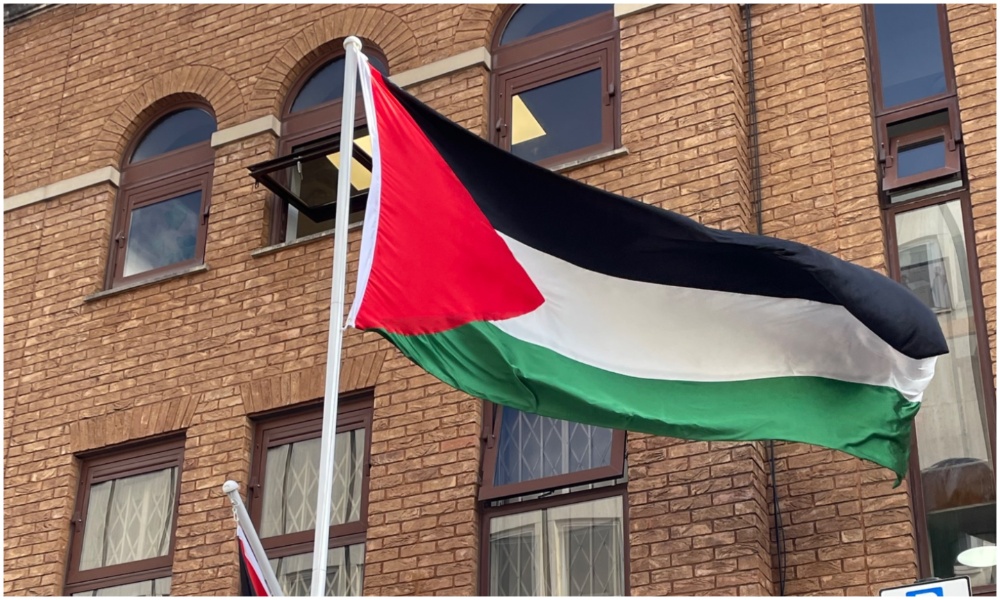


The Palestinian Mission to the UK in London held a special ceremony on Monday to mark British recognition of Palestinian statehood. (AN Photo/Mustafa Abu Sneineh)

“It comes as our people in Gaza are being starved, bombed, and buried under the rubble of their homes; as our people in the West Bank are being ethnically cleansed, brutalized by daily state-sponsored terrorism, land theft and suffocating oppression,” Zomlot said.

Palestinians hope that the UK’s recognition will be more than merely “symbolic” and will contribute to a resolution of the Israeli-Palestinian conflict that has embroiled the Middle East since 1948.

The UK, a permanent member of the Security Council and a G7 country, joined Canada, Australia, and Portugal on Sunday in recognizing Palestinian statehood, while France is expected to follow suit this week at the UN General Assembly.

“This moment stands as a defiant act of truth, a refusal to let genocide be the final word; a refusal to accept that occupation is permanent; a refusal to be erased and a refusal to be dehumanized,” Zomlot said.

“(It is) righting historic wrongs and committing together to a future based on freedom, dignity and fundamental human rights.”

A defining moment in securing self-determination for Palestine and peace through a two-state solution

John Swinney, Scotland’s first minister

The impassioned speech quoted the famous lines, “On This Land, There Are Reasons to Live,” a poem by the national poet Mahmoud Darwish.

“Please join me as we raise the flag of Palestine with its colors representing our nation: black for our mourning, white for our hope, green for our land and red for the sacrifices of our people,” Zomlot concluded.

John Swinney, the first minister of Scotland, attended the event along with former Labour leader Jeremy Corbyn. Swinney wrote on X that it was “a defining moment in securing self-determination for Palestine and peace through a two-state solution.”

Corbyn, an independent MP, congratulated those “who have tirelessly campaigned for the recognition of Palestine,” which he described as an “inalienable right” of the Palestinian people, in a post on the X platform.

He called on the UK government to “recognize the genocide in Gaza, end its complicity in crimes against humanity, and stop arming Israel.”

Saudi Arabia and France are co-hosting a one-day event at the UN in New York this week to advance the two-state solution, as more countries are expected to recognize the State of Palestine.

The long road to Palestinian statehood
An Arab News Deep Dive

Enter


keywords

Dick Cheney, powerful former US vice president who pushed for Iraq war, dies at 84

In this April 25, 2013, file photo former Vice President Dick Cheney. (File/AP)
Updated 10 min 36 sec ago
Follow

Dick Cheney, powerful former US vice president who pushed for Iraq war, dies at 84

In this April 25, 2013, file photo former Vice President Dick Cheney. (File/AP)
  • Years after leaving office, Dick Cheney became a target of President Donald Trump
  • A survivor of five heart attacks, Cheney long thought he was living on borrowed time

WASHINGTON: Dick Cheney, a driving force behind the US invasion of Iraq in 2003, was considered by presidential historians as one of the most powerful vice presidents in US history.
He died at age 84 on Monday from complications of pneumonia and cardiac and vascular disease, his family said in a statement on Tuesday.
The Republican — a former Wyoming congressman and secretary of defense — was already a major Washington player when then-Texas governor George W. Bush chose him to be his running mate in the 2000 presidential race that Bush went on to win.
As vice president from 2001 to 2009, Cheney fought vigorously for an expansion of the power of the presidency, having felt that it had been eroding since the Watergate scandal that drove his one-time boss Richard Nixon from office. He also expanded the clout of the vice president’s office by putting together a national security team that often served as a power center of its own within the administration.
Cheney was a strong advocate for the 2003 invasion of Iraq and was among the most outspoken of Bush administration officials warning of the danger from Iraq’s alleged stockpile of weapons of mass destruction. No such weapons were found.
He clashed with several top Bush aides, including Secretaries of State Colin Powell and Condoleezza Rice, and defended “enhanced” interrogation techniques of terrorism suspects that included waterboarding and sleep deprivation. Others, including the US Senate Select Committee on Intelligence and the UN special rapporteur on counter terrorism and human rights, called these techniques “torture.”
His daughter Liz Cheney also became an influential Republican lawmaker, serving in the House of Representatives but losing her seat after opposing Republican President Donald Trump and voting to impeach him in the wake of the January 6, 2021 attack on the Capitol by his supporters. Her father, who agreed with her, said that he would vote for Democratic candidate Kamala Harris in 2024.
“In our nation’s 248 year-history, there has never been an individual who is a greater threat to our republic than Donald Trump,” said the man who had long been a foe of the left.
Cheney was troubled much of his life by heart problems, suffering the first of a number of heart attacks at age 37. He had a heart transplant in 2012.

Taking on Iraq
Cheney and Defense Secretary Donald Rumsfeld, who had been colleagues in the Nixon White House, were key voices pushing for the March 2003 invasion of Iraq.
In the run-up to the war, Cheney suggested there might be links between Iraq and Al-Qaeda and the September 11, 2001 attacks on the United States. A commission on the 9/11 attacks later discredited this theory.
Cheney predicted US forces would be “greeted as liberators” in Iraq and that the troop deployment — which would last around a decade — would “go relatively quickly ... weeks rather than months.”
Although no weapons of mass destruction were found, Cheney in later years insisted that the invasion was the right decision based on the intelligence at the time and the removal of Iraqi President Saddam Hussein from power.
More than a decade earlier, as defense secretary under President George H.W. Bush, Cheney had directed the US military operation to expel an Iraqi occupation army from Kuwait in the first Gulf War.
He urged Bush senior to take an uncompromising line against Iraq after Saddam Hussein sent his troops to occupy Kuwait in August 1990. But at that point Cheney did not support an invasion of Iraq, saying the United States would have to act alone and that the situation would become a quagmire.
Because of Cheney’s long ties to the Bush family and experience in government, George W. Bush chose him to head his vice presidential search in 2000. Bush then decided the man doing the search was the best candidate for the job.
Upon his re-entry into politics, Cheney received a $35 million retirement package from oil services firm Halliburton, which he had run from 1995 to 2000. Halliburton became a leading government contractor during the Iraq war. Cheney’s oil industry links were a subject of frequent criticism by opponents of the war.

The first republican in generations
Richard Bruce Cheney was born in Lincoln, Nebraska, to Marjorie Lorraine (née Dickey) and Richard Herbert Cheney on January 30, 1941, the day then-President Franklin Roosevelt turned 59. His mother was a waitress turned softball player, his father a federal worker with the Soil Conservation Service.
Both sides of the family were staunch New Deal Democrats, he wrote in his 2011 book “In My Time: A Personal and Political Memoir.”
Convinced that the president would want to know that he shared a birthday with the newborn, Cheney’s grandfather urged Marjorie and Richard to share the news by telegram with the White House.
In his family he “was the first Republican probably since my great-grandfather who fought in the Civil War on the Union side,” he told the PBS documentary “Dick Cheney: A Heartbeat Away.”
He moved as a boy to Wyoming with his family, before attending Yale University. “I was a mediocre student, at best,” he said. He dropped out.

“A deadly allergy to olive drab”
Back in Wyoming in 1962, he worked on building electrical transmission lines and coal-fired power stations, before eventually earning undergraduate and master’s degrees in political science from the University of Wyoming.
Of that time he recalled a visit by then President John F. Kennedy, who addressed students on the importance of using what they were learning to build a better nation and a better world. “He had inspired us all, and at a time when I was trying to put my life back together, I was particularly grateful for the sense of elevated possibilities he described,” Cheney wrote in his memoir.
In his 20s, Cheney strongly disagreed with the students who shut down campuses in protest against the Vietnam War, he recalled in his memoir. “As a general proposition, I supported our troops in Vietnam and the right of the Kennedy and Johnson administrations to make the decision to be involved there,” he wrote. He himself was never drafted.
According to his biographer, John Nichols, Cheney repeatedly applied for deferments and exemptions to avoid conscription. “Cheney reacted to the prospect of wearing his country’s uniform like a man with a deadly allergy to olive drab,” Nichols wrote in The Nation magazine in 2011. Cheney stated that he would have been happy to serve.

Embracing Darth Vadar
Cheney went to Washington in 1969 as a congressional intern and held various White House jobs during the Republican administrations of Nixon and Gerald Ford. One of his earliest mentors was Rumsfeld, who worked as secretary of defense in both the Ford and George W. Bush administrations. When Cheney became Ford’s chief of staff, he succeeded Rumsfeld.
During the 10 years he served as Wyoming’s only congressman, Cheney had a highly conservative record, consistently voting against abortion rights. He also voted against the release of imprisoned South African leader Nelson Mandela and against gun control and environmental and education funding measures.
His wife Lynne, who had been his high school sweetheart, became a conservative voice on cultural issues. Liz, the couple’s eldest daughter, was elected to the House in 2016 after building a reputation for pushing hawkish foreign policy views similar to her father’s.
During his time as vice president, late-night television comedians referred to Cheney as Darth Vader. He shrugged it off by joking that he was honored to be compared to the “Star Wars” villain, even dressing as Vader for an appearance on the “Tonight Show” to promote his memoir.

Even before the rise of Trump, his support for conservative issues was not uniform. His second daughter, Mary, a Republican fundraiser, is a lesbian. Cheney spoke supportively of same-sex relationships, which put him at odds with the Bush administration’s push for a constitutional amendment against gay marriage. That amendment ultimately failed.
Mary and Liz both survive him, as does Lynne. All three were with him as he died, the family said.
In 2006 he made headlines during a hunting trip in Texas when he accidentally wounded his friend, Texas lawyer Harry Wittington, in the face with a spray of birdshot.
Controversy continued to dog Cheney even after he left the Bush administration. He was the subject of a scathing biographical film in 2018 titled “Vice,” starring Christian Bale, who gained 40 pounds (18 kg) and shaved his head to mimic the former vice president’s paunchiness and baldness.
“Thank you to Satan for giving me inspiration on how to play this role,” Bale said in accepting a Golden Globes award for his Cheney portrayal.
During a book tour for his memoir, Cheney seemed to relish raising the ire of critics. Just before its release he gleefully predicted it would leave heads “exploding” all over Washington.
He devoted parts of the book to settling scores with former colleagues such as Rice, whom he depicted as naive. Cheney also took aim at then-President Barack Obama’s world view, puzzling over the Democrat’s concern that the US military prison at Guantanamo Bay in Cuba was harmful to America’s image.