- UN chief: ‘To call this situation untenable, and morally and legally indefensible, doesn’t begin to capture the scale of human suffering’
- Saudi envoy slams ‘lack of accountability and prevalence of impunity,’ urges Security Council to ‘shoulder its responsibilities’
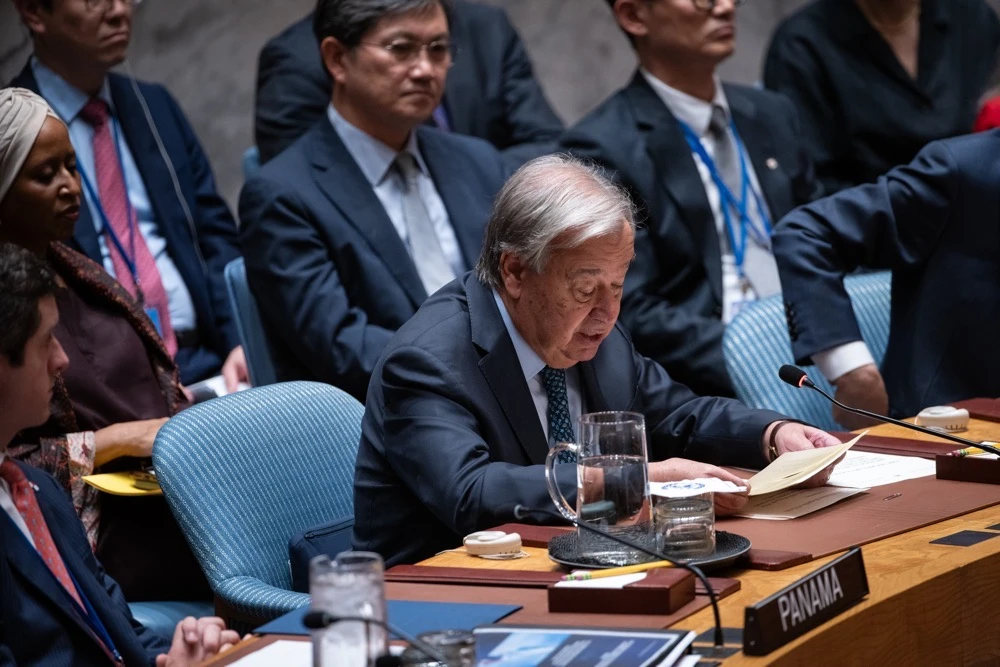
NEW YORK: The world is confronting “one of the darkest chapters of the Israeli-Palestinian conflict,” the UN secretary-general said on Tuesday, warning that nearly two years after the “horrific Hamas terror attacks” of Oct. 7 and the “devastating Israeli military response,” violence has only deepened across the Occupied Territories, posing grave threats to regional and global peace and security.
The Israeli onslaught in Gaza City is compounding an already catastrophic humanitarian crisis, said Antonio Guterres.
“Famine is a reality, with the population constantly forced to move and being starved,” he told a high-level UN Security Council meeting. “To call this situation untenable, and morally and legally indefensible, doesn’t begin to capture the scale of human suffering.”
Impunity prevails “and our collective credibility is being undermined,” he said, adding that violence is spreading from Gaza to the occupied West Bank and beyond, including several countries in the region, most recently Qatar.
“Efforts to secure a ceasefire and hostage release deal — led by Qatar, Egypt and the US — suffered a serious blow on Sept. 9,” Guterres said.
“The Israeli attack (on Doha) wasn’t only a violation of Qatar’s sovereignty and territorial integrity — it also threatened the very norms and mechanisms we rely on for diplomacy and conflict resolution.”
Guterres also warned that the viability of a two-state solution is “steadily eroding,” reaching its “most critical level in more than a generation.”
He added: “Relentless settlement expansion, de facto annexation, forced displacement, cycles of deadly violence — including by extremist settlers — have entrenched an unlawful Israeli occupation and pushed us perilously close to a point of no return.”
Guterres sounded the alarm over Israel’s recent approval of settlement construction in the E1 area which, if implemented, would destroy the contiguity of a Palestinian state. “Israeli settlements aren’t just a political issue — they’re a flagrant violation of international law,” he said.
Meanwhile, the Palestinian Authority is facing an existential crisis, with fiscal, political and institutional pressures severely undermining its ability to function, he added.
Israel’s withholding of tax revenues, the collapse of the Palestinian economy, and a drastic decline in donor aid have left the PA unable to pay salaries or provide basic services, Guterres said.
He emphasized the urgent need for international financial and political support to stabilize the PA and maintain it as a viable partner for peace.
He noted a “glimmer of hope” with the High-Level International Conference for the Peaceful Settlement of the Question of Palestine and the Implementation of the Two-State Solution that took place on Monday, commending France and Saudi Arabia for co-chairing it and helping to revive political momentum.
Guterres welcomed increased international recognition of Palestinian statehood, particularly by France and the UK, calling this the clearest path to achieving a two-state solution based on pre-1967 borders with Jerusalem as the shared capital.
He urged the international community to seize this momentum, stressing that the future of Gaza must be rooted in international law, free of ethnic cleansing and aligned with a political vision for a viable Palestinian state.
He called for an immediate halt to settler expansion, violence and annexation threats, and reiterated the International Court of Justice’s demands for Israel to end its settlement activities and unlawful presence in the Occupied Territories.
Saudi Arabia’s permanent representative to the UN, Abdulaziz Alwasil, described Gaza as “a catastrophic situation that’s deteriorating day by day” due to ongoing military escalation and a prolonged siege.
He said the repeated Israeli aggressions and violations of international law stem from “the lack of accountability and the prevalence of impunity,” which has undermined the credibility of the UN and threatens both regional and global peace and security.
Alwasil criticized the failure of the international community to deter these actions, warning that it risks erasing national sovereignty and deepening the regional conflict.
He called on the UNSC to “shoulder its responsibilities” by enforcing accountability measures against Israel to restore peace and uphold international legitimacy.
He condemned Israel’s continued intransigence and expansionist policies, including violations of the sovereignty of regional countries such as Qatar.
Stressing the urgent need for a just resolution, Alwasil insisted that peace can only be achieved through a comprehensive approach based on the “implementation of a two-state solution and the establishment of an independent Palestinian state along the lines of 1967 with East Jerusalem as its capital.”
Slovenia’s Foreign Minister Tanya Fajon lamented the UNSC’s paralysis and its failure to fulfill its obligations to maintain international peace and security.
She warned that when politicians facing charges for war crimes and crimes against humanity walk free while judges are placed under sanctions, the international community cannot remain silent without becoming complicit through complacency.
Fajon stressed that the breakdown of the rules and obligations underpinning the international system constitutes a direct threat to global peace and security.
“Gaza has become a textbook example of the failure of the international community,” she said. “It has become a place in which people dread the nightfall and fear what a new day will bring.
“Gaza has become the deadliest place for children, the deadliest place for humanitarian and medical workers, the deadliest place for journalists, the place of the first-ever proclaimed famine in the Middle East.
“Marked by continuous offensives and strikes against hospitals, schools, homes, shelters and holy places, it’s defined by death and despair, where hostages suffer and civilians count heartbeats left.”
Tajon told council members that “Gaza is a man-made catastrophe which is live-streamed across the globe and sustained by those acting in contradiction to everything we stand for.”
Danish Foreign Minister Lars Lokke Rasmussen told the UNSC that it is essential that Israel change its course immediately and that the war in Gaza ends.
He emphasized that the council, tasked with maintaining international peace and security, should be able to make this demand as a bare minimum.
“That means all of us, every single member, working in concert and common cause toward this goal. It means setting aside political differences to save lives,” he said.
Rasmussen lamented last week’s US veto, the sixth since the start of the war, on a resolution demanding an immediate ceasefire and the release of Israeli hostages.
Addressing Americans directly, Rasmussen quoted President Donald Trump as saying the war in Gaza needs to be stopped immediately.
“Denmark continues to support the dedicated efforts of the US, Qatar and Egypt to mitigate a ceasefire,” he said.
“Your unwavering commitment to find a path to peace is critical in the context, but we count on you in this council too. Your leadership is critical in our joint aspirations of bringing peace and stability to the region.”
UK Foreign Secretary Yvette Cooper said her country’s “historic recognition” of Palestine is part of acting to protect the viability of the two-state solution as the only path “to a just and lasting peace,” and part of “rejecting extremist ideas on all sides, which involved too often fantasies of the destruction of the State of Israel or expulsion of the Palestinian population.”
Mike Waltz, US permanent representative to the UN, reiterated Washington’s demand that Hamas immediately release all remaining hostages, “cease putting civilians in harm’s way, cease sacrificing their own people for propaganda aims,” and “disarm” and “surrender,” adding: “This war could end today if that happened.”
Waltz said there was no credible Palestinian partner for peace, adding that PA leaders were denied visas to be in New York this week because they “failed to meet their Oslo commitments.”
He said: “The commitments were basic, including renouncing terrorism, renouncing violence, resolving issues through direct negotiations with Israel.
“The Palestinian Authority has failed to clear even those low bars, and their attempts to bypass negotiations through what can only be called lawfare, including at the ICC (International Criminal Court) and at the ICJ, and its pushes for unilateral recognition of statehood … this charade is disappointing. It’s clearly fueled by domestic politics, and has given Hamas a reward for refusing to surrender.”