- Trump “welcomed” the request from Seoul “and he expressed his willingness to be engaged with North Korea again,” says South Korean FM
- The US president and North Korea's Kim Jon Un met three times in 2018 and 2019 as North Korea was building a nuclear weapons stockpile
UNITED NATIONS: South Korea’s president has asked President Donald Trump to become “a peacemaker” and use his leadership to get North Korea to talks to reduce military tensions on the Korean Peninsula, the South’s top diplomat said Friday.
Trump “welcomed” the request from President Lee Jae-myung “and he expressed his willingness to be engaged with North Korea again,” Foreign Minister Cho Hyun said in an interview with The Associated Press. There was no immediate word from the White House.
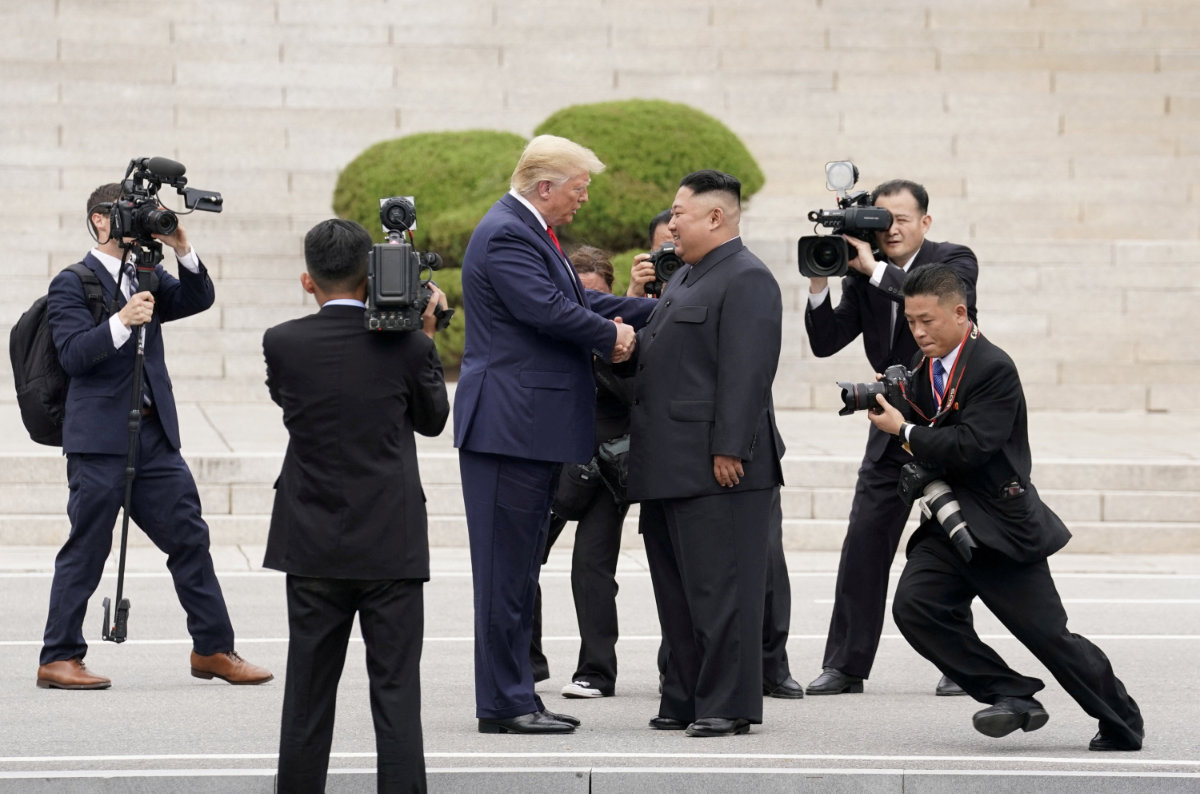
Trump and North Korean leader Kim Jong Un met three times as North Korea was building a nuclear weapons stockpile, which Kim views as key to the country’s security and his continued rule of the northeast Asian country.
There were two summits in Singapore in June 2018, and in Vietnam in February 2019, where Trump and Kim disagreed about US-led sanctions against the North. A third meeting that year at the border between the two Koreas failed to salvage their nuclear talks — and Kim has since shunned any diplomacy with the US and South Korea.
“It would be fantastic if they met with each other in the near future,” Cho said. “And President Lee Jae-myung made it clear to President Trump that he will not be sitting in the driver’s seat. He asked president Trump to become a peacemaker, and he relegated himself to become a pacemaker,” the foreign minister said. “We don’t mind. On the contrary, we want president Trump (to) exercise his leadership to pull North Korea to dialogue table.”
Can a meeting happen?
Since Trump returned to power in January, he has repeatedly expressed hope of restarting talks with Kim. The North Korean leader said Monday he still has “good memories” of Trump but urged the United States to drop its demand that the North surrender its nuclear arms as a precondition for resuming long-stalled diplomacy.
Trump is expected to visit South Korea next month to attend the Asia-PacificEconomic Cooperation summit, which has prompted media speculation that he might meet Kim again at the border. Trump is also expected to meet with Chinese leader Xi Jinping during that meeting.
The foreign minister said Lee asked Trump to take the lead because the world has changed and become “much more precarious” since Russia invaded Ukraine in 2022.
“Accordingly, we are equally worried about any possible military skirmish on the Korean Peninsula,” Cho said. “So we are compelled to explore dialogues with North Korea to reduce the military tension, and at least we want to have a hotline.”
He stressed that denuclearization of the Korean Peninsula “is the imperative – we cannot let it go.”
Tensions between the Koreas continue apace
Early Friday, South Korea’s military said it fired warning shots to drive away a North Korean merchant ship that briefly crossed the disputed western sea boundary between the two countries, amid continuing high tensions.
“I’m not surprised at all,” Cho said, “but this incident justifies the policy of the new government that we need to have a hotline between the militaries, reduce the military tension and build confidence between the two parties.”
Lee, who headed the left-leaning Democratic Party, won a snap election in June following the impeachment of former President Yoon Suk Yeol after his short-lived imposition of martial law in December. Cho, a career diplomat and former UN ambassador, took office as foreign minister on July 19.
In Lee’s speech to the annual meeting of world leaders at the UN General Assembly on Tuesday, he said South Korea has come back to the international community as a normal state after the domestic turmoil and has demonstrated its commitment to democracy.
Cho said he felt “a bit uncomfortable” talking about the previous government compared to the current government, since Yoon was elected. But Cho recalled that when Yoon was elected, he was convinced “he would become an aberration.”
Peace is the priority, the diplomat says
Since becoming foreign minister, Cho said he has been explaining to neighboring countries, including during visits to Japan and China, that the new government “is determined to seek peace on the Korean Peninsula and also in northeast Asia.”
He said the government wants to engage China and he had a “very good constructive meeting” with Foreign Minister Wang Yi, “but I meade it clear that there are certain things we cannot accept.”
Cho referred to China’s installation of “something” in the Yellow Sea that infringes on South Korea’s sovereignty. “So we made it clear that it be removed. Otherwise, we would think about taking proper measures,” he said.
Cho flew to Washington after a massive raid by US immigration officers at a Hyundai plant in southeast Georgia detained 475 people, the majority of them South Koreans, became a major diplomatic issue between the two countries. The minister said Trump intervened and wanted them to remain, but they were chained and handcuffed and his primary objective was to get them back home.
Cho said his talks with Secretary of State Marco Rubio ended up having “a silver lining” because obtaining visas for South Korean workers has been a longstanding problem and “we were able to address this issue squarely and we will be able to sort out the problem.”