



KARACHI: When climate activist Ahmad Shabbar began working in garbage collection a few years ago, he was startled by what he found buried among the city’s waste: hundreds of books, from primers used in schools to novels and encyclopedias, discarded like ordinary trash.
A nuclear physicist from Reed College and a mechanical and energy engineer, Shabbar runs GarbageCAN, a waste management company focused on recycling and sustainability. He said he realized there were tons of books in good condition coming out of the trash, making him feel as if people were “throwing away a treasure of knowledge.”
The realization marked the beginning of a project, one that led him to preserve nearly 4,000 discarded books and transform salvaged materials into a living, breathing library.
“We removed the books from trash and gave them a second home,” he said in a conversation with Arab News, sharing how his efforts culminated this month in the opening of the Second Home Library – The Earth Pod, a community space in Karachi built entirely from recycled and natural materials.

The picture posted on September 17, 2025, books lying on libaray floor in Karachi, Pakistan. (Construct Earth)
The library stands inside the Rana Liaquat Ali Khan School in Karachi’s Shah Faisal Colony, a densely populated working-class neighborhood. The structure’s design mirrors its mission: to reuse, recycle and rethink.
“We figured that because the books have been salvaged, the structure of the library [should] also be constructed with salvaged materials or trash or natural materials,” he said.
Shabbar noted the Second Home Library balances “environmental, financial and structural sustainability,” combining “indigenous wisdom and scientific knowledge, both for climate adaptability and resilience.”
Pakistan is among the countries most vulnerable to climate change, ranking high on the Global Climate Risk Index.
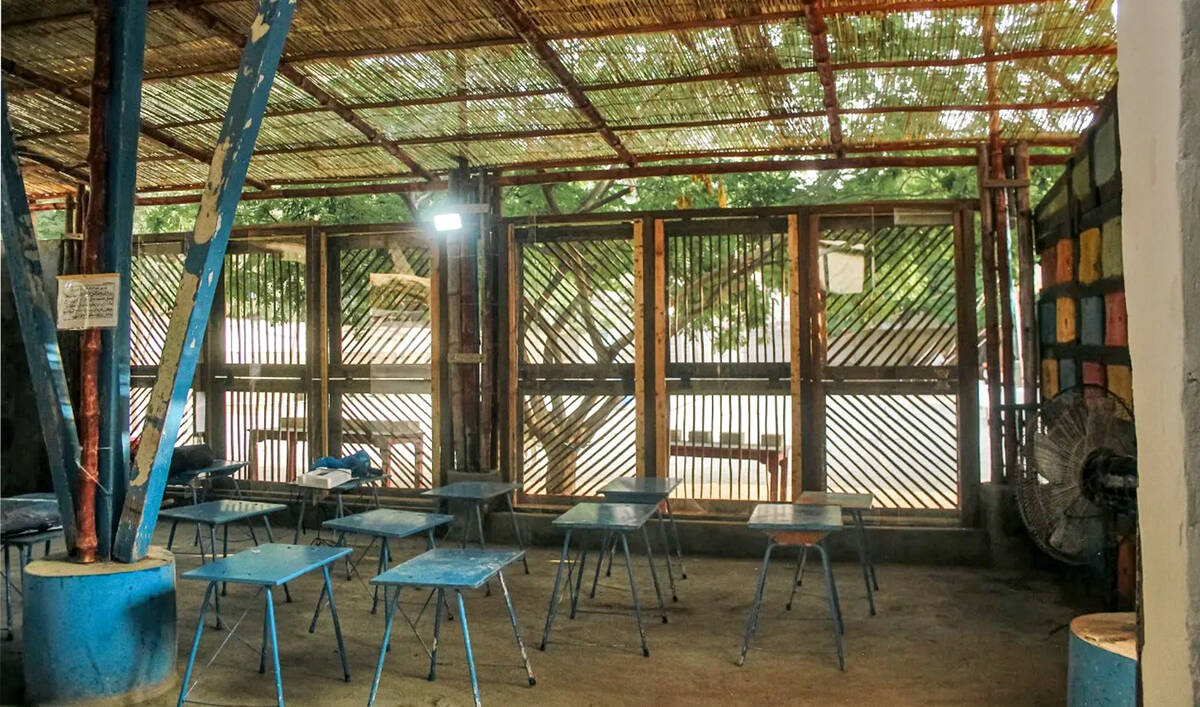
The picture posted in Ovtober 2025, shows interior view of the library. (Iffi via Google Earth)
Its susceptibility to glacial melt, extreme heatwaves and erratic monsoons — underscored by the catastrophic floods in 2022 and again this year — has made climate-resilient infrastructure critical.
“The wall behind you, it's made out of mud,” he said. “It's made out of earth bags. And there's supposed to be a 10 to 15 degrees difference between the outside temperature and the inside temperature just because of that wall.”
“Even the concrete wall integrates plastic bottles and wrappers,” he continued, adding that about 1,600 plastic bottles and 800,000 chip wrappers were used in it.
“Those chip wrappers would otherwise be in the stormwater drains, choking it and causing urban flooding or finding their way to the sea.”
The roof, made of bamboo, features a dual-canopy system with a porous bottom and a waterproof top, shaped like a funnel to enhance natural ventilation.
“Wind can naturally come in and take all the hot air away,” Shabbar said.
Inside, the library’s shelves hold a diverse mix of books — religious texts, Urdu novels, children’s stories, encyclopedias and poetry — all rescued from waste.
For Meerab, an eighth-grade student, the library has opened a new world.
“I really enjoy reading poetry books and writing poetry as well,” she said. “Since the library has opened, I come here and find many poetry books. These books give me a lot of knowledge, and they are also very good.”
Mubeen Ahmad, a ninth-grader with a passion for cricket, spends his reading time with stories and loves exploring world records.
“When it comes to books, I like English books, Urdu stories, novels and sometimes books like the Guinness World Records,” he said.
Ahmad also admired the architecture of the building, saying he found it unique.
Shabbar said he wanted to build the library in an underserved area.
“We figured that this would be the best place,” he said, referring to the vicinity where children are not from privileged families.
“A thousand kids will be utilizing this [facility],” he added. “It will be open for kids who are out of school as well.”




