UN says will ‘take some time’ to scale back Gaza famine

UN says will ‘take some time’ to scale back Gaza famine
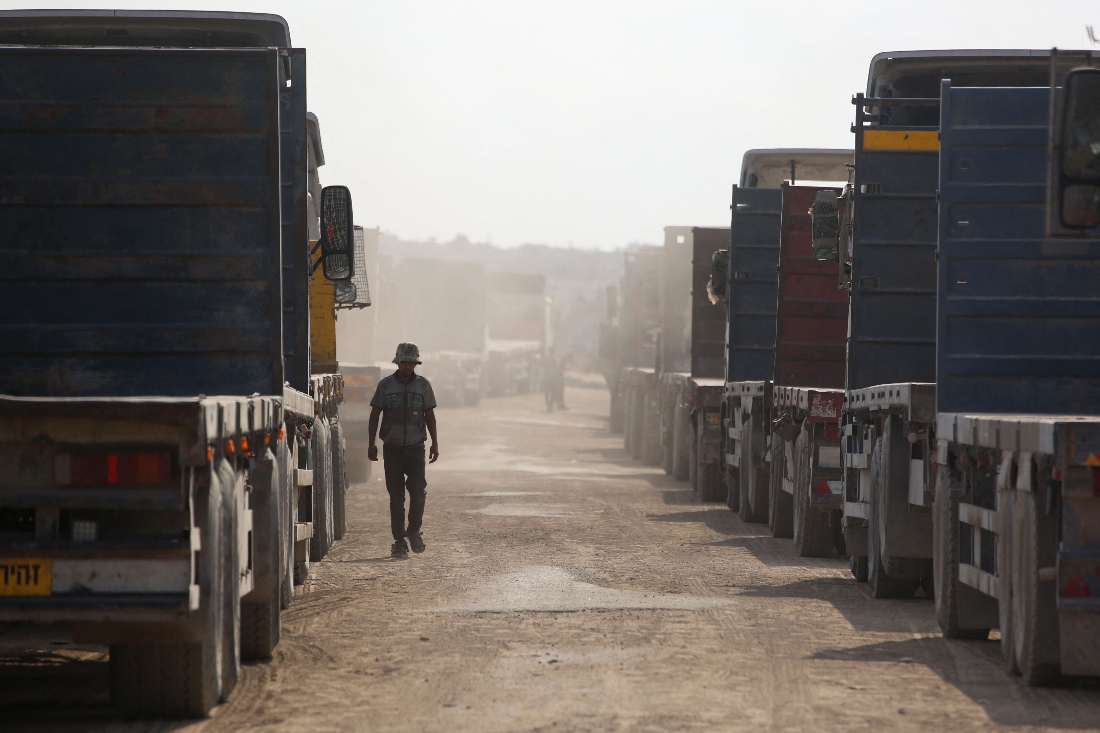
Trucks carrying aid provided by the World Food Programme (WFP) wait at the Kissufim crossing, located east of Deir el-Balah in the central Gaza Strip. (AFP)
Short Url
Updated 17 October 2025
Follow

UN says will ‘take some time’ to scale back Gaza famine

UN says will ‘take some time’ to scale back Gaza famine
  • The UN’s World Food Programme said it had been able to move close to 3,000 tons of food supplies into the war-shattered Palestinian territory since the US brokered ceasefire between Israel and Hamas took hold
  • The spokeswoman said 57 trucks in two convoys, carrying wheat flour and nutrition supplies, crossed in on Thursday and reached WFP’s warehouses intact, ready for distribution

GENEVA: The United Nations cautioned Friday it would take time to reverse the famine in the Gaza Strip, saying all crossings needed to be opened to “flood Gaza with food.”
The UN’s World Food Programme said it had been able to move close to 3,000 tons of food supplies into the war-shattered Palestinian territory since the US-brokered ceasefire between Israel and Hamas took hold.
“It’s going to take some time to scale back the famine” declared by the UN in late August, WFP spokeswoman Abeer Etefa told a media briefing in Geneva.
“The ceasefire has opened a narrow window of opportunity. WFP is moving very quickly and swiftly to scale up food assistance and reach families who have endured months of blockade, displacement and hunger.”
Etefa said WFP had five food distribution points up and running across the Gaza Strip, mostly in the south, but wanted to get to 145.
She said the WFP had been able to use the Kerem Shalom and Kissufim crossings in recent days.
From Saturday until Wednesday, around 230 trucks with 2,800 tons of food supplies crossed into Gaza, said Etefa.
The spokeswoman said 57 trucks in two convoys, carrying wheat flour and nutrition supplies, crossed in on Thursday and reached WFP’s warehouses intact, ready for distribution.
“We’re still below what we need but we’re getting there,” she said.
As of Wednesday, nine bakeries were running, with WFP working on getting 30 going throughout the Gaza Strip.
“Bread is extremely important. The smell of fresh bread in Gaza is more than nourishment: it’s a signal that life is returning,” said Etefa.
She called for all land crossings into the Palestinian territory to be opened up “so that we can flood Gaza with food supplies.”
“The faster we can move aid in, the more lives we can reach quickly,” she added.
WFP is starting its distribution of nutrition supplies in Gaza City.
“We are trying to push back on famine, especially for families returning home in the north of Gaza,” said Etefa.
WFP’s plan is to scale up to reach 1.6 million people inside Gaza over the next three months.
Lebanon warns Israeli violations threaten stability as UN peacekeepers enter final phase of mission

Lebanon warns Israeli violations threaten stability as UN peacekeepers enter final phase of mission
Updated 11 November 2025
Follow

Lebanon warns Israeli violations threaten stability as UN peacekeepers enter final phase of mission

Lebanon warns Israeli violations threaten stability as UN peacekeepers enter final phase of mission
  • UN envoy accuses Israel of jeopardizing ‘hard-won progress’ by undermining Lebanese sovereignty and territorial integrity through airstrikes and border violations
  • He says Lebanon’s army commander has presented to ministers his second progress report on a plan to extend state authority country-wide and limit weapons to state control

NEW YORK CITY: Lebanon has warned that Israeli airstrikes and border violations risk undermining progress toward achieving stability in southern Lebanon, as the UN peacekeeping mission in the country begins preparations for its withdrawal.

Speaking before the UN General Assembly’s Fourth Committee, Lebanon’s permanent representative to the organization, Ahmad Arafa, welcomed the recent renewal of the UN Interim Force in Lebanon’s mandate under Security Council Resolution 2790. This authorized the extension of the force’s operations until Dec. 31, 2026, followed by an “orderly, safe and coordinated” drawdown within a year.

“The Lebanese Armed Forces have been working tirelessly to ensure full implementation of Resolution 1701,” Arafa said, referring to the 2006 resolution that ended the war that year between Israel and Hezbollah.

It calls for the disarmament of all militias in Lebanon, including Hezbollah. The US has consistently pressured Lebanese authorities to disarm the group, designating it a terrorist organization.

The November 2024 ceasefire deal with Israel also requires Lebanon to disarm Hezbollah and establish a state monopoly on arms. The agreement states that only state security forces should bear arms, which is interpreted by Israel and others as requiring the full disarmament of Hezbollah. The group insists it applies only to southern Lebanon.

Arafa said the commander of the Lebanese army has presented to the Council of Ministers his second progress report on a plan to extend state authority throughout the country and confine possession of weapons to legitimate state institutions.

However, he accused Israel of jeopardizing the “hard-won progress” that has been made, through what he described as ongoing violations of Lebanon’s sovereignty and territorial integrity, including airstrikes, the continued occupation of Lebanese territory, and the creation of “so-called buffer zones.”

UNIFIL spokesperson Dany Ghafri said last week that Israel had carried out more than 7,000 airspace violations since the cessation of hostilities in November last year, Arafa noted. UNIFIL has warned that the airstrikes breach Resolution 1701, “threaten the safety of civilians, and undermine progress toward a political and diplomatic solution,” he added

Lebanon also condemned Israeli attacks on UNIFIL personnel and positions, describing them as “a blatant violation of international law.”

Arafa expressed gratitude to the leadership of the UN force, and the countries that contribute troops, for their “dedication and sacrifice” since the mission was established in 1978. He called for the avoidance of any “security vacuum” during the upcoming transitional period, while maintaining stability and respect for Lebanon’s sovereignty.