Biden calls these ‘dark days’ as he urges Americans to ‘get back up’

Biden calls these ‘dark days’ as he urges Americans to ‘get back up’
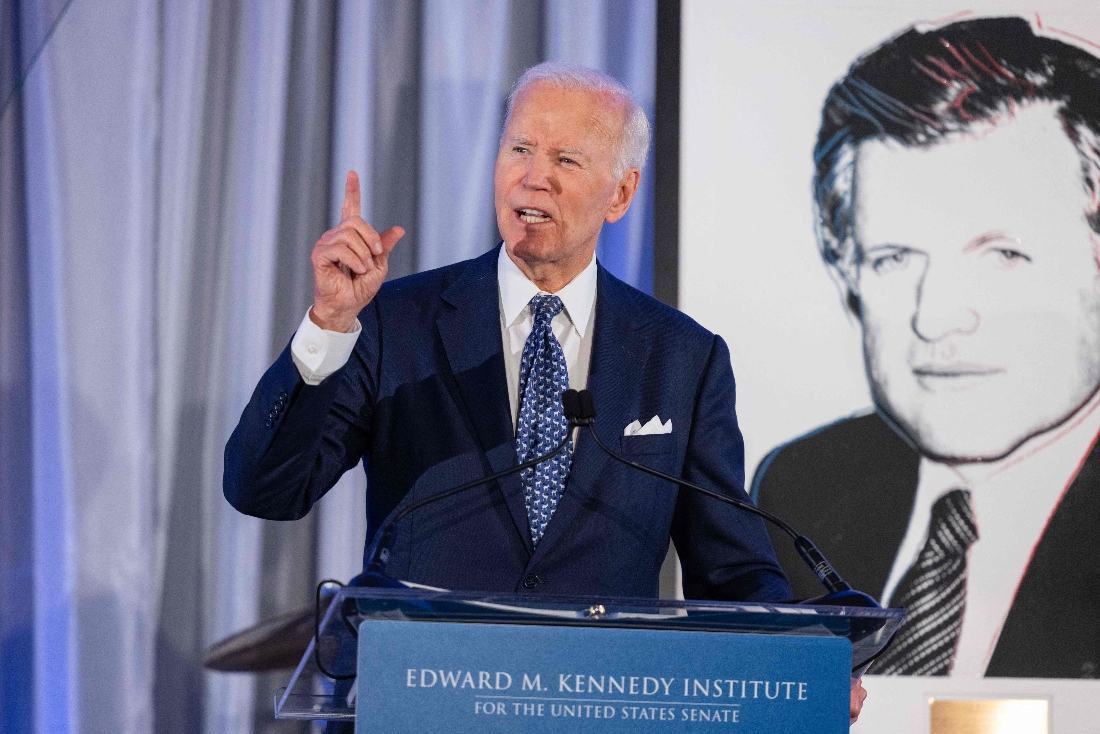
Former U.S. President Joe Biden delivers remarks during the Edward Kennedy Institute's 10th anniversary celebration at the Edward Kennedy Institute in Boston, Massachusetts. (AFP)
Short Url
Updated 27 October 2025
Follow

Biden calls these ‘dark days’ as he urges Americans to ‘get back up’

Biden calls these ‘dark days’ as he urges Americans to ‘get back up’
  • Biden, 82, speaking publicly for the first time since completing a round of radiation therapy for an aggressive form of prostate cancer, addressed an audience in Boston on Sunday night after receiving the Lifetime Achievement Award
  • “Friends, I can’t sugar coat any of this. These are dark days” Biden said before predicting the country would “find our true compass again”

Former President Joe Biden called these “dark days” as he urged Americans to stay optimistic and not to check out in response to what he says are attacks on free speech and tests on the limits of executive power by President Donald Trump.
“Since its founding, America served as a beacon for the most powerful idea ever in government in the history of the world,” Biden said. “The idea is stronger than any army. We’re more powerful than a dictator.”
Biden, 82, speaking publicly for the first time since completing a round of radiation therapy for an aggressive form of prostate cancer, addressed an audience in Boston on Sunday night after receiving the Lifetime Achievement Award from the Edward M. Kennedy Institute.
He said America depends on a presidency with limited power, a functioning Congress and an autonomous judiciary. With the federal government facing its second-longest shutdown on record, Trump has used the funding laps as way to exercise new command over the government.
“Friends, I can’t sugar coat any of this. These are dark days” Biden said before predicting the country would “find our true compass again” and “emerge as we always have — stronger, wiser and more resilient, more just, so long as we keep the faith.”
Biden listed examples of people who are standing their ground against threats from the current administration, citing the example of federal employees who resign in protest, and universities and comedians that have been targeted by Trump.
“The late night hosts continue to shine a light on free speech knowing their careers are on the line,” he said.
Biden also shouted out elected Republican officials who vote or openly go against the Trump administration.
“America is not a fairy tale,” he said. “For 250 years, it’s been a constant push and pull, an existential struggle between peril and possibility.”
He finished the speech by telling people to “get back up.”
The Democrat left office in January after serving one term in the White House. Biden dropped his bid for reelection after facing pressure following a disastrous debate against Trump and concerns about his age, health and mental fitness. Vice President Kamala Harris launched her bid right after, but lost to Trump last November.
In May, Biden’s post presidential office announced that he had been diagnosed with prostate cancer and that it had spread to his bones.
Prostate cancers are graded for aggressiveness using what is known as a Gleason score. The scores range from 6 to 10, with 8, 9 and 10 prostate cancers behaving more aggressively. Biden’s office said his score was 9.
Russia’s Kaliningrad puts on brave face as isolation bites

Russia’s Kaliningrad puts on brave face as isolation bites
Updated 09 November 2025
Follow

Russia’s Kaliningrad puts on brave face as isolation bites

Russia’s Kaliningrad puts on brave face as isolation bites
  • The Baltic states surrounding Kaliningrad, all NATO members, have been some of Ukraine’s staunchest backers since Moscow launched its offensive in February 2022

KALININGRAD: Standing in the center of rainy Kaliningrad, the isolated Russian exclave surrounded by NATO countries, Russian factory worker Alexander felt confident.
Economically hit by being cut-off from its EU neighbors and physically isolated from the rest of Russia, officials and locals are putting on a brave face amid claims they are under siege from neighbors Poland and Lithuania.
The Baltic states surrounding Kaliningrad, all NATO members, have been some of Ukraine’s staunchest backers since Moscow launched its offensive in February 2022.
Poland and Lithuania “want to show off, display their strength, reinforce their borders,” said Alexander, 25, who did not give his surname.
But his city is “certainly not one that surrenders,” he added, taking pride that Russia had far more weapons than its smaller neighbors.
His defiance echoes the Kremlin’s relentless criticism of NATO.
Russian leader Vladimir Putin has for years accused the military alliance of breaking an apparent promise not to expand eastwards.
In June, he said Russians had been “tricked, duped on the subject of NATO’s non-expansion.”
Ukraine and the West reject that narrative as a pretext advanced by Putin to justify the offensive, which has become Europe’s largest conflict since World War II.
In Russia’s neighbors, the intensity of the confrontation is palpable.
Poland and Lithuania, which have a land border with Kaliningrad, have virtually closed their borders for Russians, bar limited exceptions.
In recent weeks, Estonia and Lithuania have reported Russian jets violating their airspace.
And Poland’s new president Karol Nawrocki said he believed Russia was “ready to hit at other countries” after NATO scrambled jets to shoot down Russian drones flying through Polish airspace.

‘Let them bark’ 

Kaliningrad — a previously German city called Konigsberg until it became Soviet after WWII — is strategic for Moscow.
It is home to Russia’s Baltic Fleet, as well as Iskander ballistic missiles, the same kind that Moscow regularly fires on Ukraine.
The region’s governor did not respond to an AFP request for an interview.
The Kremlin’s hard-line messages run deep with many.
Marina, a 63 year-old who works in a clothes shop, mocked the region’s EU neighbors, saying they should focus on their own problems.
“Let them bark,” she said. “I am 100 percent protected in Kaliningrad. I am not scared of NATO.”
Showing Russian tourists round the tomb of philosopher Immanuel Kant, guide Anna Dmitrik was relieved that Kaliningrad had not been targeted by the Ukrainian retaliatory drone attacks that have hit many other regions.
“It’s calm here. We are not scared for now,” she said, adding: “I don’t know what will happen next.”
Still, reminders of the war are everywhere.
Banners encouraged men to sign up to fight in Ukraine for Russia’s “victorious army.” Giant Zs — the symbol of Moscow’s forces in Ukraine — decorated buildings.

‘Life was better then’ 

But behind the defiance, Kaliningrad’s locals struggled with the feeling of being more isolated, and worse off, than before February 2022.
Banned from EU airspace, planes connecting the exclave to the rest of Russia must take a long detour northwards via the Gulf of Finland.
A train linking it to Moscow is physically sealed as it crosses Lithuania, with Russian passengers requiring a visa or transit permit to board.
And Vilnius has closed its border with key Russian ally Belarus for at least a month over the intrusion of balloons carrying thousands of illegal cigarettes into the EU state.
Before “you could go to Poland to shop or just take a walk. Buses and trucks were running,” said mechanic Vitaly Tsypliankov, 48.
“Life was better then,” he added.
“Now everything is closed. Everything is more expensive, absolutely everything has become costlier.”
Inflation has surged across Russia amid the Ukraine offensive, but complicated logistics hit Kaliningrad especially hard.
While Poland’s border is technically open, only Russians with EU residency can enter. Traffic into the country has virtually stopped.
Most petrol stations near the border are empty if not shut down.
The giant Baltia shopping mall, on the road to the airport, is sparsely frequented.
“Kaliningrad’s economic situation is very bad,” said Irina, a saleswoman there.
“Logistics are very complicated to bring in products from (the rest of) Russia,” she said, puffing on a cigarette.
“Everything is more expensive.”