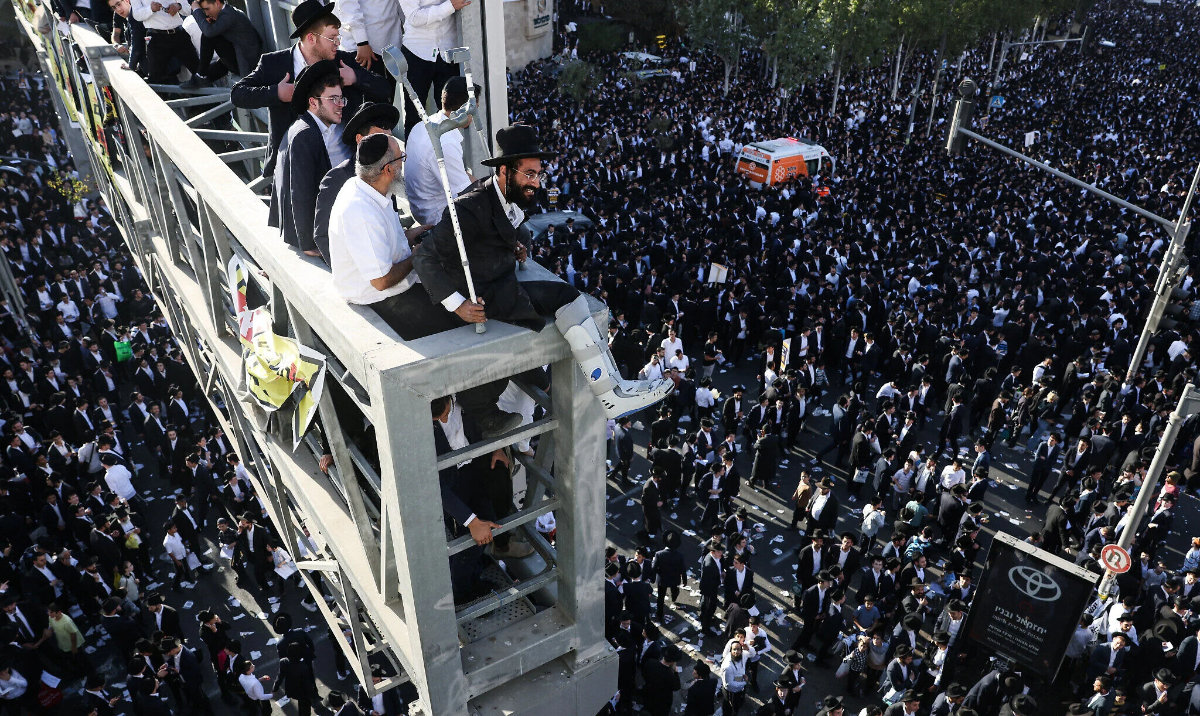

There is hardly a more contentious issue in Israeli society than military service, or more accurately, the draft dodging by Haredi, or ultra-Orthodox, youth. The vitriol has increased over the last two years since Israel has been engaged in multifront wars.
For many decades now politicians have been doing what they do best — resolving the unfair exemption of enlisting Haredi youth by kicking the can down the road. What started with exempting 400 yeshiva, or rabbinical seminar, scholars to allow them to focus on becoming the future generation of religious leaders in their communities has become a route for all youth from this community to evade compulsory military service for most 18-year-olds, which means three years for men and two years for women.
Two more recent developments have heightened the urgency of the question of enlisting ultra-Orthodox youth: one legal, the other practical. Legally, the clause in the Law for Security Service, which granted blanket military service exemptions for ultra-Orthodox yeshiva students, expired in mid-2023, and the following year, the High Court ruled that the government was, therefore, obligated to begin drafting them, as continuing their exemption was unlawful.
Last month, the High Court expressed its extreme discontent with the government and the Knesset for failing to guarantee equality in military service for all young men and women, as they had been requested to do. Hence, it ordered the government to take, within 45 days, effective enforcement measures, without shying away from criminal proceedings against ultra-Orthodox yeshiva students who have refused to comply with Israeli military conscription orders. The judges made it clear that any further procrastination by the government in taking such measures violated the law.
The other source of the urgent need to mobilize more ultra-Orthodox for military service derives from Israel’s involvement in a multifront war for more than two years, both close and far from home. The Israeli military relies mainly on conscripts and reserve soldiers, and the past two years have taken their toll on these citizens. About 1,000 soldiers have been killed in Gaza and Lebanon, thousands of others have been injured, and many have post-traumatic stress disorder, while the mental strain, in addition to the physical one, has left many exhausted.
The immense impact on reserve soldiers serving up to 400 days over the past two years is felt keenly by themselves and their families. There is also a severe impact on professional lives, on those who missed full academic terms at universities, and on personal relations. Consequently, those who serve and their families are at the forefront of demanding equality in the burden of military service. It is estimated that currently there are about 80,000 ultra-Orthodox men aged between 18 and 24 who are eligible for military service but who have not been enlisted.
Ultra-Orthodox women, unlike secular women, are automatically exempted. The Israeli military has repeatedly argued that it urgently needs 12,000 new recruits to relieve some of the accumulated strain on standing and reserve forces, but the politicians in the current coalition government have other ideas to preserve their time in power.
The survival and stability of the current coalition government also depend on the two ultra-Orthodox parties: United Torah Judaism, representing the Ashkenazi Haredi, and Shas, representing the Sephardi Haredi. These parties’ positions are dictated by their rabbis, who are not elected members of the Knesset; they are dead against drafting their youth, and are prepared to make only minimal concessions on the matter. Their inherent fear is that those who serve will adopt a secular, or at least less ultra-Orthodox, way of life in the army. Their only reason to accept any concession is the threat that if the High Court finds the new legislation fails to meet the minimum bar of equality, it will order the continuation of the suspension of many benefits that only the Haredi communities can access.
The Israeli military relies mainly on conscripts and reserve soldiers.
Yossi Mekelberg
Unlike their fellow students at universities, yeshiva students are granted a range of benefits, including day-care subsidies, stipends for each student, discounts on National Insurance Institute payments, housing subsidies, and property tax discounts. Since their studies are hardly conducive to preparing them to work in a modern economy, their contribution to the economy is a fraction of that of the rest of society, which infuriates the latter.
Emotions are running high in the Knesset and throughout the country since attempts to legislate a new bill are about politics, not military needs or equality, which will only perpetuate unfairness and inequality. Unequal military service is an open wound in Israeli society, leaving some youth paying at a young age with their life or health at the behest of their country, while others are protected by their representatives in the Knesset, who are blackmailing a prime minister desperate to stop his corruption trial, by keeping him in power indefinitely as he becomes increasingly authoritarian and erratic.
What further infuriates those who serve in the military is that, unlike the early days of the Jewish state, the ultra-Orthodox parties have veered to the right, turning hawkish and supporting the stalling of any possibility of a two-state solution with the Palestinians. In other words, they have become a significant cog in the machine that perpetuates war and conflict — so long as it is someone else’s blood that is spilt.
Those who have lost any shame also have the audacity to claim that their sacrifice and contribution to the country by spending all their time studying the Jewish scriptures is greater and more meaningful than that of those who serve in the army. Beyond the insolence of this stand, it is also a reflection of their detachment, much of it intentional, from the rest of Israeli society.
For the first time in many years, enlisting ultra-Orthodox youth is not entirely an issue for opponents of the coalition, and there are members of the coalition who also oppose any legislation that would fail to establish equality in military service. The court opened the door for the legislature to resolve one of the most profound schisms in Israeli society.
However, there are too many in the current coalition, first and foremost Prime Minister Benjamin Netanyahu, who would rather act to preserve their short-term vested interests than take a bold decision to ensure that all young people are treated equally, without discrimination, and according to the law when it comes to military service. Failure to do that will continue to haunt Israeli society and future Israeli governments.
• Yossi Mekelberg is professor of international relations and an associate fellow of the MENA Program at Chatham House.
X: @YMekelberg