

Iran’s famed “forward defense” strategy appears to be backfiring. That strategy was meant to shield its territory from attack by moving the potential battlefields away from its borders. However, some of Tehran’s so-called forward allies are today either gone or seriously weakened, while its home front is burning and the economy is in shambles.
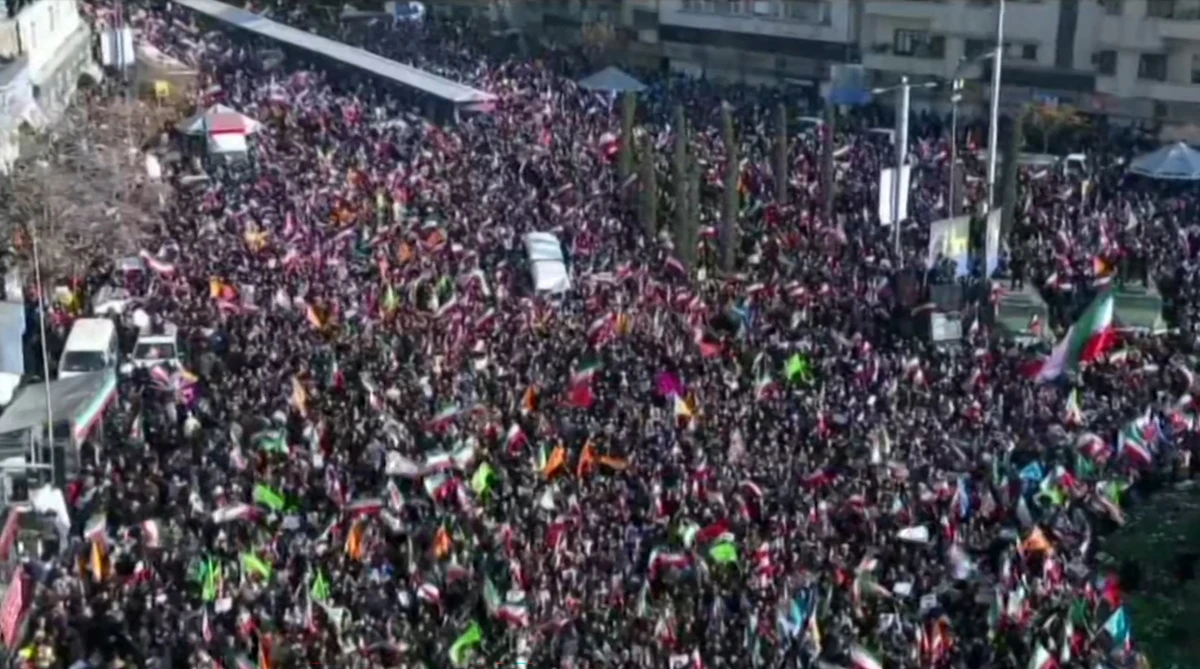
Protests are now sweeping the country, more widespread and violent than other waves seen since 1979. Thousands of protesters and security forces have been killed in bloody confrontations engulfing places far and wide, such as Ahvaz, Arak, Dargahan, Farsan, Fasa, Fuladshahr, Hamadan, Isfahan, Izeh, Kermanshah, Mashhad, Marlik, Najafabad, Nurabad, Qeshm, Qom, Shiraz, Sari, Tehran and others.
Iran has consistently been lowly ranked in international comparisons when it comes to peace and security at home. The Global Peace Index has for some time placed the country in its least peaceful tier, with the most recent edition placing it 142nd out of 163 countries, reflecting a significant deterioration in its scores since 2020 and making it one of the most volatile nations in the world.
Forward defense has cost Iran dearly in economic terms. Militarizing the economy and prioritizing foreign adventures have seriously damaged the country’s economic potential. In 1978, the year before the February revolution, its economy was comparable to that of Saudi Arabia, its peer competitor at the time. Iran’s gross domestic product was estimated at $78 billion, compared to the Kingdom’s $80 billion. Today, Iran’s GDP is a mere $356 billion, or 28 percent of Saudi Arabia’s $1.3 trillion, according to International Monetary Fund figures. The statistics are even more striking when you compare the two countries’ GDP per capita, with Saudis’ per capita income being almost 10 times that of Iranians. Between 18 and 28 million Iranians, depending on data sources, are living below the poverty line.
Relying on what it thought to be formidable weapons, Iran had little use for diplomatic, economic or other soft power tools
Dr. Abdel Aziz Aluwaisheg
So, the current protests should not be surprising when you consider the worsening living conditions in Iran, tightening sanctions and declining confidence in the country’s ability to defend itself against external attacks or deal with a changing regional and international environment, in which Iran appears to be on the losing side.
Iran’s forward defense strategy was meant to project its power beyond its borders, deter threats and prevent attacks on Iranian soil, using proxies in other countries, advanced missiles and drones, and cyberwarfare to create greater strategic depth and keep war away from its lands.
For some time, that strategy worked. After the so-called Arab Spring, Iranian officials beamed with satisfaction that they were in control of four Arab capitals. Tehran succeeded in making Hezbollah in Lebanon a powerbroker, while lethal military forces engaged throughout the region in serving Iran’s interests.
It propped up Syria’s Assad regime, which in exchange swore blind allegiance to Iran’s interests. In Yemen, it backed the Houthi militia, which staged a successful coup against the democratically elected and internationally recognized government. The Houthis were used later to disrupt international trade in the Red Sea between 2023 and 2025. In other places, Tehran armed and funded nonstate groups to undermine its perceived adversaries.
Iran amassed an impressive missile and drone arsenal. Ballistic missiles and drones served as key deterrents and power projection tools, capable of striking regional targets, including in Saudi Arabia and the UAE. Naval capabilities were also extended beyond the Gulf to the Arabian Sea, Red Sea and Indian Ocean, allowing it to reach targets thousands of miles from its borders.
Starting with its neighbors, Tehran should prioritize diplomacy and eschew the use of force in reshaping its regional ties
Dr. Abdel Aziz Aluwaisheg
Iran developed advanced cyberwarfare capabilities as part of its asymmetric toolkit, which it employed against its adversaries, including its neighbors in the Gulf and far beyond.
Relying on what it thought to be formidable weapons, Iran had little use for diplomatic, economic or other soft power tools. Its neighbors were frequently on the receiving end of attacks from Iran directly or through proxies. Beyond its neighborhood, it also adopted an uncompromising attitude toward other nations and was often defiant with the international community. One case in point is its dealings with the International Atomic Energy Agency. With so many antagonists, Iran became isolated, often labeled by its adversaries as a pariah or rogue state.
Some of its early successes proved to be Pyrrhic. In December 2024, the Syrian people got rid of the Assad regime, depriving Iran of one of its most important bases for forward defense. Iran lost another proxy when Hezbollah was decimated by Israel. The group is now being challenged by the Lebanese government to disarm.
Another forward defense pillar crumbled during Iran’s long-distance missile warfare with Israel. In the first direct war with its sworn enemy, Iran appeared too weak to inflict as much damage on Israeli military targets as it had long promised.
Last year’s 12-day Iran-Israel war exposed the fatal weakness of its forward defense doctrine. Israel, supported by the US, brought the battle to Iranian territory and was able to expose its vulnerability.
If Iran can get out of its current crisis, it should pursue a strategy other than forward defense. Starting with its neighbors, which have offered it a grand bargain, Tehran should prioritize diplomacy and eschew the use of force in reshaping its regional ties. Should it agree to live by the international norms that govern relations between nations, the Gulf countries are ready to normalize relations with Iran and integrate it within the regional economic and social fabric. That should not be difficult, because it was the state of affairs between the two shores of the Gulf for thousands of years. Iran could again become an important economic and cultural link between West and Central Asia, for example, as it was over the centuries.
- Dr. Abdel Aziz Aluwaisheg is the GCC assistant secretary-general for political affairs and negotiation. The views expressed here are personal and do not necessarily represent those of the GCC. X: @abuhamad1


