
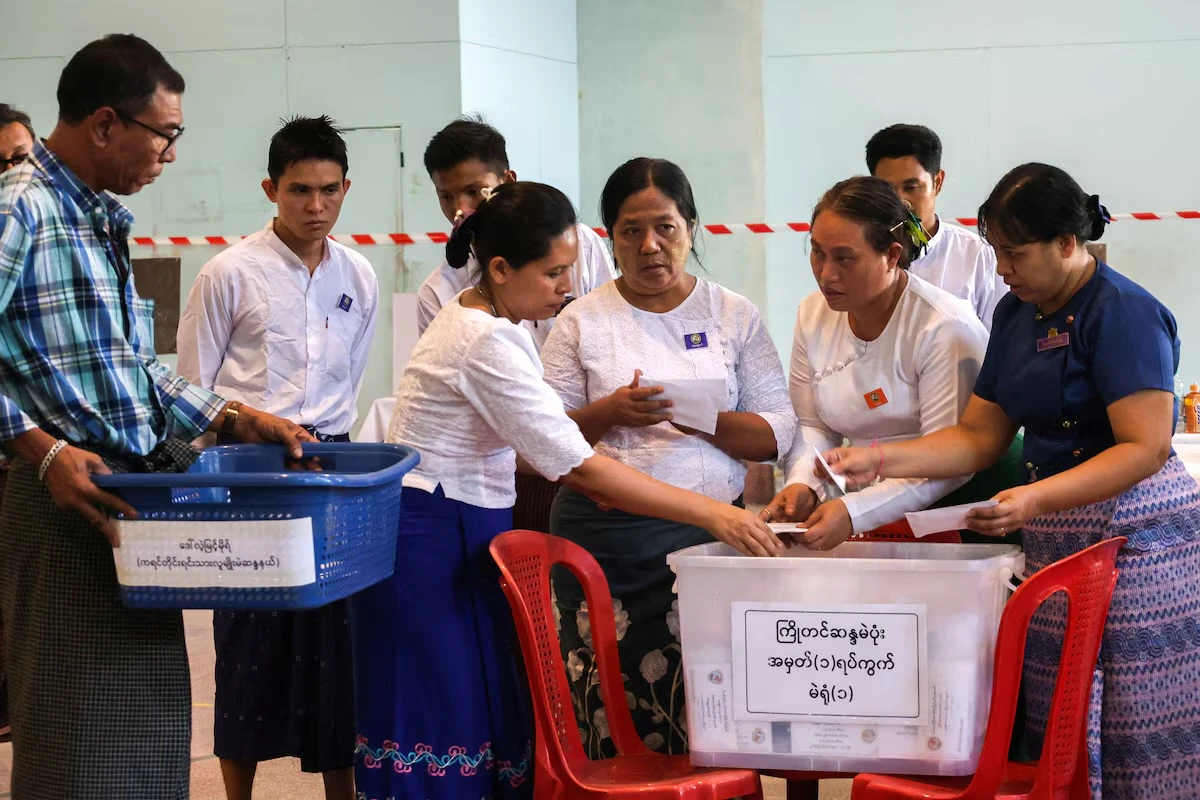

Myanmar’s announcement that it will hold by-elections in 55 constituencies next April appears, at first glance, to be a relatively minor electoral development. The seats include 34 in the lower house, five in the upper house and 16 in state or regional legislatures. The vote will also take place in areas that could not participate in the previous election because of conflict, including at least seven towns recently recaptured by the military.
The results are unlikely to transform parliament. The military-backed Union Solidarity and Development Party and its allies already dominate the legislature after winning nearly 90 percent of seats in January’s general election. That is precisely why the April 2027 vote matters for reasons that have relatively little to do with who wins.
In a fragmented civil war, an election can do more than choose representatives. It can become an instrument for turning military control into political sovereignty.
There are three different forms of control at stake in a conflict such as Myanmar’s. The first is coercive control: can an armed force enter and hold a town. The second is administrative control: Can it reopen government offices, register residents, secure roads and make institutions function. The third is political legitimacy: Do people accept the authority claiming the right to govern them?
An election can do more than choose representatives. It can become an instrument for turning military control into political sovereignty
Dr. Azeem Ibrahim
Military victory establishes only the first. Elections can help governments attempt to move from the first toward the other two.
Organizing a ballot requires much more than placing boxes in polling stations. Authorities must define constituencies, compile voter lists, appoint officials, move electoral materials, enforce rules and demonstrate that bureaucratic institutions can operate. Each of those apparently mundane activities is also an assertion of sovereignty. They determine which authority records the population, which laws apply and which institutions have the right to organize political life.
In stable democracies, these functions are so routine that their political significance is easy to overlook. In contested territory, they are anything but routine.
This is what makes Myanmar’s planned by-elections particularly interesting. Several constituencies are located in areas where the military has only recently restored control, while fighting continues in other areas scheduled to vote. The ballot therefore becomes more than an electoral exercise. It becomes a declaration that these territories have returned to the administrative map of the state.
For Myanmar’s authorities, expanding voting into areas previously excluded by conflict can support a broader narrative
Dr. Azeem Ibrahim
The sequencing is important. Military forces recapture territory. Civil administration follows. Elections then provide institutions, representatives and the appearance of normal political life. In that sense, the ballot can help consolidate battlefield gains.
That does not mean the election will confer genuine democratic legitimacy. Myanmar’s political environment makes such a conclusion extremely difficult. Major opposition forces reject the process. Aung San Suu Kyi’s National League for Democracy was dissolved after rejecting the military-designed electoral framework. The January election took place in only 263 of Myanmar’s 330 townships because insecurity prevented voting elsewhere.
There is therefore an essential distinction between electoral presence and political consent. A government may be capable of opening polling stations without persuading the population that the political order behind them is legitimate. Turnout in recently contested territory may tell us little about genuine public support. Opposition parties may be absent because meaningful political competition is impossible. Heavy security around polling stations may demonstrate state capacity while simultaneously revealing the limits of public consent.
This distinction matters because governments emerging from conflict have strong incentives to convert control into normality as quickly as possible.
A town shown on a battlefield map one year can appear on an electoral map the next. Once it possesses polling stations, representatives and functioning administrative routines, outsiders may gradually begin treating it less as contested territory and more as part of an operating state. Elections therefore have an external audience as well as a domestic one.
For Myanmar’s authorities, expanding voting into areas previously excluded by conflict can support a broader narrative that territory is being stabilized, institutions are returning and political life is normalizing. This matters at a time when Naypyitaw is seeking greater regional engagement, investment and international acceptance.
Foreign governments should consequently be careful about what they infer from the ability to conduct an election. Holding a vote may demonstrate administrative reach. It does not necessarily demonstrate democratic legitimacy. Confusing those two things risks allowing the machinery of elections to substitute for evidence of genuine political consent.
The lesson also applies to Myanmar’s resistance. Armed organizations have understandably concentrated on seizing and defending territory. But prolonged civil wars are not ultimately decided only by who controls military positions. They are also struggles over administration.
Controlling a town means less if another authority can eventually restore schools, registries, courts, taxation, local government and electoral institutions. The deeper contest is over which institutions ordinary people use when they need to educate a child, resolve a dispute, register property or conduct business.
Myanmar therefore demonstrates a broader truth about sovereignty. Sovereignty is not simply something a government possesses. It is something governments continually perform.
A flag over a government building demonstrates possession. Soldiers demonstrate coercive authority. A functioning bureaucracy demonstrates administrative power. An election goes further by claiming that the population itself has been incorporated into the political order.
This is why the April by-elections deserve attention even if they barely change the parliamentary arithmetic. The most important result will not necessarily be the number of seats won by each party. It will be the geographic expansion of places where Myanmar’s authorities believe they can once again perform the functions of normal government.
The ballot box is usually presented as the alternative to the battlefield. In Myanmar, it is becoming part of the struggle over what happens after the battlefield moves on.
Dr. Azeem Ibrahim is the director of special initiatives at the New Lines Institute for Strategy and Policy in Washington.
X: @AzeemIbrahim


