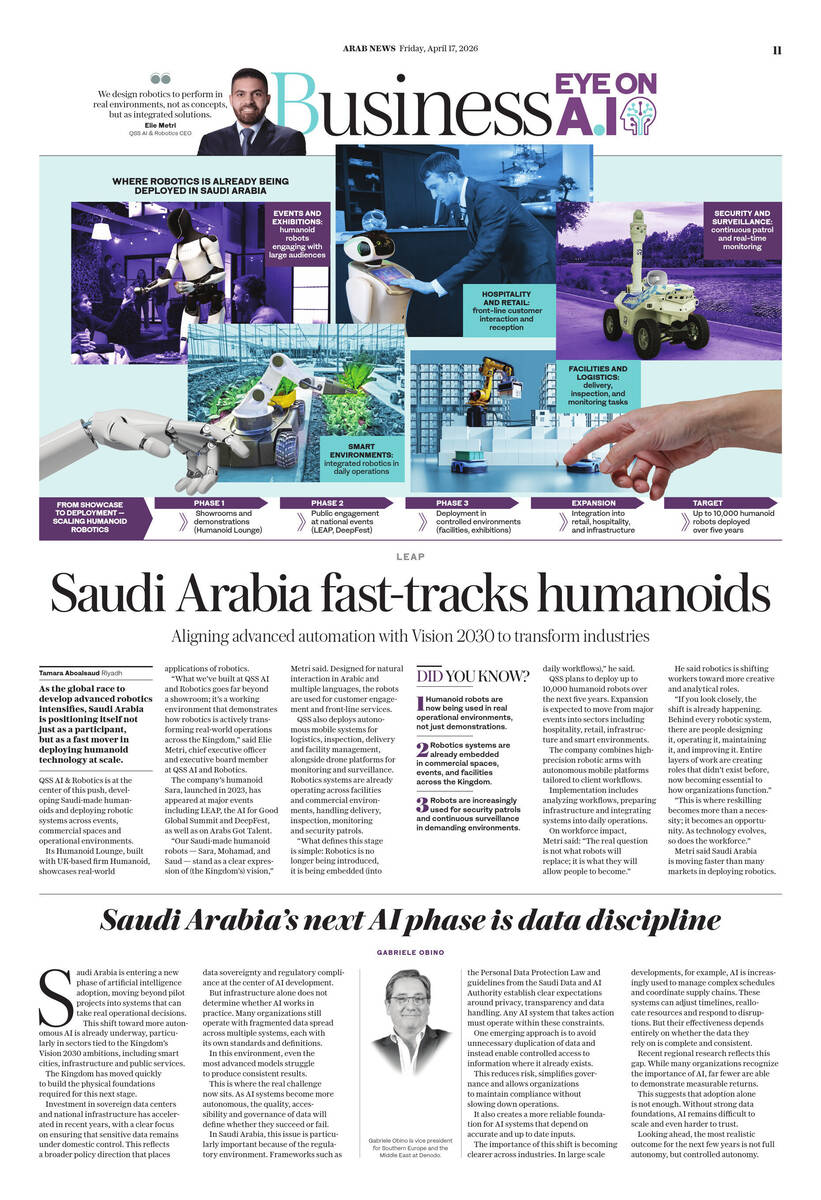
- Aligning advanced automation with Vision 2030 to transform industries
RIYADH: As the global race to develop advanced robotics intensifies, Saudi Arabia is positioning itself not just as a participant, but as a fast mover in deploying humanoid technology at scale.
The Humanoid Lounge, a robotics showroom created by QSS AI and Robotics — a Saudi company specializing in artificial intelligence, robotics, and emerging technologies — in partnership with UK-based firm Humanoid, highlights how this momentum is translating into tangible economic and social impact.
“What we’ve built at QSS AI and Robotics goes far beyond a showroom; it’s a working environment that demonstrates how robotics is actively transforming real-world operations across the Kingdom,” Elie Metri, chief executive officer and executive board member at QSS AI and Robotics, told Arab News.
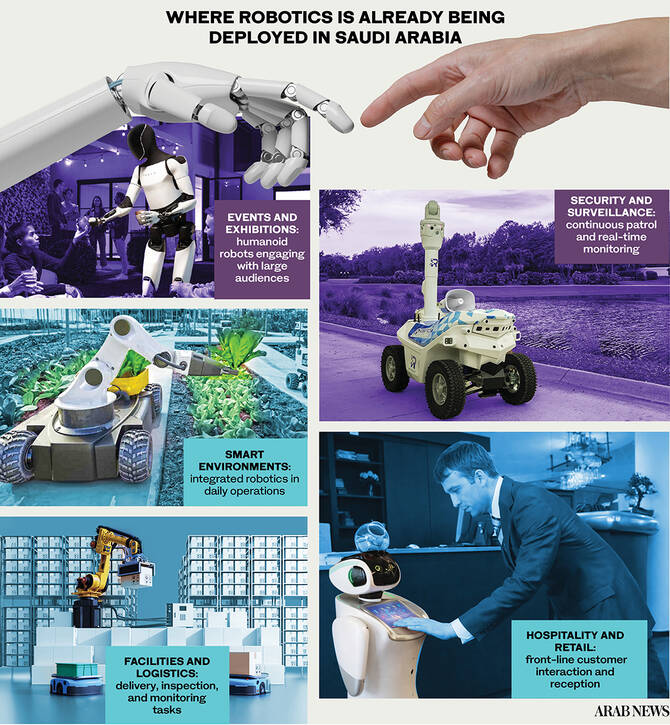
QSS AI and Robotics has established itself as a major contributor to Saudi Arabia’s automation ambitions. The company develops locally built humanoid robots, including Sara, while also deploying integrated robotic systems across major events, commercial venues, and operational settings.
Its partner, Humanoid, contributes global expertise in advanced AI and humanoid technologies, supporting the creation of interactive, human-centric robots designed for customer engagement and service-oriented roles.
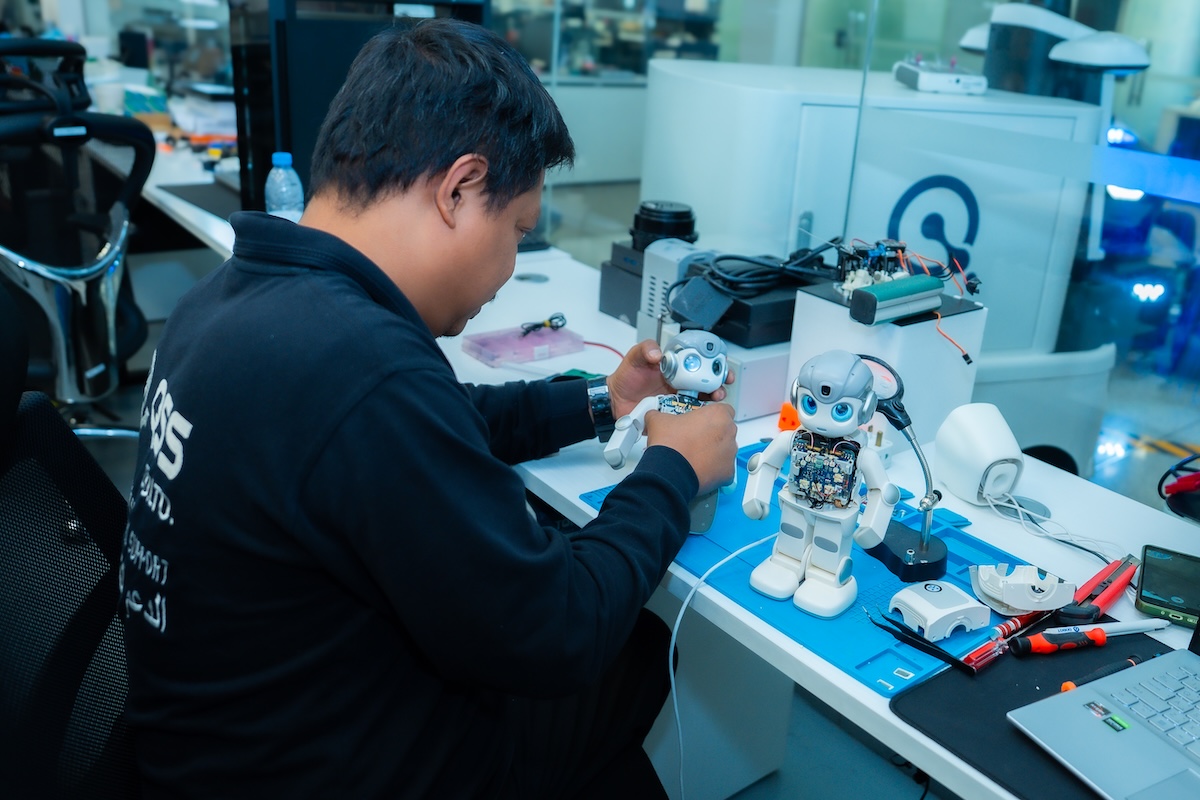
The QSS robotics ecosystem encompasses a wide range of specialized solutions — from service and delivery robots to security, cleaning, and collaborative systems — each tailored to meet the needs of various industries.
Sara, the first Saudi-made humanoid robot, was introduced in early 2023 and has since become a familiar presence at major events such as LEAP, the AI for Good Global Summit, and DeepFest. It has also appeared on the MBC/Shahid broadcast of Arabs Got Talent.
“Our Saudi-made humanoid robots — Sara, Mohamad, and Saud — stand as a clear expression of (the Kingdom’s) vision,” Metri continued.
Designed to communicate naturally in Arabic and multiple languages, these humanoids aim to transform customer engagement, reception, and front-line services, a goal Metri says is already being realized.
Beyond humanoids, the showroom features autonomous mobile systems that bring mobility, awareness, and adaptability into operational environments. These systems support logistics, inspections, facility management, and delivery, integrating seamlessly into everyday workflows.
This capability is further enhanced by QSS’s drone platforms, which provide extended monitoring and surveillance, enabling organizations to operate with greater control and real-time situational awareness.
“What connects all these technologies is a clear philosophy: we design robotics to perform in real environments, not as concepts, but as integrated solutions that deliver measurable results.
“This reflects how we see the future of automation in Saudi Arabia: practical, scalable, and built locally to support the ambitions of Vision 2030,” Metri said.
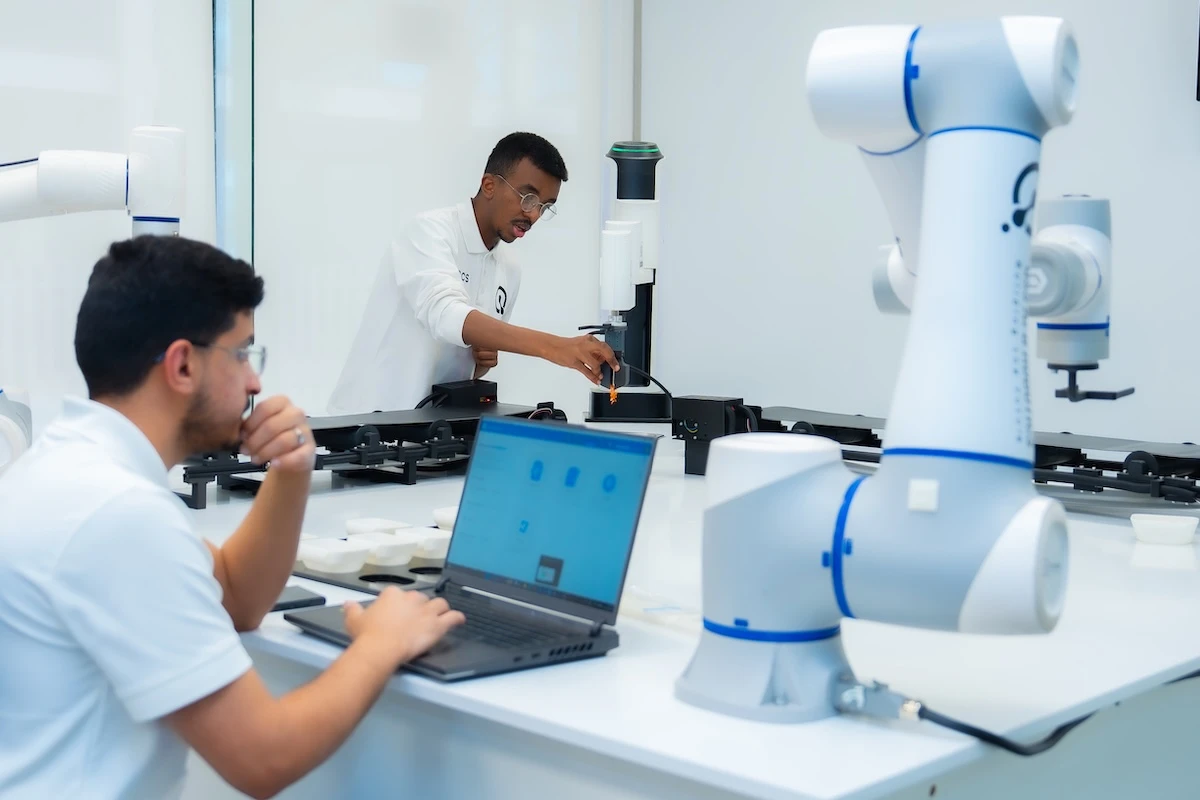
He noted that robotics in the Kingdom are already proving their value daily, pointing to the participation of Sara and Mohamad in major exhibitions and national events, where they actively engage with visitors.
QSS’s autonomous mobile systems are also being deployed across facilities, commercial spaces, and operational environments, performing tasks such as delivery, inspection, monitoring, and ground support.
At the same time, robotic platforms are increasingly used in security and surveillance roles, carrying out patrols and continuous monitoring in environments that require uninterrupted performance.
“What defines this stage is simple: Robotics is no longer being introduced, it is being embedded (into daily workflows),” he said.
During the launch of the Humanoid Lounge, QSS AI and Robotics revealed plans to deploy up to 10,000 humanoid robots over the next five years.
“The deployment is not a projection, it reflects the scale of capability we are building within Saudi Arabia.”
In practice, deployment begins in sectors where Saudi Arabia already excels — large-scale national events, exhibitions, and public platforms where humanoid robots can engage directly with large audiences.
These environments provide ideal conditions for rapid scaling while maintaining consistency and performance. From there, expansion is expected to extend into hospitality, retail, infrastructure, and smart environments, embedding humanoid systems into daily operations where interaction and reliability are essential.
Metri emphasized that this scale is achievable due to a locally developed ecosystem operating under a unified strategy — spanning manufacturing, engineering, deployment, and operations.
“QSS AI and Robotics is positioned to deliver this rollout in a structured and sustainable way over the coming years.”
The company customizes its robots to meet each client’s operational requirements, offering a comprehensive range of solutions.
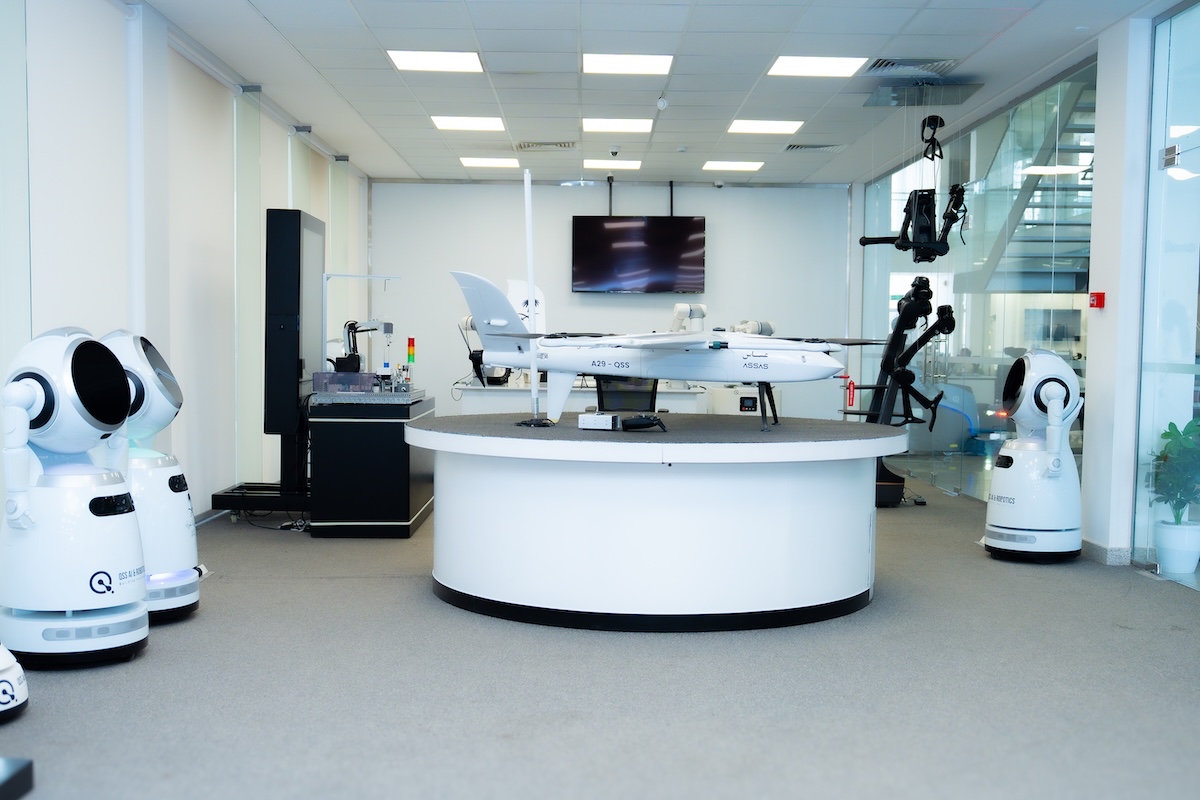
At one end, robotic arms deliver high-precision, repeatable performance for structured processes such as handling, assembly support, and execution tasks.
These systems are engineered for accuracy, consistency, and controlled operation, making them ideal for environments where strict performance standards are required.
Meanwhile, autonomous mobile platforms introduce flexibility and mobility, managing transport, inspections, and facility workflows through advanced navigation, obstacle detection, and real-time path optimization.
The strength lies in combining both approaches — fixed precision where necessary and dynamic movement where adaptability is key.
“This allows us to design solutions that are fully aligned with the client’s workflow, rather than forcing operations to adapt to the technology.”
The implementation process, described as a “complete operational process,” begins with analyzing how an environment functions: how people move, how tasks are performed, and where efficiency can be improved.
From there, the infrastructure is prepared to support reliable navigation, stable connectivity, and seamless performance.
“Whether it’s mapping movement paths or aligning with existing infrastructure, every detail is structured to support consistent operation.”
Each system is then configured according to its role, ensuring it can move, respond, and perform tasks with precision, consistency, and control — transforming it from a passive presence into an active contributor.
The final stage is full integration into daily workflows, allowing robots to operate as part of the team. The result is a system that runs smoothly, adapts to its environment, and maintains long-term performance.
When asked about the broader impact of robotics on the workforce and economy, Metri said:
“The real question is not what robots will replace; it is what they will allow people to become.”
He explained that as robotics becomes more widespread, the shift is less about job loss and more about job transformation.
Repetitive, physically demanding, and time-consuming tasks are increasingly handled by machines, enabling people to focus on roles that require creativity, judgment, and human interaction.
“If you look closely, the shift is already happening. Behind every robotic system, there are people designing it, operating it, maintaining it, and improving it. Entire layers of work are creating roles that didn’t exist before, now becoming essential to how organizations function.”
Metri stressed that robotics is reshaping — not replacing — the human role, allowing individuals to focus on their strengths within a more advanced, collaborative environment.
“This is where reskilling becomes more than a necessity, it becomes an opportunity. As technology evolves, so does the workforce.”
According to Metri, Saudi Arabia is advancing faster than many global markets in turning robotics into operational reality.
“In many markets, robotics is still introduced in phases. In Saudi Arabia, it’s moving faster because everything is aligned. There’s a clear direction, strong support, and a willingness to move from idea to real deployment without hesitation,” he said.
“Saudi Arabia is showing that robotics can move beyond pilots and into real, large-scale deployment, setting a pace that others will follow.”