

The post-Second World War international order rests on a simple premise: governments govern, states exercise sovereignty over their territory and diplomacy is conducted between internationally recognized authorities. That assumption is becoming increasingly detached from reality.
Across the world, modern conflicts are producing de facto authorities that exercise many of the functions of government without international recognition. They administer territory, collect taxes, police communities, operate courts, deliver public services and negotiate with neighboring actors. Yet they remain outside the formal structures of international diplomacy.
The gap between legal recognition and effective governance is emerging as one of the defining challenges of 21st century international relations.
Myanmar may become the first major test of how the international community responds.
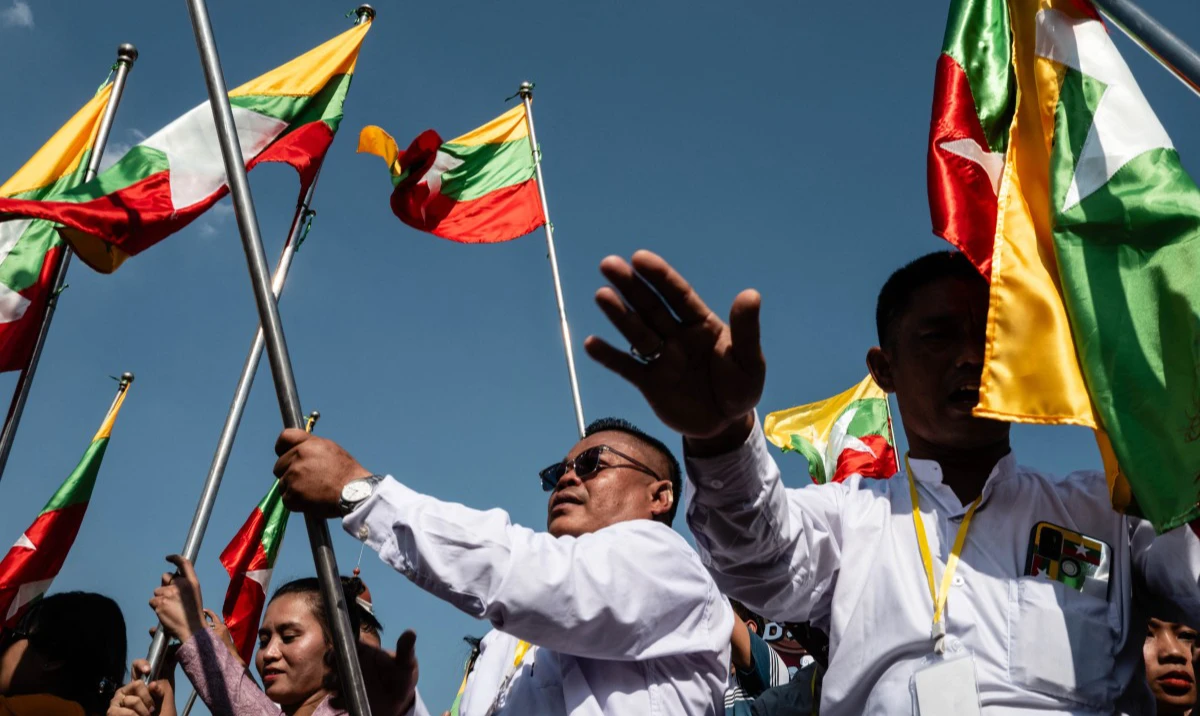
More than four years after the military coup, Myanmar no longer resembles a conventional struggle between a government and an opposition. The conflict has evolved into a fragmented political landscape in which different actors exercise varying degrees of authority across different parts of the country. While the junta remains Myanmar’s internationally recognized government, its control over territory has steadily diminished as ethnic armed organizations and resistance forces have expanded their influence.
Nowhere is this transformation more apparent than in Rakhine State.
The Arakan Army has consolidated control over much of the state, establishing itself as the dominant military and political actor across large areas. In territories under its influence, it is increasingly performing functions traditionally associated with government, including local administration, policing, dispute resolution and taxation.
Whether one views the Arakan Army as a legitimate political movement or simply another armed group misses the larger point. The question confronting policymakers is not whether they recognize the Arakan Army. It is whether they can realistically avoid engaging with an actor that exercises effective authority over large parts of one of Myanmar’s most strategically important regions.
The system lacks a coherent approach toward authorities that govern in practice without governing in law
Dr. Azeem Ibrahim
This distinction matters because the challenges facing Rakhine cannot be addressed through legal recognition alone.
Humanitarian organizations require access to populations in need. Reconstruction will eventually require functioning local institutions. Refugee repatriation cannot occur without credible security arrangements. The future of more than 1 million displaced Rohingya will ultimately depend not only on decisions taken in Naypyitaw but also on whoever exercises authority in the communities to which they may one day return.
For years, international policy has largely treated Myanmar as though these questions could be deferred until a comprehensive political settlement is reached. That assumption is becoming increasingly difficult to sustain.
The international system has well-established mechanisms for engaging sovereign governments. It also has legal frameworks governing sanctions, armed conflict and humanitarian law. What it lacks is a coherent approach toward authorities that govern in practice without governing in law. The result is a policy vacuum.
International actors already engage with de facto authorities far more frequently than official diplomacy acknowledges. Humanitarian agencies negotiate access with armed groups controlling territory. Neighboring governments establish practical communication channels to manage borders and security. International organizations develop informal relationships to facilitate aid delivery.
These arrangements are often necessary. They are also largely improvised. Because there is no agreed framework, engagement varies from one conflict to another, creating uncertainty for governments, aid organizations and local populations alike.
Myanmar simply exposes a problem that is becoming increasingly common elsewhere.
In Syria, different authorities govern different regions despite the existence of one internationally recognized government. Libya has spent years divided between competing political and military authorities. Sudan’s civil war has produced multiple centers of power. Somalia has long struggled with similar tensions between formal sovereignty and fragmented governance.
The international community must develop clearer principles for engaging authorities that exercise sustained governance
Dr. Azeem Ibrahim
In each case, the international community has been forced to navigate the uncomfortable reality that legal sovereignty and effective control no longer necessarily coincide.
Myanmar may become the clearest illustration of why this matters. Consider the future of the Rohingya. For nearly a decade, international discussions have centered on accountability, humanitarian assistance and the principle of voluntary repatriation. These remain essential objectives. Yet one question has received remarkably little attention.
Who will actually govern the communities to which the Rohingya are expected to return? Citizenship can only be meaningful if accompanied by security. Security requires institutions. Institutions require authorities capable of exercising effective control.
If those authorities are no longer exclusively those of Myanmar’s internationally recognized government, then international policymakers face an uncomfortable dilemma. Can humanitarian assistance, reconstruction and refugee return be planned without engaging the actors that actually administer territory? Ignoring the question will not make it disappear.
None of this implies that de facto authorities should automatically receive diplomatic recognition. Recognition carries profound legal and political consequences and should remain subject to rigorous international standards. But recognition and engagement are not the same thing.
The international community must develop clearer principles for engaging authorities that exercise sustained governance while withholding formal recognition where appropriate. Such engagement should be conditional, transparent and firmly tied to international humanitarian law, the protection of civilians and respect for minority rights.
Myanmar demonstrates why this distinction is becoming increasingly important.
The world is entering an era in which fragmentation, rather than state collapse or decisive military victory, may become the more common outcome of civil wars. As conflicts become more prolonged and political authority more dispersed, the number of de facto governments is likely to grow.
International institutions, however, remain structured around a model of sovereignty developed in the aftermath of the Second World War. That model assumes governments govern. Increasingly, the reality is more complicated than that.
Myanmar should serve as an early warning. The challenge posed by de facto governments is not a temporary anomaly confined to one country. It is an emerging feature of the international landscape. Unless international institutions begin adapting to that reality, the gap between diplomatic doctrine and conditions on the ground will only continue to widen — often at the expense of the very civilians the international system was designed to protect.
• Dr. Azeem Ibrahim is the director of special initiatives at the New Lines Institute for Strategy and Policy in Washington. X: @AzeemIbrahim


