
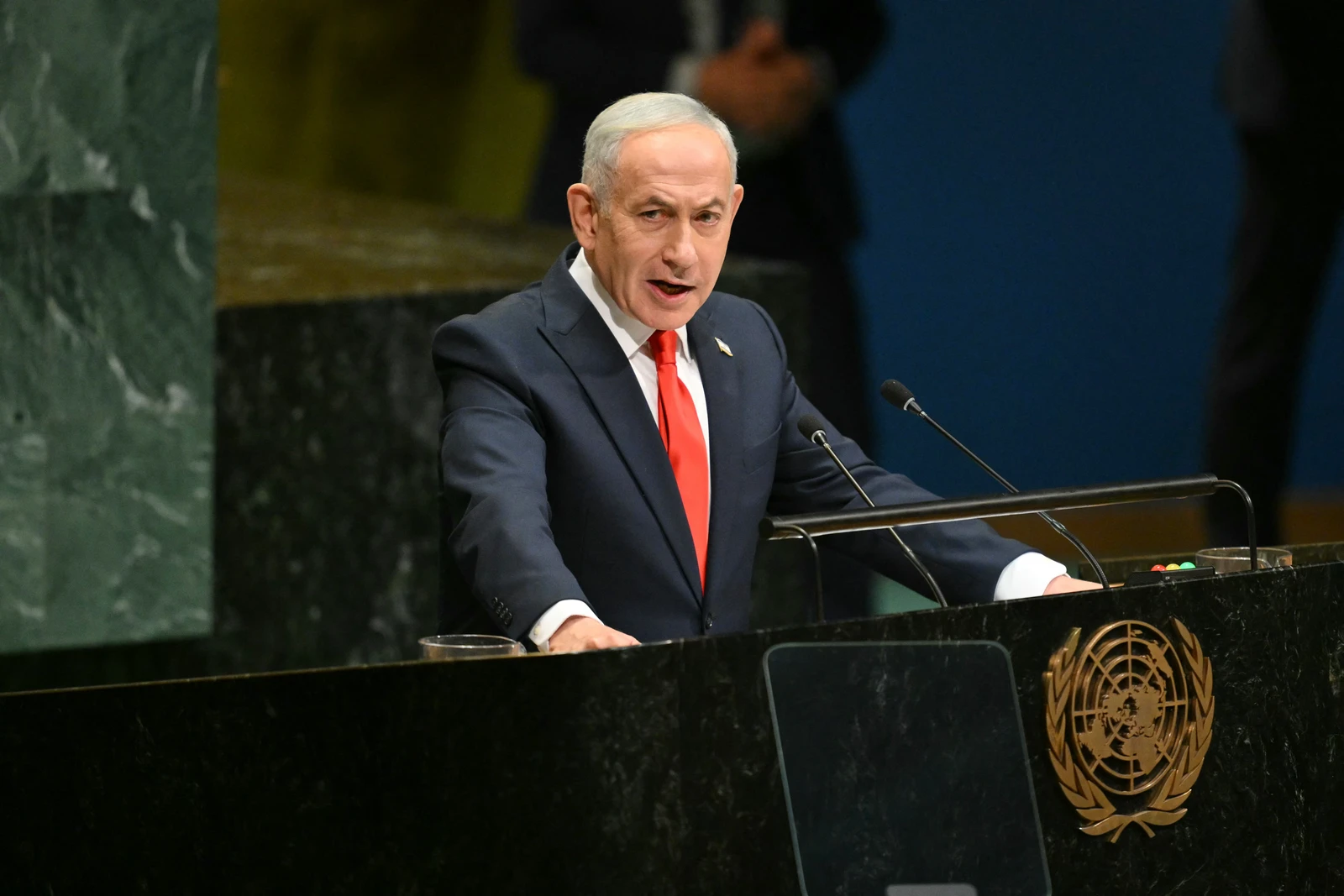

Benjamin Netanyahu’s UN General Assembly address last week contained many false claims and even blatant lies. A thorough fact-checking of each claim renders his haughty speech empty of any substance. While most of his claims were not new and were debunked long ago, the assertion that Israel is the only place in the Middle East where Christians are “growing, thriving and succeeding” is so outrageous that it should not pass without challenge.
When it serves his purpose, Netanyahu has on many occasions pointed to the shared Judeo-Christian culture that Israel is supposedly defending. But aside from many American evangelicals, who embrace a Christian Zionist narrative linking faith to support for Israel, the Catholic, Orthodox and mainline Protestant churches, including the Lutheran World Federation and the World Council of Churches, have rejected Israel’s occupation of Palestinian territories and condemned anti-Christian practices, particularly in East Jerusalem.
Israel’s Central Bureau of Statistics reports some 184,000 Christians in Israel, about 1.9 percent of the population. In the West Bank, about 45,000 Christians live as part of the 3.2 million-strong Palestinian population. Gaza’s Christian community, about 1,000 before October 2023, has shrunk further. In 1948, Christians made up about 10 percent of historic Palestine. Today, they are about 2 percent.
In reality, particularly under Netanyahu’s far-right ultranationalist, ultrareligious coalition, attacks on Christians in East Jerusalem, the West Bank and Gaza have spiked.
Netanyahu has on many occasions pointed to the shared Judeo-Christian culture that Israel is supposedly defending
Osama Al-Sharif
A July report in The Washington Post concluded that, “across the Holy Land, Christians are being targeted by a tide of hostility and violence,” and that, “in Jerusalem, Christians say they are routinely harassed by ultra-Orthodox Jews,” who “rampage through the Old City, destroying property during their processions.”
The paper cited the case of Taybeh, the West Bank’s only predominantly Christian town, where the population is dwindling after years of unrelenting attacks and economic pressure from armed Jewish settlers. When US Ambassador to Israel Mike Huckabee, an evangelical pastor who has often spoken in Tel Aviv’s defense, visited Taybeh last year after settlers set fire to its most famous landmark, the 1,500-year-old Church of St. George, he denounced what he called “an act of terror.”
Weeks earlier, settlers attacked the Armenian Convent in Jerusalem’s Old City, spitting on monks, crosses and holy icons. Israeli police arrived some 25 minutes after the attackers had already fled and, in almost all similar cases, there have been no arrests and no prosecutions.
Viral videos show Jewish settlers spitting on Christian pilgrims in the Old City. When questioned about these incidents, Israeli National Security Minister Itamar Ben-Gvir dismissed spitting on priests as “not criminal.”
The Jerusalem-based Rossing Center and the Religious Freedom Data Center have documented a sharp rise in anti-Christian attacks inside Israel and East Jerusalem in recent years. They include documented incidents of Christian clergy being spat on in the Old City, Christian cemeteries vandalized and monasteries defaced with graffiti by Jewish fanatics.
Christian organizations should work together to shine a light on their persecution in the Occupied Territories
Osama Al-Sharif
In war-torn Gaza, an October 2023 Israeli airstrike hit the Greek Orthodox Church of St. Porphyrius, the third-oldest church in the world, killing at least 17 people who had taken shelter inside. Two months later, an Israeli sniper shot dead a 49-year-old church worker and her elderly mother as they attempted to cross the courtyard of the Holy Family Church. Seven others were shot while trying to protect them.
In July 2025, an Israeli tank shell struck the Holy Family Church — Gaza’s only Catholic parish — killing three people, including a mother and her 17-year-old son, while wounding 10 others, among them the parish priest. Israel called it a mistake, attributing it to “stray ammunition,” though Latin Patriarch of Jerusalem Cardinal Pierbattista Pizzaballa said the tank had hit the church “directly.” Pope Leo called the attack “unjustifiable.” Advocacy groups say Israeli fire has killed at least 23 Christians sheltering in Gaza’s two oldest churches since the war started.
In south Lebanon, Israeli strikes have damaged or destroyed at least eight churches, including the medieval St. Mema Church and Monastery in Deir Mimas, St. George Church in Derdghaya and St. Elijah the Living Church in Alma Al-Shaab. In Yaroun, Israeli forces demolished a Catholic convent and school run by the Salvatorian Sisters.
Israeli soldiers have been filmed desecrating Christian symbols across southern Lebanon. In one video, a soldier was seen placing a lit cigarette in the mouth of a statue of the Virgin Mary and, in another, a soldier used a jackhammer on a statue of Jesus on the cross in the village of Debl. Ironically, it is the Israeli soldiers who post these videos on their own social media accounts.
One additional false claim made by Netanyahu at the UN is that Bethlehem was 80 percent to 90 percent Christian under Israeli control and became 80 percent to 90 percent Muslim only after being handed to the Palestinian Authority in 1995, implying that Israeli rule was the era of safety. But statistics reveal that Bethlehem’s Christian population was already declining well before 1995, driven by emigration during three decades of Israeli occupation.
Netanyahu failed to mention the effect of land confiscation, checkpoints and the separation barrier that cuts directly through Bethlehem’s own agricultural land as factors in driving the city’s Christians to leave. Overall, Christians have been able to emigrate faster than their Muslim neighbors because they are more likely to have relatives settled in the West, making resettlement and asylum easier to obtain. But one should not discount other factors, such as the eruption of the Second Intifada and the rise of Islamist militancy across the Occupied Territories.
In contrast, the population of Christian Palestinian citizens of Israel has indeed grown, albeit modestly, in recent years. But while they have citizenship rights, they are also subject to discriminatory policies and intimidation within the larger Israeli society. Under the Netanyahu government, municipal budgets for Arab communities have been cut drastically and these communities suffer from lawlessness and crime rates that are higher than the national average.
Meanwhile, Netanyahu also failed to mention that Israeli governments and settler organizations have been working together to confiscate church-owned lands and properties in Jerusalem and beyond for decades. Using strict tax laws and forged documents, as well as special municipal laws, the goal is to confiscate and seize Arab, including Christian, lands in East Jerusalem. Israel’s Jerusalem municipality resorts to so-called gardening orders — a mechanism deployed to seize control of supposedly neglected land under the guise of “landscaping.” Using such orders, the municipality stormed and seized lands belonging to the Greek Orthodox Patriarchate in Wadi Rababah, East Jerusalem, in June.
Christian churches and organizations should work together to debunk Netanyahu’s claims and shine a light on the persecution of Christians in the Occupied Territories, especially Jerusalem. Palestine’s Christians have more of a physical, cultural and historical bond to the land than any other group. They have been living here continuously for more than 2,000 years. Their struggle to survive on their ancestral lands is a symbol of the larger cause of Palestinians retaining and defending their identity and securing their inalienable right to self-determination and liberty.
Netanyahu seems to believe that if he repeats debunked claims from a big enough podium, they eventually harden into fact. They do not and, in fact, this only underscores the opposite reality. Israel’s record is not one of protection but of exploitation. It is a record of burned churches, shelled sanctuaries and the suffering of a vulnerable minority.
Osama Al-Sharif is a journalist and a political commentator based in Amman. X: @plato010


