
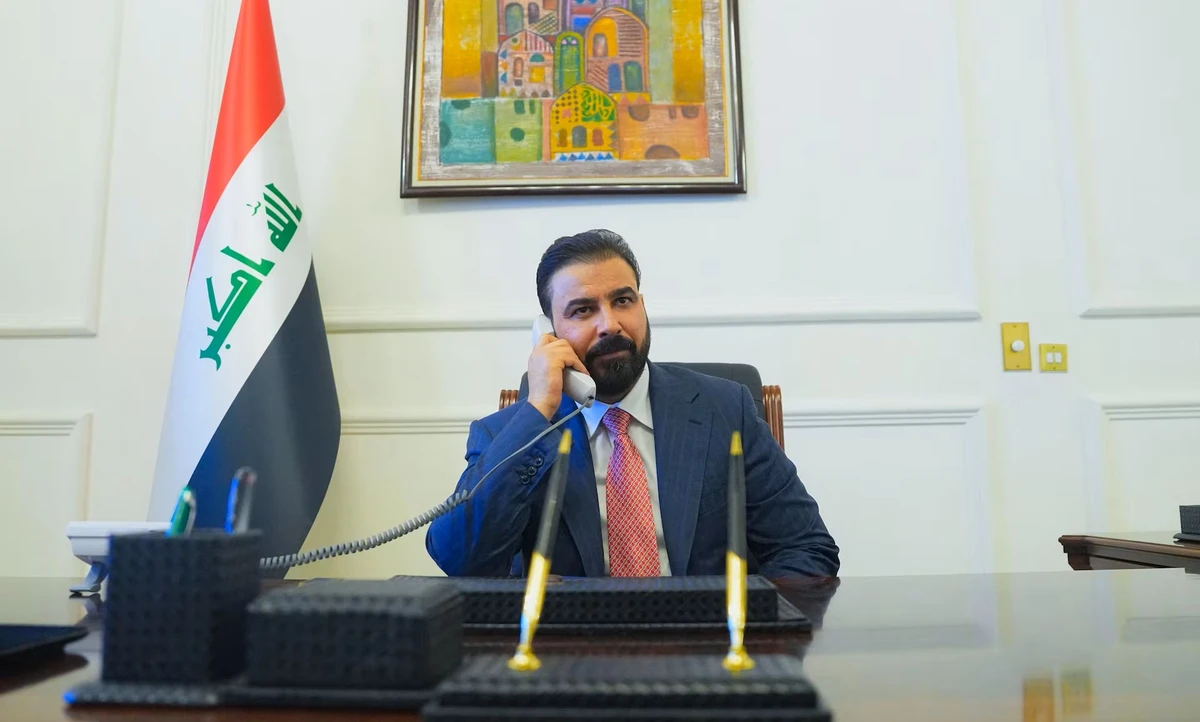

Baghdad is witnessing thunderous chapters in the war on corruption. Factual reports are mixed with fabrications and accurate images with doctored pictures. The Baghdadis’ schadenfreude over the fall of the “big catches” has been loud and public. They watch the news: piles of dollars buried inside walls or in gardens. They pass stories of gold around and of the crowns of corruption. They laugh in the streets every time the misdeeds of a parliamentarian, a governor or a senior official are exposed in one of the state’s “mines” — and there are many.
I visited a well-placed official and the meeting was as enjoyable as it was instructive. He said: “Please don’t compare your corruption to ours. You cannot compare an ordinary appetizer platter with a lavish, indeed fabulous, banquet. Besides, the thieves of Baghdad are far more dangerous than the thieves of Beirut. The figures in your country look terribly modest next to ours. The talk in Baghdad is of a figure close to $500 billion; now the number keeps climbing.”
He added: “Would you believe that a country sleeping on staggering wealth was racing toward an economic collapse — one that would have included an inability to pay salaries — had the matter not been addressed in time?”
The Iraqi street has clearly embraced the battle that Ali Al-Zaidi’s government has launched against corruption and the corrupt. It is no small matter to haul corrupt figures in for questioning after they had long enjoyed what are known as partisan, factional or mafia “protections” and to demand they give back what they had looted. Some Iraqis do not hide their fear that the “sponsors of corruption” may set aside their differences to throw political, security and legal sticks into the wheels of the current government. They fear impediments to the confinement of weapons to the hands of legitimate forces and ending the long era of uncontrolled weapons — an era whose costs have proven steep after it battered the state’s authority at home and its credibility among its neighbors.
A visitor to Baghdad hears words that would not have been heard a few years ago. A politician who fiercely opposed Saddam Hussein now concedes: “Saddam squandered enormous wealth on wars and their aftermath. But he was not a thief, in the sense that he never reached into public funds to build a personal fortune.”
The politician added: “Abdul-Karim Qasim was poor when he was executed by the first Baath regime in 1963. He did not even own an apartment. President Abdul Salam Arif was never accused of encroaching on public money or of illicit enrichment. As for his brother, President Abdul Rahman Arif, he received assistance from the very man who overthrew him, Saddam, to cope with daily life and retirement.”
One sentence, heavy with implication, stayed with me: “Are the looters of public money after the American invasion not ashamed before Qasim, Saddam and the two Arifs, who never stretched out their hands to seize public funds?”
Baghdad is also busy with what a number of its politicians call a transitional phase in the Middle East, following the hurricane that swept the region and raised many questions.
I asked him to explain the hurricane. He replied that, for now, it is enough to note that Iran is holding funeral rites for Ali Khamenei, who led it after the passing of the founding supreme leader. Khamenei was killed in an Israeli strike at the beginning of the American-Israeli war against Iran — no small matter. The war was then stopped by the force of the memorandum of understanding that Iran concluded with the US. This will open the door to arduous negotiations over Iran’s nuclear program and other issues. Nor can we ignore that Iran signed an agreement with an America led by the man who did what his predecessors had avoided: killing Gen. Qassem Soleimani and launching a war against Iran.
He believes Iran will undergo a transitional phase whose contours and whose real balance of power are difficult to predict. He said he has information indicating that Mojtaba Khamenei has the capacity to carry out the major duties entrusted to the supreme leader, even though his health keeps him away from day-to-day issues. He noted that Mojtaba had suffered a serious knee injury requiring three surgeries and a facial wound whose marks reached his lips. In the early period, he resisted his doctors’ advice to undergo cosmetic surgery, which may explain — in this man’s reading — his public absence.
The hurricane’s remaining chapters are evident. Bashar Assad had expected to reside in the presidential palace forever. He now resides in his Russian exile. Syria was hit by the hurricane and now finds itself in the care of President Ahmad Al-Sharaa. The hurricane’s impact is visible in Lebanon and Gaza — the former is without Hassan Nasrallah, the latter without Yahya Sinwar.
The Iraqi street has embraced the battle the government has launched against corruption and the corrupt.
Ghassan Charbel
Similar questions echo through conversations, searching for answers. What Iran will we see in the coming phase? Was Mojtaba forced to drink the poison of the memorandum of understanding to stave off economic collapse, while awaiting the arrival of billions of dollars with which to resume the policies of his father’s era? Can the countries of the region accept a new Iranian general named the Strait of Hormuz, accompanied by the “proxies?” And can they blunt the significance of the strait and find alternatives, however costly? Will Iraq succeed in confining weapons to the hands of legitimate forces, avoiding a repeat of the actions undertaken from its territory by certain factions — actions that damaged its relations with the Gulf Cooperation Council states?
In Prime Minister Al-Zaidi’s office, one hears categorical statements. No tolerance for corruption and no retreat from confining weapons to the state. His first foreign visit will be to Washington. Iraq wants partnerships and seeks cooperation. It accepts neither tutelage nor the transformation of its territory into an arena for others’ conflicts. It wants the best cooperative relations with Turkiye, Iran and the GCC states.
Iraq’s Arab identity runs deep and cannot be erased. It is clear that the war on corruption is the test that must be passed if the effort to confine weapons to the state is to succeed and if Iraq is to go back to being a normal state in this tumultuous region.
- Ghassan Charbel is editor-in-chief of Asharq Al-Awsat newspaper. X: @GhasanCharbel — This article first appeared in Asharq Al-Awsat.


