
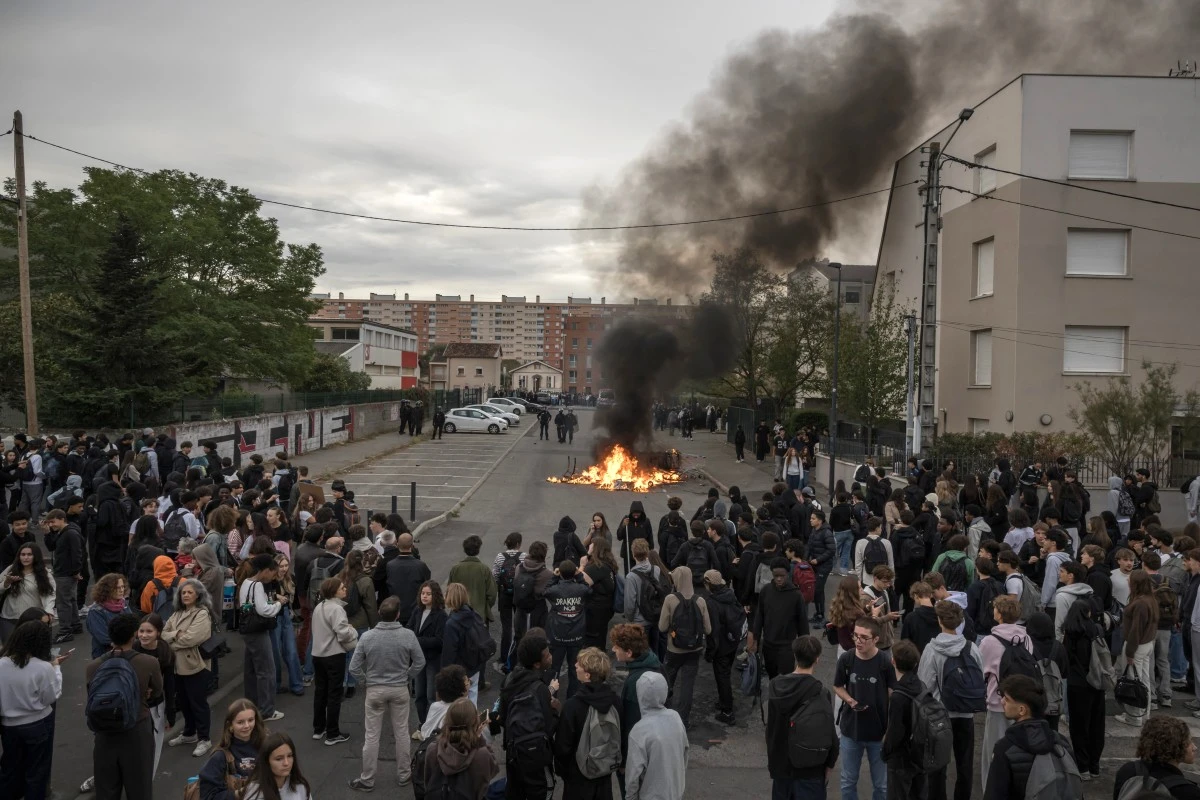

Watching the mass protests unfold across France, one wonders who is not trying to exploit the social unrest there.
The cliche that France since 1789 and later 1968 is a country used to demonstrations and revolutions does not vindicate the student protesters, who were joined by union members and public sector workers to protest the country’s worsening educational provision and cost-of-living crisis.
But the scenes of riots and looting and the masked men clashing with police could be telling a different story. And protesters could lose their right to demonstrate, guaranteed by the constitution, as the nation imposes curfews and other emergency measures.
The big question being posed is whether political parties and criminal groups have been exploiting the civil unrest to further their criminal and political agendas.
The month-long violent protests demonstrate that France is rioting against France. As recent history has shown, the country — all of France — continues to be divided over the need for economic and social reforms.
France needs change. But how? The public debt and political paralysis continue to rot the country from within, exposing it to political instability and chaos. And those parties that pose as potential firefighters if their leaders were to win next year’s presidential election are themselves, in various instances, playing the arsonists without regard to human life, property or political insight as to what could fix the French system.
Thinking they would reap the benefits from stirring up violence, the far left backed the protesters’ grievances
Mohamed Chebaro
President Emmanuel Macron is in the final months of his presidency. His center-right movement has tried for 10 years to reform the country to no avail, as forces on both the right and the left have opposed its much-needed reforms.
Thinking it would reap the benefits from stirring up violence, the far left backed the protesters’ grievances. Presidential contender Jean-Luc Melenchon, while seeming to condemn the looting and vandalism, has been accused of encouraging violence.
Melenchon and his party, France Unbowed, champion higher wages and pensions, better healthcare and other public services, and more funding for education. Such policies are disconnected from reality. If he were to win the presidency, Melenchon, like his predecessors, would have difficulty raising the money required to fund the welfare state in an already heavily taxed country.
Simply ending financial support for Ukraine would not remedy the ailing finances of a country that has been in the red for decades. Neither would taxing the rich.
Far-right leader Marine Le Pen, seen as favorite to win next year’s election, is acting like any far-right leader and trying to turn the anger over riots, lawlessness and disorder in her favor, blaming people from the suburbs who are known to have a foreign background for the violence.
Le Pen stays quiet about how she or her party will balance improving the welfare state with a sound fiscal policy
Mohamed Chebaro
Le Pen’s National Rally party has urged citizens to channel their anger into voting to reestablish security, promising more power to the police. But the convicted politician, who for many years flirted with antisemitic, Islamophobic and pro-Russia narratives, stays quiet about how she or her party will balance improving the welfare state with a sound fiscal policy.
Macron had a point when he lashed out at the “stupid” comments of foreign leaders about events in France and about the danger sowed by artificial intelligence-generated images of scenes that never took place. He alluded to certain forces clearly having an interest in amplifying images of chaos.
Experts have monitored the role of black-dressed masked men of the “Black Bloc” anarchist group who infiltrated the protests. Members of the ultra-left group are accused of attacking the police and lighting fires to cause mayhem.
In parallel, foreign online interference and disinformation campaigns were noticed by EU security experts, exacerbating the French riots and similar outbursts of looting and vandalism in other European countries. Security officials have been examining pro-Russian and far-right social media accounts linked to the spread of violent videos and content in an attempt to encourage chaos. Iran and Algeria are also suspected of being behind some of the messaging.
The crisis in France has not escaped the notice of the Trump administration, which has previously warned of “civilizational erasure” in Europe. President Donald Trump himself reacted to the protests by saying “France is burning.” US officials have magnified the role of immigrants, wrongly blaming them for the violence, which will only fan the flames further. Vice President J.D. Vance blamed “Western liberals” for opening the EU’s borders to the “third world,” warning Americans to look at France’s misfortune before voting for Democrats in next week’s midterm elections.
The demonstrations have exposed the fragility of the French state but not offered any clear pathway to power for those on the right and the left who are trying to exploit the protests for their own ends.
The events in France and across Europe should be a lesson to policymakers on how quickly violence can overshadow the rightful demands of protesters. Demonstrations should never become a cover for criminal acts. Young people at schools and universities, or even those belonging to a union, ought to know better and should prevent their anger from being exploited.
In France, the misleading narrative of the extreme right and radical left of a pan-French revolt could have dire consequences. The images of unrest dig deep and erode national trust.
From the outside, it is baffling how youth-led protests about a lack of investment in education in one of the most civilized countries in the world could lead to looting, vandalism and a loss of control by authorities. How can a rich country with excellent public services and a higher than normal quality of life witness such anarchic violence?
Those parties, both domestically and internationally, that are seeking to exploit the crisis might be in for a surprise as, once the fire spreads, it could also engulf the arsonists. The French fiscal crisis is unsolvable without national unity and a realistic national dialogue. Unfortunately, the aspirers to power on the far right and radical left seem to be failing France — they are polarizing forces that are unable to present a platform that unites the country and solves its problems rather than exacerbating them.
Mohamed Chebaro is a British-Lebanese journalist with more than 25 years of experience covering war, terrorism, defense, current affairs, and diplomacy.


