
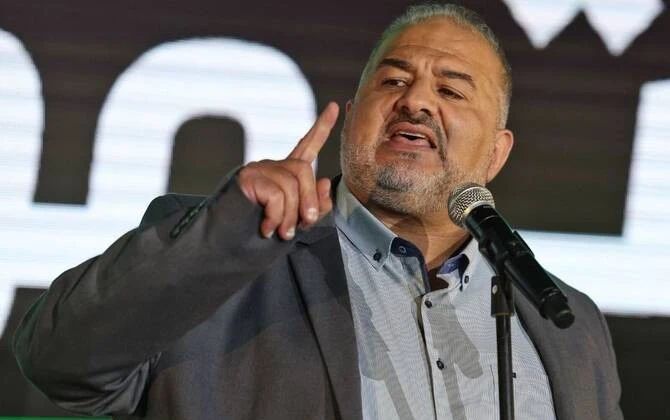

In the unfortunate reality of Israeli society, Palestinian citizens of Israel attract widespread public attention only under a few circumstances: when crime rates, especially homicides, rise within their communities; during elections, when the Jewish majority wonders how Palestinian parties might affect the formation of the next coalition government; and when one of their political representatives expresses an opinion that challenges the dominant narrative.
Far less attention is paid to their achievements. For instance, their representation in Israel’s healthcare sector is significantly higher than their proportion of the population, despite decades of neglect and discrimination.
The darker reality is that, since the beginning of the year, 154 Palestinian citizens of Israel have fallen victim to violent crime. This is a staggering figure but it becomes even more alarming when compared with the 24 homicide victims recorded among the remaining 80 percent of Israel’s population. The scale of the crisis, and the daily insecurity and fear experienced in these communities, becomes painfully obvious.
A decade ago, the homicide rate among Palestinians was approximately four times that of Jews; today, it is closer to 15 times higher and the gap continues to widen. Violence has become endemic. Much of it stems from organized crime, clan rivalries and the settling of criminal scores, but it also claims the lives of innocent bystanders and fuels domestic violence, affecting people of all ages.
It would be erroneous to place all the blame for the current situation on the present government. The neglect, discrimination and marginalization of Israel’s Palestinian minority have been allowed to fester since the establishment of the state in 1948. Some of this neglect has been deliberate, while much of it reflects long-standing political indifference. However, the situation has deteriorated significantly under the current government. With National Security Minister Itamar Ben-Gvir, whose political views are rooted in Kahanism, overseeing the police, the government’s apparent indifference to the almost-daily killings is deeply troubling and ingrained in its approach to Palestinians.
By contrast, during the brief Naftali Bennett-Yair Lapid government, when Labor Party minister Omer Bar-Lev was responsible for policing, the number of murders in the Palestinian community declined. This was achieved through more professional policing, a recognition of the severity of the crisis, greater cooperation with local communities and a determined effort to confront organized criminal gangs.
As if the situation were not already grave enough, many Palestinian citizens are blamed by their Jewish compatriots for failing to stop the violence within their own communities. This attitude stems variously from ignorance, hypocrisy, racism or, in many cases, a combination of all three.
Reducing the widespread violence requires a genuine partnership between all branches of government. This includes preventing the continued flow of illegal weapons, increasing proactive police operations, expanding the police presence in the areas most affected by violence and working closely with local leaders. It is easy for those living outside this violent reality to urge ordinary citizens to stand up to criminal gangs. Yet doing so often places them and their families at mortal risk, particularly when they have justifiably little confidence that the police will protect them.
Moreover, while many within the Jewish majority, and especially members of the current government, portray the high levels of violence in Palestinian communities as evidence of cultural differences, this narrative reflects not only appalling bias and prejudice but also an unwillingness to confront the state’s own failures.
The crisis is first and foremost a consequence of systemic neglect. Successive governments have failed to address both the immediate security crisis and the deeper social and economic conditions that enable organized crime to flourish and disempower the rest of the society. Chronic underinvestment in public services, discriminatory policies and unequal access to resources have all contributed to the problem.
There is a long list of laws that discriminate against Palestinian citizens of Israel, most notably the Nation-State Law. More recently, the Knesset passed legislation that, according to the human rights organization Adalah, provides substantial benefits to residents of towns with Jewish populations of between 35 percent and 55 percent that are classified as peripheral, according to state criteria. The use of Jewish demographic composition as a criterion for allocating state benefits leaves little doubt about the discriminatory logic underpinning such legislation.
Nominally, Palestinian citizens of Israel enjoy equal citizenship. But “nominally” is the operative word. Israel prides itself on being a liberal democracy but no single political party has ever won an outright parliamentary majority, making coalition governments inevitable. Despite comprising roughly one-fifth of the population, parties representing Palestinian citizens have been almost entirely excluded from governing coalitions, with only one notable exception.
In a political system where influence and resources are largely distributed through coalition participation, this exclusion leaves the Palestinian minority at a profound disadvantage. Symbolically, it sends a message of tolerated but not equal citizens. Without representation in government, their interests are rarely advanced effectively. This sorry situation shows no sign of changing under the present circumstances.
The short-lived Bennett-Lapid government marked a historic exception, with the United Arab List, led by Mansour Abbas, joining the governing coalition. By most practical measures, this partnership proved successful. Yet, for Benjamin Netanyahu and the opposition, Abbas’ participation became, in the most despicable way, a powerful tool for attacking the government.
Ironically, despite Netanyahu’s own long-standing policy of indirectly strengthening Hamas, he portrayed Abbas, and by extension the government, as somehow linked to Hamas. Such accusations rested largely on Abbas’ religious conservatism and, more fundamentally, on the fact that he represented the Palestinian citizens of Israel.
There is a long list of Israeli laws that discriminate against Palestinians, most notably the Nation-State Law.
Yossi Mekelberg
The horrific wave of killings within that community highlights a much deeper crisis. At first, from 1948, Palestinian citizens of Israel lived under military rule for 18 years and, even since the military administration ended, they have never been treated as fully equal to their Jewish neighbors. They are descendants of those Palestinians who survived the Nakba and remained within the borders of the newly established state of Israel rather than becoming refugees. Yet their Palestinian identity has never been fully recognized by the state. Instead, they are commonly referred to simply as “Arab Israelis,” while their Palestinian national identity is frequently denied or marginalized.
Addressing this crisis should be treated as a matter of national urgency. Israel’s political leadership, together with leaders across all sectors of society, must acknowledge the scale of the crisis facing the Palestinian community and declare it a national priority. The immediate objective must be to stop the violence. Beyond that, Israel needs a comprehensive, long-term national program aimed at creating a genuinely shared society — one in which all communities enjoy equal protection under the law, equal access to public services and opportunities, and equal participation in every aspect of national life. Only then can equality for the Palestinian citizens of Israel become the rule rather than the exception.
- Yossi Mekelberg is a professor of international relations and an associate fellow of the MENA Program at Chatham House. X: @YMekelberg


