

In the words of Christiane Amanpour, one of the most respected journalists of our time: “Be truthful, not neutral.” I have always admired the principle behind these words. But looking at political developments around the world today, I find myself wondering what we actually mean when we talk about truthfulness.
Are we talking about the whole truth? Or have we reached a point where certain truths are given prominence while others, equally relevant, are conveniently left out?
With elections in Israel and the American midterms taking place within days of each other, perhaps this is a good moment to ask some difficult questions. Questions that should be obvious to anyone who believes in intellectual honesty, yet somehow seem to have disappeared from much of our public debate.
I was watching CNN’s “State of the Union,” with Dana Bash interviewing Republican Senate candidate Mike Rogers about his Democratic opponent in Michigan, Abdul El-Sayed. The discussion concerned allegations associating El-Sayed with the Muslim Brotherhood. Bash challenged Rogers and pointed out that El-Sayed had disavowed the organization. But I found myself asking why we had arrived at this discussion in the first place.
Words shape public perceptions long before people have an opportunity to examine the underlying facts
Khalid Abdulla-Janahi
Here is an American citizen, a physician and a candidate for the US Senate, being forced to answer questions about his religion and alleged associations for which no credible evidence has been presented.
Meanwhile, President Donald Trump has described El-Sayed as a “jihadist.” Why is this not receiving the same level of serious examination? What has happened to the responsibility that comes with the office of the president?
In Minnesota, we see similar attacks directed at Rep. Ilhan Omar. One can disagree strongly with her political positions but surely that disagreement should not open the door to questioning her belonging in the country she represents.
I wonder whether the same standards would apply if these politicians came from a different religious background.
These are not small issues. They concern the way political narratives are constructed and the responsibility of journalists in deciding what deserves to be challenged.
The same questions become even more uncomfortable when we turn to the Middle East. For years, Palestinian representatives appearing on international television have been expected to begin by condemning Hamas. I understand why journalists ask about attacks on civilians. Such attacks must be condemned.
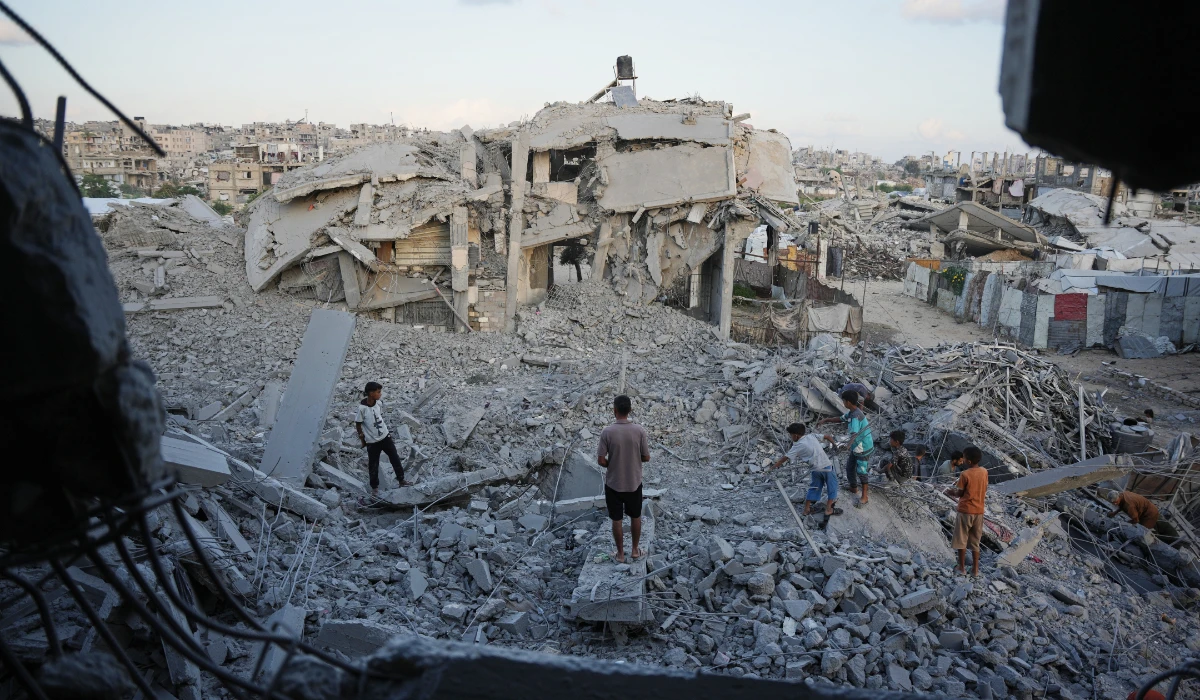
But I struggle to understand why Israeli officials are not asked with similar regularity to condemn the actions of the Israeli military in Gaza, the killing of civilians and the violence carried out by settlers in the West Bank. Surely, if we are interested in understanding what is happening, these matters should be part of the same conversation.
Let us go back to 1993 and the Oslo Accords. We have spent more than three decades listening to explanations of why peace has failed. Much of the responsibility is placed on the Palestinians, including their leadership failures and internal divisions. There is truth in some of these criticisms.
But what has happened to Israeli settlement expansion throughout these decades? What has happened to the land that was supposed to become the basis of a Palestinian state?
We frequently hear the expression “facts on the ground,” almost as though these facts appeared naturally. Who created them? Who allowed them to continue expanding? And why should the consequences of these decisions now be accepted as the starting point for future negotiations?
Settler violence has also become part of the daily reality faced by Palestinians in the West Bank. Yet the language used to describe these developments is remarkably different from the language applied to Palestinian actions. In the media, we hear and read news of Israeli settler violence, while the Palestinian reaction to this violence is labeled as terrorism.
We need to be careful with words. They shape public perceptions long before people have an opportunity to examine the underlying facts.
The current confrontation with Iran presents another example. We have rightly criticized Iran for attacking its neighbors. The sovereignty of countries in the Gulf cannot be treated lightly and Iranian actions have created legitimate security concerns.
But in following the international coverage, I am struck by how often the discussion begins with Iranian attacks, without sufficient examination of the American and Israeli military campaign of aggression against Iran.
It is becoming easier to present a particular part of a story without necessarily saying anything factually false
Khalid Abdulla-Janahi
How did we arrive at this situation? What international legal principles apply? What are the consequences for the wider region? These questions deserve serious attention, including from those who fundamentally disagree with the Iranian government.
Saudi Arabia’s approach to this crisis is worth considering. The Kingdom has avoided direct involvement in the wider war with Iran and has continued to pursue diplomatic channels, including discussions involving Pakistan and Turkiye and engagement with Tehran. This reflects an understanding of the enormous consequences that further regional escalation could have. Having experienced decades of conflict and instability around us, we should recognize the importance of efforts to prevent another prolonged war.
There is, however, a separate question concerning Yemen.
The war in Yemen has brought immense suffering and outside intervention has contributed to a situation in which Yemen’s political future is too often discussed in terms of the interests of other countries. Saudi Arabia, the UAE, Iran, the US and others all have their security concerns and interests. But Yemen belongs to the Yemenis.
The Houthis are now an undeniable part of Yemen’s political and military landscape. Their actions must be subject to accountability, but no serious political settlement can ignore their role. They will have to be part of a political arrangement with other Yemeni groups, including those with whom they have fought for years. That will be difficult but the alternative is to continue allowing others to decide Yemen’s future.
Ultimately, Yemenis themselves must determine how they are governed.
I return to Amanpour’s words because I believe they raise a responsibility that extends beyond journalists. We all have a tendency to accept information more readily when it supports our existing beliefs. Political leaders understand this very well and increasingly sophisticated media environments make it easier to present a particular part of a story without necessarily saying anything factually false.
This is what concerns me most. A statement can be accurate and still leave the public with a seriously distorted understanding of events because essential context has been omitted.
I do not expect every journalist to ask every question in every interview. Nor do I suggest that every party to a conflict carries the same responsibility. But I do expect serious journalism to apply standards consistently and to recognize when the absence of context changes the meaning of what is being reported.
Perhaps the greatest challenge facing journalism today is the willingness to question narratives that have become accepted within its own political and institutional environment. And perhaps we, as readers and viewers, should be asking ourselves the same difficult questions.
Amanpour was right to say, “Be truthful, not neutral.” But there is something we must add to those four words: Truthfulness must include the truths we would rather not hear, the facts that make us uncomfortable and the questions we hesitate to ask because we already know how unpopular the answers might be.
Otherwise, we may end up living with a spectrum of selected truths, each convenient to a different audience, while the whole truth becomes increasingly difficult to find.
Khalid Abdulla-Janahi is a leading financier, global strategy pundit and philanthropist. He is co-founder of the Maryam Forum Foundation (UK). He previously served as co-chair of the World Economic Forum Global Agenda Council on the Middle East and North Africa and vice chair of the Arab Business Council.


