



QUETTA: A wave of militant attacks on freight trucks along two key highways linking Pakistan with Iran and the country’s commercial hub Karachi has disrupted cargo traffic through Pakistan’s southwestern Balochistan province this year, hurting businesses, slowing fuel supplies and prompting authorities to plan a dedicated highway protection force.
The attacks have targeted transporters using the N-40 Quetta-Taftan Highway, which connects Pakistan to the Iranian border crossing at Taftan, and the N-25 Quetta-Karachi Highway, one of Balochistan’s main transport arteries linking the province to Pakistan’s commercial hub. Together, the routes carry goods ranging from fuel and food products to consumer goods moving between Pakistan, Iran and the rest of the country.
According to the provincial Chamber of Commerce and Small Industries, bilateral trade, which is estimated at $2.8 billion, is heavily dependent on these two highways but the uncertainty and attacks have disrupted the import and export of fruits, vegetables, rice, oil and gas products and other general food items.
Separatist militant groups, most notably the Baloch Liberation Army (BLA), have increasingly targeted freight traffic on both highways in recent months. According to government data obtained by Arab News, 107 freight trucks have been set on fire on provincial highways amid dozens of attacks since January 2026, with the majority of the assaults reported on the N-25 and N-40 highways in the last three months.
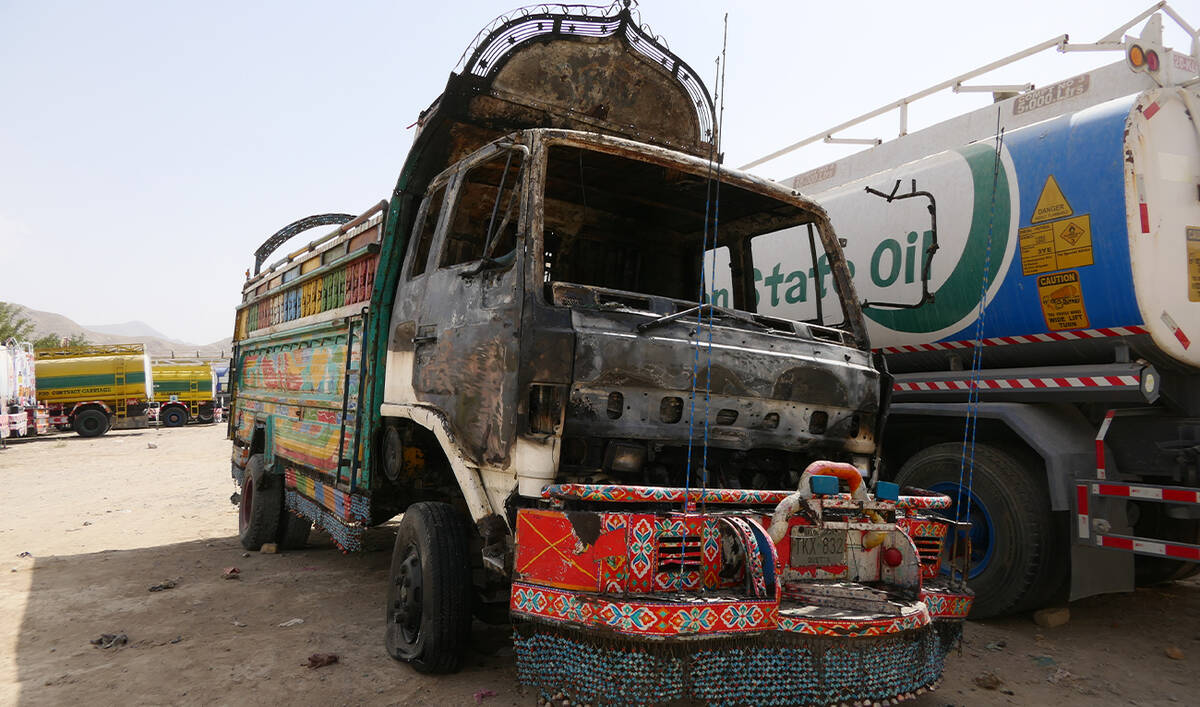
The photograph taken on July 31st, 2026, shows Allah Gul’s destroyed truck parked in Quetta, Pakistan. (AN Photo)
Government officials did not share the number of casualties in the attacks. However, a provincial transport owners association said two drivers were killed and five others were injured.
Balochistan has faced a low-level separatist insurgency for decades, but attacks have intensified in recent years as militants increasingly target infrastructure, security forces and economic assets, particularly projects linked to trade and regional connectivity.
Among those caught up in the violence is 40-year-old truck driver Allah Gul.
“They fired multiple bullets on my truck, broke the front window glass and set fire to my truck,” Gul told Arab News, recalling the attack on July 27.
The Mazda truck, which Gul said he bought for Rs4.5 million ($16,248) on a monthly installment plan in 2011, was his family’s only source of income. For 15 years, he transported goods across Pakistan, supporting three families comprising around 40 people. He said he was close to paying off the vehicle when it was destroyed.
The attack occurred while he was transporting soft drinks from Quetta to Nushki district.
The attacks have also disrupted Pakistan’s trade with neighboring Iran, particularly imports of liquefied petroleum gas (LPG), an important cooking and industrial fuel.
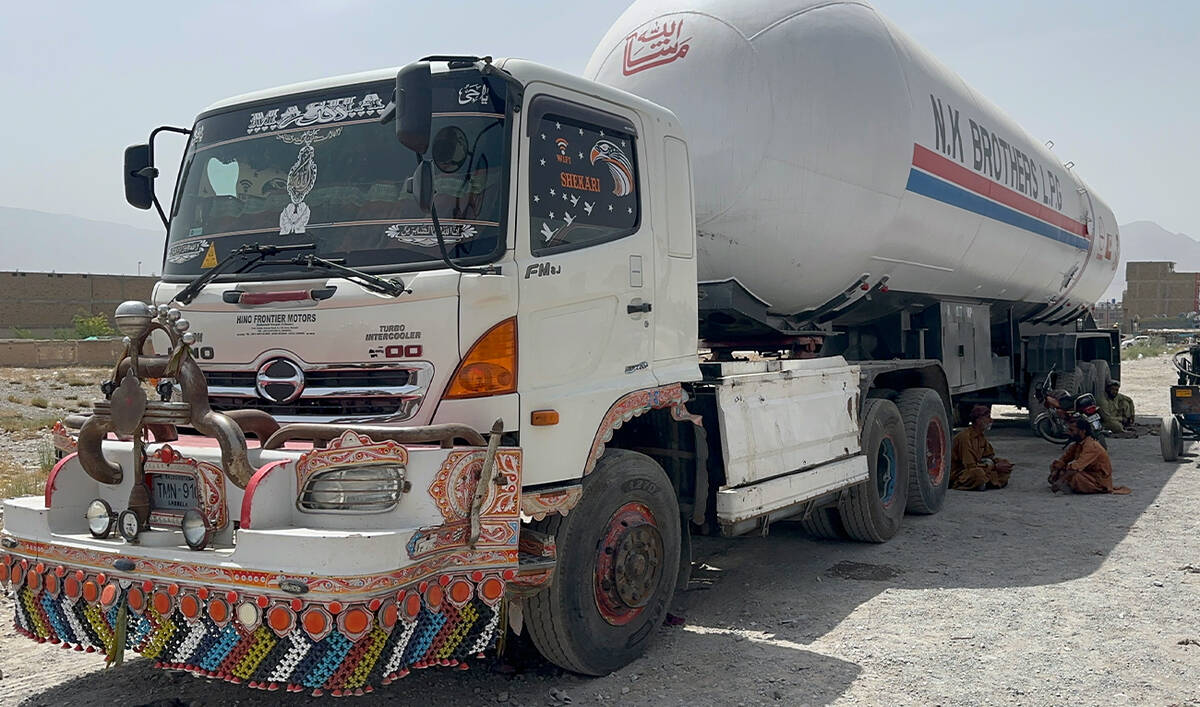
Allah Ditta, an LPG driver sits on the shadow of his LPG freight in Quetta, Pakistan, on August 1st, 2026. (AN Photo)
In an official press conference in June this year, Pakistan’s Petroleum Ministry unveiled plans to expand daily LPG imports from Iran through the 909-kilometer (564-mile) border shared by the two countries in Balochistan.
Pakistan imports more than 60 percent of its LPG from Iran, according to the Payne Institute for Public Policy, a US-based research center at Colorado school of mines.
Those supplies have also been disrupted.
Hajji Shoukat Essazai, a major LPG importer and clearing agent in Taftan who operates LPG plants in Taftan, Lahore, Sargodha, Rawalpindi and Peshawar, said his business had declined by more than 90 percent over the past three months.
“I used to transport 50 LPG bowsers each carrying 50 tons of gas from Taftan to other provinces,” Essazai told Arab News. “But now, barely 15 bowsers depart in an entire week.”
“ECONOMIC DESTRUCTION OF BALOCHISTAN”
In response to the deteriorating security situation, the Balochistan government says it plans to establish a dedicated force to protect trade routes.
“In order to secure trade with Iran through the N-40 highway, the government has plans to form a dedicated highway protection force,” Babar Yousafzai, an aide to the provincial home department, told Arab News.
“A new regional zone of the paramilitary Frontier Corps called ‘IG-West’ is being established in the Rakhshan division for better security and facilities for transporters and the business community,” he added.
Despite those plans, traders say business activity remains severely affected.
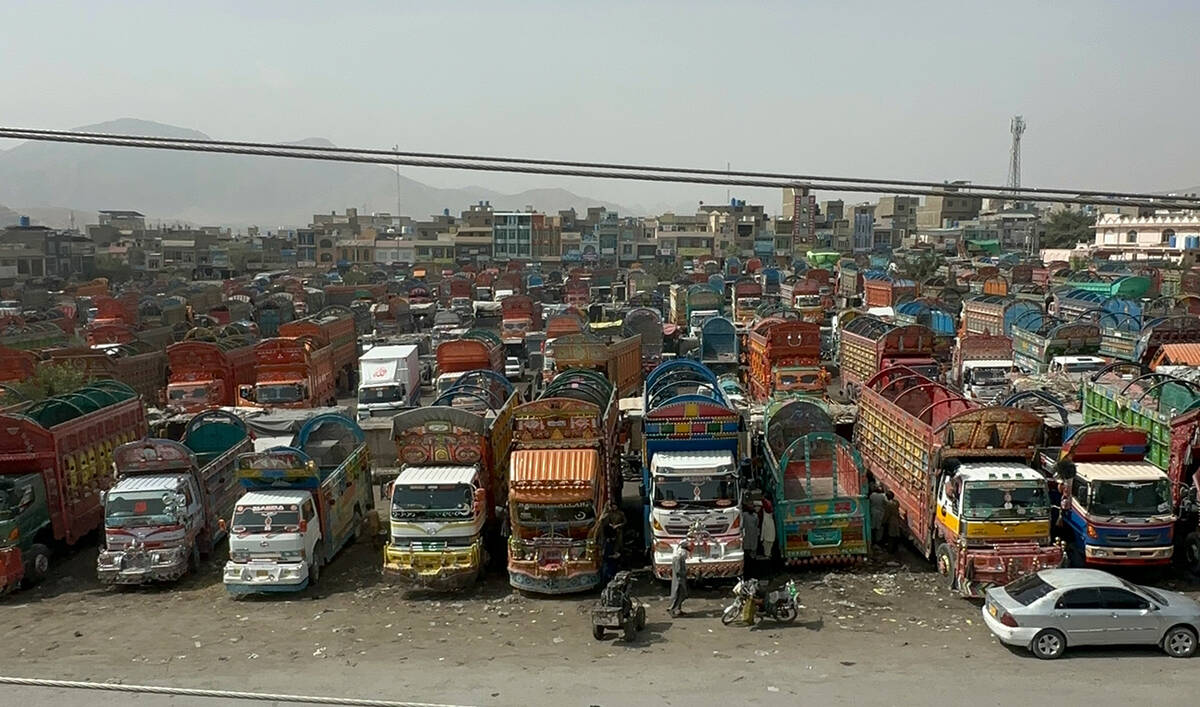
Drivers Park their trucks to avoid travel on highways in in Quetta, Pakistan, on August 1st, 2026. (AN Photo)
Abdul Rahim Kakar, president of the Central Traders Association in Balochistan, said traders had suffered losses worth “billions of rupees” since May this year:
“Daily, 300 loaded trucks used to arrive in Balochistan from Punjab and Sindh provinces before the attacks on transport started. But now, supply chains are severely disrupted, forcing traders to face mounting losses as well.”
Balochistan Goods Truck Owners Association President Hajji Noor Muhammad Shahwani said many transporters had stopped operating because drivers no longer felt safe using the highways.
“This is the economic destruction of Balochistan, and it will trigger widespread damage for the entire country’s economy,” Shahwani said.
He said many truck owners had parked their vehicles while drivers refused to travel because of the security risks.
Among them is 58-year-old LPG bowser driver Allah Ditta.
After arriving from Punjab, he has spent more than two weeks waiting in Quetta to travel onward to Taftan to load his tanker.
“I have been living in my LPG freight for the last 18 days under this open sky,” he said. “I wonder how I will feed my family now if the situation continues.”





