
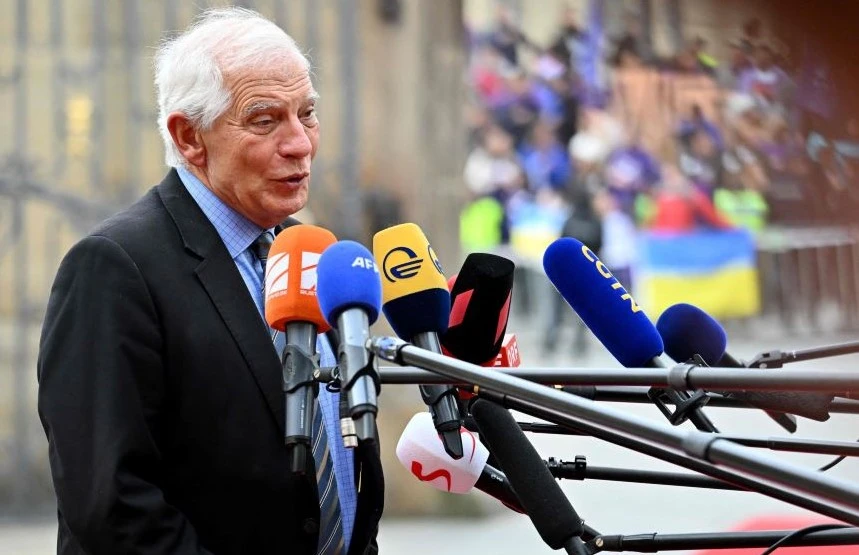

There has been some controversy over a recent speech the EU High Representative and Vice President Josep Borrell gave to students at the College of Europe. Part of what he said was taken out of context and given a certain spin in some media. In his speech, Borrell described the profound transformation affecting our world, including but not limited to Russia’s invasion of Ukraine, which we as European diplomats need to take into account in our daily work. His use of the “jungle metaphor” was in reference to those who violate the rule of law and long-established international policies.
War is back in Europe, and it is the gravest threat to European security in decades. Our vision of a world governed by multilateral rules is under threat, and we are doing all we can to uphold it. The message is clear: Might does not make right. Never did. Never will. Increasingly, we are witnessing a world of power politics in which interdependencies, such as energy and information, are weaponized. This is the “jungle” we do not accept, and as the EU we must adjust accordingly our response and stance as a geopolitical actor. And we are not alone: The overwhelming majority of states who voted for UNGA Resolution ES‑11/1 also condemned the illegal annexation of territories belonging to a sovereign and independent state, Ukraine. This shows there are many around the world who want to preserve a peaceful order and reject the law of the strongest, which erodes agreed international norms. We have moved on since Thucydides said, “The strong do what they can, the weak suffer as they must.”
Now on the “garden” remark. Borrell has always spoken out against a “Fortress Europe” approach and has been strongly engaged in advancing relations with other parts of the world, including Latin America, Africa, Asia and, most recently, the Gulf, as evidenced by the new EU strategic partnership with the Gulf unveiled last May. He has been advocating since the beginning of his mandate to change perspective and look at the EU from an outside perspective. The combination of political freedom, economic well-being and social cohesion characterizes Europe as a place where it is good to live and where many people would like to live. Young Europeans are lucky to live in a continent that provides these elements. But as Europeans, we must commit ourselves more to the rest of the world and continue to promote together freedom and the rule of law, which are today under threat. We must stay engaged and not isolate ourselves.
Increasingly, we are witnessing a world of power politics in which interdependencies, such as energy and information, are weaponized.
Patrick Simonnet
The EU has always supported those suffering from war and conflict. We are now welcoming refugees from Ukraine just as we are continuing to provide shelters and assistance for Syrians, Afghans, Yemenis and Eritreans fleeing danger. The EU and its member states also represent the largest providers of development aid worldwide with a strong track record of support to all vulnerable people, regardless of their religion, nationality, ethnicity or skin color. For decades, the EU has been cementing peace and cooperation among previously warring parties and showing a shared commitment to multilateral rules and laws. “United in diversity” is not just our motto; it is also our roadmap. Inclusion has always been vital to the development of the EU and to our European society at large. Europe has rich cultural diversity, celebrates its cultural ties and brings people of different backgrounds and nationalities together.
The EU is firmly opposed to any form of contempt or racism toward anyone. In his speech, Borrell told young Europeans not to barricade themselves in a world of relative comfort, nor protect themselves by building walls, but to engage with the rest of the world, with an open spirit, looking at it the way it is.
- Patrick Simonnet is EU Ambassador to Saudi Arabia. Twitter: @eusimonpa


