


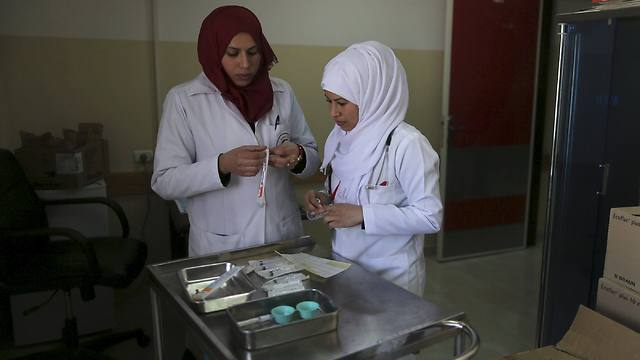
What if coronavirus reaches the besieged Gaza Strip? While this issue is of great concern for all Palestinians living under Israel’s military occupation, the Gaza situation is particularly complex and extremely worrying.
More than 50 countries have already reportedcases of COVID-19. If developed countries such as Italy and South Korea are strugglingto contain the deadly virus, one can only imagine what occupied Palestinians would have to face should it strike them.
In fact, according to official Palestinian reports, coronavirus may already have reachedPalestine thanks to a visit by a South Korean delegation between Feb. 8 and 15, which included tours of Jerusalem, Nablus, Jericho, Hebron, and Bethlehem. Nine members of the party were later confirmed to have contracted coronavirus.
The Palestinian Authority (PA) scrambled to contain the fallout of this news, which caused palpable panic among a population that had little faithin its leadership to begin with. Prime Minister Mohammed Shtayyeh said: “We hope that the owners of the unknown facilities (visited by the Korean delegation) have a sense of responsibility. We call on them to inform the authorities concerned and abide by the instructions.”
The Ministry of Health followed this by declaring a state of emergency in all hospitals under PA jurisdiction in the West Bank and designating a quarantine center near Jericho for those arriving from China and other areas that have been hard hit by coronavirus.
For Palestinians, however, fighting an outbreak of coronavirus is not a straightforward matter, even if the dysfunctional PA facilities followed the instructions of the World Health Organization (WHO) to the letter.
Palestinians are separated by an Israeli matrix of control, which has left many communities stranded behind large walls, military checkpoints and impossible-to-navigate army ordinances that are designed to weaken the Palestinian community and ease the Israeli government’s mission of controlling Palestinians and colonizing their land.
What can the PA do to come to the aid of tens of thousands of Palestinians in the so-called Area C of the West Bank? This region is entirelyunder the control of the Israeli army, which has little interest in the welfare of its Palestinian inhabitants. Such questions would have to be considered in the context of what WHO refersto as “health inequalities” among Palestinians on the one hand, and between Palestinians and privileged illegal Jewish settlers on the other.
In some ways, many Palestinian communities are already quarantined by Israel, but for political not medical reasons. An outbreak of coronavirus in any of these communities — especially the ones cut off from proper health care — would prove disastrous.
However, the worst fate would await Gaza should the deadly and fast-spreading virus find its way through the hermetic siege that engulfs this minuscule but densely populated region. Gaza, which is enduring its 13th year of Israeli siege and is still reeling from the mass destruction of several wars, has already been branded“unlivable” by the UN.
However, the misery of Gaza never ceases to worsen. Not a single UN report on Gaza’s ailing medical facilities or preparedness has, for at least the last 10 years, used any positive or even hopeful language. Last March, UN Humanitarian Coordinator for the Occupied Territories Jamie McGoldrick bemoanedGaza’s “chronic power outages, gaps in critical services, including mental health and psychosocial support, and shortages of essential medicines and supplies.”
In January, the Israeli rights group. B’Tselem reported an unprecedented health crisis in besieged Gaza — one that is not fueled by coronavirus or any other such epidemic, but by the fact that the Strip’s barely functioning hospitals are desperately trying to deal with the fallout of the thousands of injuries resulting from the “Great March of Return.”
B’Tselem last year reportedon “the unlawful open-fire policy Israel is using against these demonstrations. Allowing soldiers to shoot live fire at unarmed protesters who endanger no one has led to horrific results.” And in January the Israeli group citedmoderate estimates provided by the WHO that, by the end of 2019, Gaza physicians had to perform limb amputations on 155 protesters, including 30 children. This is in addition to the dozens of protesters who have been paralyzed because of spinal injuries.
This is only a small part of a multifaceted crisis. Not only have measles and other highly contagious diseases foundtheir way back into Gaza, but water-borne diseases are also spreading at an alarming rate. As much as 97 percent of all Gaza’s water is not fit for human consumption, according tothe WHO, which raises the question: How could Gazan hospitals possibly confront coronavirus when, in some cases, clean water is not even available in its largest hospital, Al-Shifa? “Even when it is available, doctors and nurses are unable to sterilize their hands because of the water quality,” according tothe RAND Corporation.
The WHO’s Palestine director Gerald Rockenschaub spoke assuredly about his meeting with PA Health Minister Mai Al-Kaila in Ramallah on Feb. 23, when they discussed the need for more “preparedness measures” and “additional priority preparedness actions” in the West Bank and Gaza. The organization also announced that it is “coordinating with local authorities in Gaza” to ensure the Strip’s preparedness to cope with coronavirus.
Gaza’s hospitals are as dysfunctional as ever, its water is as dirty as ever and, despite repeated warnings, the Strip is still unfit for human habitation.
Ramzy Baroud
Such soothing language, however, masks an ugly reality — one that the WHO and the entire UN have failed to confront over the course of a decade. All previous reports on Gaza by the WHO, while accurately detailing the problems, have done little to acknowledge their roots or fashion any permanent solutions. Indeed, Gaza’s hospitals are as dysfunctional as ever, its water is as dirty as ever and, despite repeated warnings, the Strip is still unfit for human habitation thanks to the brutal Israeli siege and the silence of the international community.
The truth is, no amount of “preparedness” in Gaza — or, frankly, anywhere in the Occupied Territories — could stop the spread of coronavirus. What is needed is a fundamental and structural change that would emancipate the Palestinian health care system from the horrific impacts of the Israeli occupation and the Israeli government’s policies of perpetual siege and politically imposed “quarantines,” also known as apartheid.
- Ramzy Baroud is a journalist, author and editor of The Palestine Chronicle. His latest book is “The Last Earth: A Palestinian Story” (Pluto Press, London). Baroud has a Ph.D. in Palestine studies from the University of Exeter. Twitter: @RamzyBaroud


