
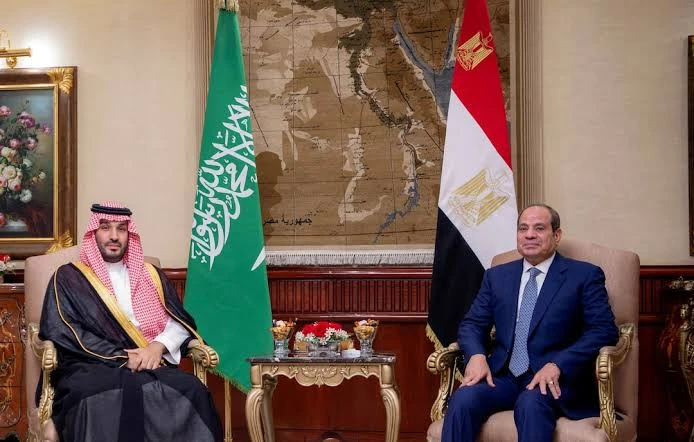

Egypt’s readiness to support Saudi Arabia carries a message that extends beyond the immediate confrontation with the Houthis. It expresses a judgment about the consequences of allowing attacks on a major Arab state to become a recurring instrument of regional pressure. Cairo’s position deserves to be understood through that judgment, alongside the limits it has placed on any prospective military role.
Those limits are essential to the policy’s purpose. President Abdel Fattah El-Sisi has clarified that Egyptian military action would be directed toward defending Saudi territory and borders, without extending to an offensive inside Yemen. This distinction identifies the objective against which Egypt’s intentions, preparations and eventual decisions should be assessed. It also offers a basis for aligning defensive assistance with efforts to contain the conflict.
For Egypt, Saudi security has immediate national significance. The two countries face each other across a sea whose stability affects their economies and strategic interests. Disruption around the Red Sea and Bab Al-Mandab threatens the maritime connections on which the Suez Canal depends. Instability in the Gulf also affects Egyptian workers and families, investment, energy costs and confidence in the wider regional economy.
This gives substance to the language of shared Arab security. Geography makes the consequences of insecurity difficult to contain within national borders. When airports, energy facilities or shipping routes become targets, the damage reaches businesses and households far beyond the location of an attack. Egypt therefore has a legitimate interest in helping prevent the deterioration of its strategic surroundings.
There is a political dimension as well. Persistent attacks can encourage the belief that pressure against civilian life and economic infrastructure will produce concessions. A credible capacity to protect Saudi Arabia may alter that calculation. If attacks become less effective and their political costs rise, the incentive to pursue them could weaken. That is the potential contribution of Egyptian support to deterrence.
It could also give diplomacy more room to operate. A state confident that it can defend its population and essential infrastructure may have greater freedom to negotiate and calibrate its response. Reliable assistance can help create that confidence. In this sense, Egyptian solidarity could reinforce Saudi Arabia’s ability to pursue a political outcome while resisting attempts to impose one through force.
Egypt has a legitimate interest in helping prevent the deterioration of its strategic surroundings
Dr. Abdellatif El-Menawy
This outcome is possible, not automatic. Military signals can be misunderstood and additional involvement can generate further escalation. Clarity about objectives must therefore accompany credibility. Cairo and Riyadh need a common understanding of the purpose, geographical scope and limits of any assistance. Arrangements for coordination should also ensure that an incident does not unintentionally expand the mission.
Egypt’s National Defense Council provided an important framework on Oct. 18. It coupled support for Saudi Arabia’s security and territorial integrity with a commitment to intensify political and diplomatic efforts toward regional de-escalation and peaceful settlements. The practical challenge is to ensure that both parts of that position advance together. Defensive preparations should give diplomacy greater weight, while diplomacy defines the political outcome those preparations are intended to support.
The request for parliamentary authorization belongs within this framework. Decisions involving Egyptian forces require institutional scrutiny of their objectives and consequences. Questions about the mission, the protection of personnel, financial commitments and the circumstances under which participation would end deserve serious answers. A partnership becomes more dependable when the responsibilities it entails are understood by the institutions and publics expected to sustain it.
It is important to recognize that debate over the form of support can coexist with a firm commitment to the Kingdom’s security. Egyptians can acknowledge the necessity of solidarity while asking how it will be exercised. Explaining the connection between Saudi security and Egyptian interests helps build durable support. Transparent political objectives, alongside appropriate operational confidentiality, strengthen the credibility of any commitment.
Diplomacy must also address those capable of influencing the course of the fighting. Egypt’s communication with Iran gives it a channel through which to press for restraint and respect for Gulf security. Tehran should be encouraged to use its influence constructively. At the same time, the Houthis have their own calculations and responsibilities. Any arrangement to halt attacks requires commitments from the actors expected to implement it, with mechanisms to assess compliance.
Lasting Saudi security is connected to a viable political settlement in Yemen. Defensive measures can protect territory and reduce vulnerability but they cannot alone resolve Yemen’s internal divisions. A serious political effort must protect civilians, sustain humanitarian access and create the conditions for meaningful negotiations among Yemeni parties. Egypt should use its diplomatic weight to support that effort alongside its assistance to the Kingdom.
Success will also require careful management of expectations. An announcement of readiness does not specify the composition or scale of a military contribution and political solidarity cannot substitute for practical agreement. Each government must retain clear responsibility for its decisions. Defining what can be delivered, under what conditions and for what purpose protects the relationship against misunderstandings when circumstances become more difficult.
In my view, the strategic value of Egypt’s position will ultimately be measured by its contribution to a safer regional order. A halt to attacks, greater protection for civilians, secure maritime routes and a credible return to negotiations would serve both Egyptian and Saudi interests. Cairo has an opportunity to help make these outcomes more attainable. Its support will be strongest when the determination to defend is matched by an equally clear determination to bring the confrontation to an end.
Dr. Abdellatif El-Menawy has covered conflicts worldwide. He is the author of “The Copts: An Investigation into the Rift between Muslims and Copts in Egypt.”
X: @ALMenawy


