
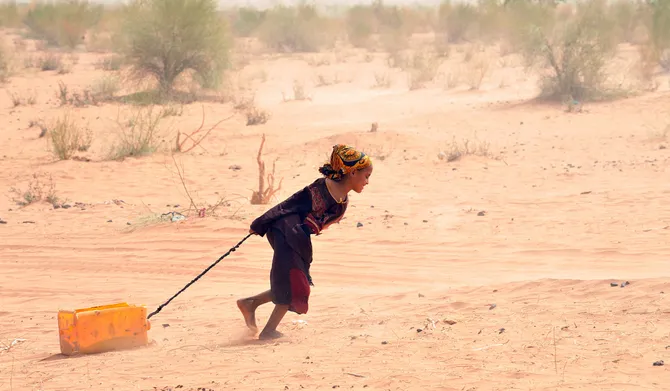

In northern Mali, a dry season can function as a border, courtroom, tax office, and recruitment center. During the 2023-24 drought, disputes over shrinking water access sharpened tensions between herders and farmers, while state officials remained largely absent after Mali’s externally propped-up security architecture had fractured.
Along came Jama’at Nusrat Al-Islam wal-Muslimin, or JNIM, operatives who have since occupied the political space created by that absence: mediating disputes, regulating movement, and extracting payments. A quarrel over water consequently became something far larger — a test of who can govern scarcity, and ultimately, profit from it.
Unfortunately, international policy still tends to classify climate change merely as an “amplifier” of conflict. The Sahel and Horn of Africa suggest something different altogether because increased climate stress is becoming a mechanism through which governance fails: territorial authority fragments, and armed groups acquire legitimacy.
Behind these woeful aggregates is a more consequential shift, as rainfall becomes less predictable, pastures deteriorate, and harvest windows contract. Ordinary administrative failures become security failures or compound existing ones. A government unable to secure a well, protect a grazing route or arbitrate a land dispute progressively surrenders functions that armed actors can easily appropriate.
A similar pattern is also visible in the Horn. Somalia’s federal government remains heavily concentrated around Mogadishu and major transport corridors, leaving Al-Shabab substantial room to administer rural disputes. Sudan’s war, meanwhile, has displaced more than 10 million people and shattered administrative capacity across Darfur, Kordofan, and Blue Nile. In both regions, environmental stress magnifies the value of whoever can enforce access to land, water, and markets.
Clearly, militant groups have learned the lesson faster than many governments. JNIM has exploited water points and livestock corridors across the Liptako-Gourma tri-border region, imposing taxes on movement and livestock. Al-Shabab’s rural courts have acquired a reputation for predictability because rulings are enforced. During shortages, insurgents can tax grain, collect zakat, and redistribute resources, reproducing fragments of a welfare state.
The next decade in Africa’s climate-stressed, fragile, and conflict-affected regions will be contested through resource governance.
Hafed Al-Ghwell
Scarcity therefore creates a political market. Communities need predictability — armed groups can sell it. Livelihood collapse supplies recruits, while abusive or absent governments deepen alienation. Research by the UN has conclusively shown that economic grievances and experiences of state abuse can outweigh ideological motivations in pathways to violent extremism.
Yet Western strategies remain poorly aligned with the transactions taking place at ground level. Billions have gone into counterterrorism, training, intelligence, and military deployments. Far less has gone into securing pastoral corridors, clarifying land tenure, governing wells or adapting agriculture at the scale required. Humanitarian agencies can keep people alive, but food distribution alone cannot determine who controls the road, the pasture or the next harvest.
The next decade in Africa’s climate-stressed, fragile, and conflict-affected regions will be contested through resource governance. The decisive political constituency may be the millions whose survival depends on increasingly scarce water, pasture, and food. Security policy must therefore move the climate question into the center of conflict diplomacy, where land, water, and adaptation finance become instruments of stabilization rather than peripheral environmental concerns.
The choice is becoming clearer at every drying well; climate governance will either reinforce legitimate institutions, or armed groups will govern the scarcity for captive constituents. The harder question now, however, is what a genuine climate security table would actually negotiate.
Peace processes traditionally bargain over political authority — territory, ministries, elections, ceasefires, constitutional rules. Resource conflicts require a different unit of negotiation. A functioning settlement may begin with something as prosaic as the opening date of a grazing corridor, the depth at which a communal well becomes restricted, the price of water delivered by a tanker, or the compensation owed when livestock destroy cultivated fields. Such questions rarely reach national peace talks, yet they determine whether communities perceive government as useful.
Future climate tables therefore need to operate closer to the ground. Governments should retain political authority while delegating carefully defined resource decisions to district administrations, customary leaders, pastoral associations, farmers’ cooperatives, and women’s groups. Meteorological information should become part of the settlement machinery. Forecasts of poor rainfall can trigger pre-agreed grazing rotations, emergency fodder reserves, temporary livestock markets, and negotiated migration routes before households begin moving under pressure.
Such arrangements would also change the economics of prevention. Governments routinely spend far more after displacement — communal violence and market disruption having begun — than they would have spent protecting a shared borehole or maintaining a livestock corridor beforehand. A $100,000 water-management project can look like rural development on a budget document while functioning as conflict prevention once its avoided costs are counted. The security sector needs accounting systems capable of recognizing that return.
Another shift concerns data. Most conflict databases count shootings, kidnappings, battles, and fatalities. Resource disputes often begin weeks or months earlier in signals that those systems barely capture; such as unusual livestock movements, spikes in grain prices, wells running dry, school closures caused by displacement or sudden increases in land transactions. Governments should build “resource stress indicators” into early warning systems. A district with falling groundwater, rising food prices, and accelerating displacement should trigger intervention before armed actors acquire the opportunity to present themselves as problem-solvers.
In addition, the most important change may involve time horizons. Counterterrorism programs are frequently judged in months; hydrological systems, pastoral adaptation, and land reform operate over years. Armed groups understand the difference. They can cultivate a community gradually, collect taxes repeatedly, settle disputes consistently, and wait for the next drought to deepen dependence. States often arrive with a short project cycle, a new task force, and another round of training.
Climate security consequently demands institutional patience. The goal is not simply to make communities resilient enough to endure shocks. Governments need to become more useful because shocks are becoming structural rather than exceptional. A resource-centered doctrine would also force policymakers to reconsider what counts as a security partner.
African governments frequently compete for adaptation funds using project-by-project applications, while communities experience climate stress as a connected system of water, food, mobility, and security. Donors should therefore finance corridors, watersheds, and grazing systems as integrated security zones rather than scattering small projects across administrative boundaries.
Successes would look deceptively ordinary, but they may nevertheless determine whether a state retains political authority in the places where authority matters most. The emerging lessons are uncomfortable for policymakers accustomed to siloed thinking in capitals, commands, and campaigns. Sovereignty is experienced locally. A government becomes real to a citizen when a contract is enforced, a road remains open, a market functions, a dispute receives a ruling, and a scarce resource can be accessed without paying an armed intermediary.
• Hafed Al-Ghwell is senior fellow and program director at the Stimson Center in Washington and senior fellow at the Center for Conflict and Humanitarian Studies.
X: @HafedAlGhwell


