


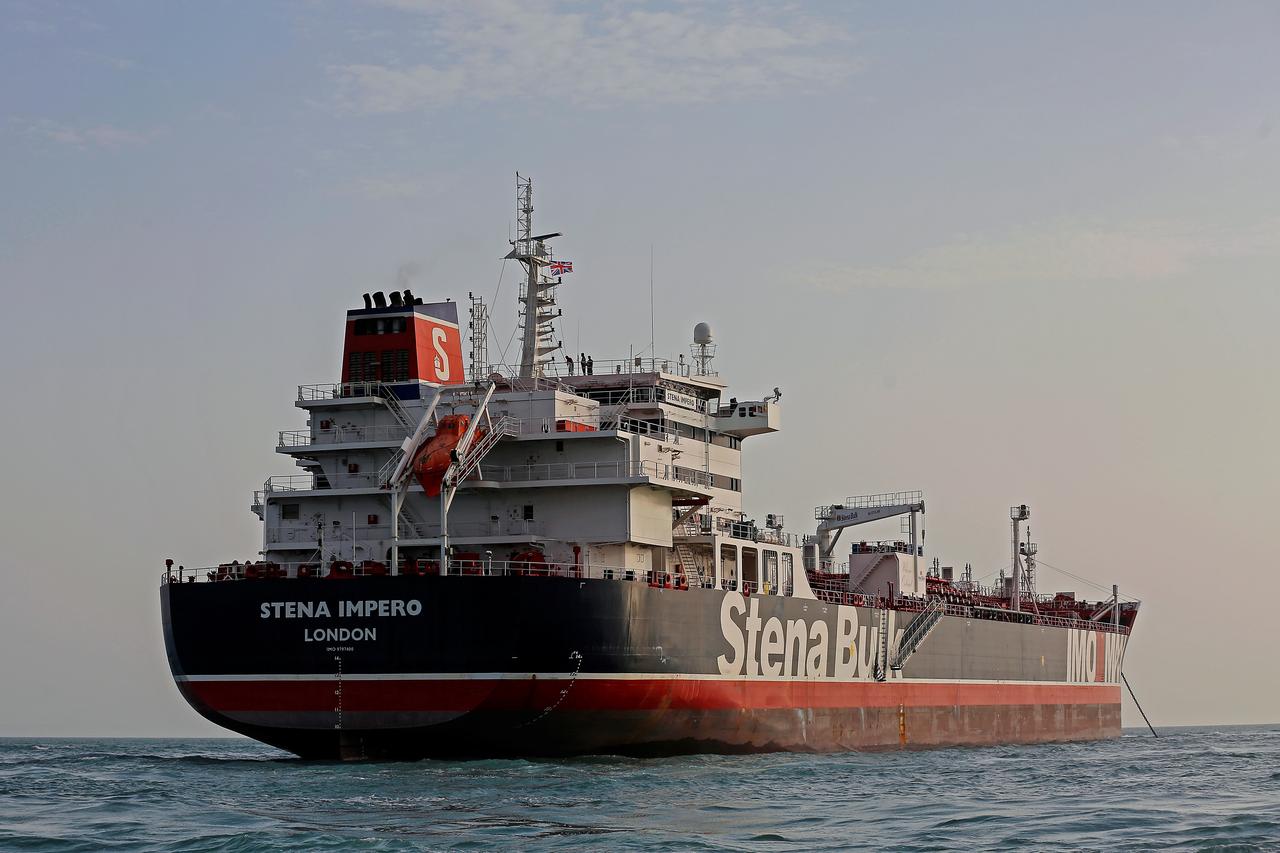
The Islamic Revolutionary Guard Corps’ July 19 seizing of the British-flagged oil tanker Stena Impero and detention of its crew quickly became the most prominent of a number of incidents in the Arabian Gulf.
While Iran’s regime was keen to deny any links to subversive acts, it quickly presented legal justifications to legitimize the seizure of oil tankers. It cited the sovereign rights of countries in their territorial waters, although none of the seized tankers had violated the maritime passage rights enshrined in the UN’s 1982 Convention on the Law of the Sea.
The targeting of oil tankers in the region reveals the depth of the crisis the regime is currently experiencing, as well as demonstrating Iran’s systematic policy behind this escalation, through which it wants to achieve several objectives.
At the international level, Tehran wanted to test the US reaction and find out how far it can go before Washington is ready to carry out military action. At the same time, this Iranian policy helps the leadership in Iran fulfill its desire to respond to the US pressures put on its oil exports with its own countermeasures. The US sanctions have led to Iranian oil exports plummeting to a reported 200,000 barrels per day. In the medium term, this level of oil exports will create tremendous challenges for the regime at home. Also, the regime is betting on influencing global oil prices and oil/gas safety, as well as their supply, as a means of changing the approach of major powers toward Iran. Finally, by seizing oil tankers, Tehran wants to deter global powers from considering any seizure of Iranian oil tankers in the future.
At the regional level, Iran wanted to prove its ability to deprive regional countries of their oil exports in response to being deprived of its own. The regime in Tehran has repeatedly issued statements threatening retaliation since the US announced its desire to reduce Iranian oil exports to zero. It has also wanted to affect the economic stability and security of the Gulf nations in the hope of influencing their positions, in particular to reduce their role in intensifying pressure on Tehran.
While oil prices have not been affected as Iran expected, regional and international powers have decided to take decisive measures.
Dr. Mohammed Al-Sulami
Domestically, the Iranian regime wished to exploit these developments and escalations to curb unrest, which is likely to get out of control due to worsening living conditions that the regime’s powerbrokers describe as unprecedented. Also, the regime, by manipulating the situation it finds itself in, wants to present an image to the Iranian people of being powerful, cohesive and able to withstand any level of pressure.
However, contrary to the Iranian regime’s objectives, the US has opted to intensify its pressures on the country. While oil prices have not been affected as Iran expected, regional and international powers have decided to take decisive measures to respond to Iran’s hampering of navigation in the region.
Global powers have put forward proposals to internationalize the issue of maritime navigation in the Gulf. The US has proposed forming an international-led force, while Britain offered to establish a European-led force to protect free navigation and Kuwait has announced Arab-Gulf coordination.
In a related context, major powers situated in the region have begun to enhance their military presence. The UK announced it would be sending naval vessels to the Gulf to protect its oil tankers, adding that it will boost its presence if dangers increase. US President Donald Trump has also called on Japan and China to protect their oil tankers in the area, which they are likely to do since 30 percent of global energy consumption comes from this region.
In the midst of these developments, Iran has watched with great concern because it has contributed to escalating pressure on the regime and opened the door to the possibility of further harsh sanctions being imposed on it. In addition, these developments have the ability to deny Tehran one of the most important cards in its possession: Of threatening navigation in the Arabian Gulf. The announcement made by Iranian officials that they may change the security situation in the Strait of Hormuz, along with the potential formation of a European-led force to ensure maritime security in the region, could lead to a high-stakes confrontation and tremendous consequences.
There is an expectation that Iran will continue to harass oil tankers in the waters of the Arabian Gulf, whether through abductions or armed seizure of vessels, sending a message to the Iranian public that the regime is capable of standing up to pressures while warning the outside world that it can cause damage to the interests of others. And, more importantly, that Tehran seeks to score some points before sitting down at the negotiating table.
- Dr. Mohammed Al-Sulami is Head of the International Institute for Iranian Studies (Rasanah). Twitter: @mohalsulami


