
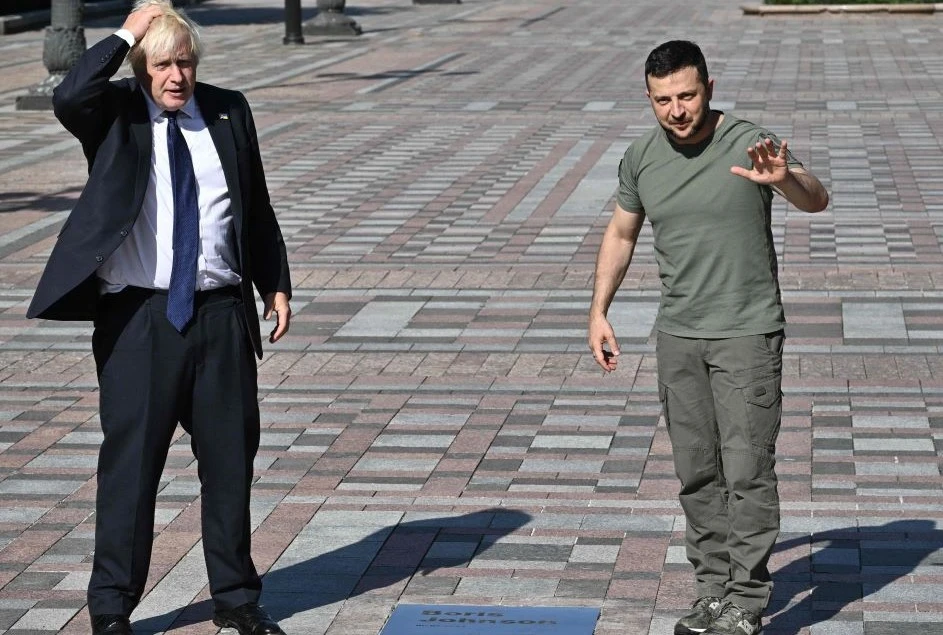

Love or loathe him, few can deny that Alexander Boris de Pfeffel Johnson has bestrode British politics for more than a decade, casting long shadows over those who struggle to share the limelight.
His two terms as mayor of London, two years as foreign secretary and three years as prime minister have rarely been tarnished with tedium. However, the removal vans have now emptied 10 Downing Street and, come Sept. 6, Johnson will revert to being a plain backbench member of Parliament. Will he be the ghost that haunts his party?
For a man who found fame on a TV news quiz show, hiding in the background or silently traipsing off stage into obscure anonymity just does not figure as an option. Johnson would inspire drama and mayhem in a vacuum.
For the doubters, I proffer five terms: Busses, cake, letter boxes, dead cats, and big dog. Johnson will be forever linked with the Brexit bus bearing the unfulfilled pledge that the National Health Service would get an extra £350 million a week if the UK left the EU. Then there was the cake that Johnson was infamously said to have been “ambushed” by at one of the 10 Downing Street parties he attended during COVID-19 lockdowns. Thanks to these parties, he leaves office as the only sitting British prime minister to have been found to have broken the law. As for letter boxes, he once wrote that women wearing burqas looked like them — a reminder of the various racist comments he stands accused of, along with the culture wars he routinely stokes.
The dead cat strategy was a specialty of Johnson’s. This is the art of making a shocking announcement to divert attention from a lingering scandal. Johnson had no trouble herding dead cats in times of turmoil. As he often said: “My friends, as I have discovered myself, there are no disasters, only opportunities. And, indeed, opportunities for fresh disasters.”
As for large canines, Johnson launched “Operation Save Big Dog” in an attempt to resurrect his political fortunes earlier this year. The operation failed, though who would rule out an “Operation Bring Back Big Dog” in a few years’ time. Johnson certainly will not.
Disasters were never in short supply. Diplomacy did not come naturally, if at all. The Westminster commentariat were left aghast when Theresa May made him foreign secretary. The media could not get enough of his embarrassing moments, such as when he lined up alongside a major international figure he had once lampooned in his own inimitable style. In 2015, Johnson reacted to criticism of London from Donald Trump with the putdown: “The only reason I wouldn’t go to some parts of New York is the real risk of meeting Donald Trump.” He also made disparaging comments about Hillary Clinton and wrote a deeply unflattering poem about President Recep Tayyip Erdogan of Turkey.
But his proponents keep chirping that, while he is typically as organized as his hairdo, he “got the big calls right.” Famously, in 2016, he wrote two opinion pieces for and against leaving the EU before opting for Brexit — a move that arguably gave that campaign the winning impetus it required. He did indeed deliver the country’s exit from the EU, but his much-vaunted “oven-ready deal” was not as well prepared as he initially declared. The issue of Northern Ireland could yet see an EU-UK trade war become one of Johnson’s legacies.
On the pandemic, yes Johnson can boast about the success of the UK’s vaccination program, but perhaps history will be less kind about the vacillating nature of some of the decision-making. Many members of his party were furious that there was any kind of lockdown at all. Johnson will also never want to be known as the leader who canceled Christmas, as he did in 2020.
Perhaps least controversial was his robust position on the Russian invasion of Ukraine. Johnson placed Britain in the avant-garde of those states backing Kyiv and he remains a popular figure there. How history will judge this position will depend on the long-term outcome, but he did not back down in challenging Russia’s actions.
So, what will “Boris” do now? Some of his predecessors sought solace and riches in some grand international position. This might appeal. This is a man who apparently dreamed of becoming “world king.” Yet he has few allies in Europe post-Brexit and he and US President Joe Biden share little chemistry. Johnson may have to cool his heels on the British stage for now.
At home, Johnson has already shown his keenness to prove his premiership was a success. He has a devoted base both in the parliamentary Conservative Party and among Tories generally. Polls of party members show that Johnson would comfortably defeat the two candidates to succeed him. After all, he delivered an 80-seat parliamentary majority in 2019, the largest for the party since the Thatcher era. He can still play to this gallery.
Whoever succeeds him — and it looks like it will be a Johnson loyalist in Foreign Secretary Liz Truss — will have to keep looking in the rear-view mirror for that forest of blond hair. He will not sanction huge shifts from the paths he chose. He will be a magnet for any opposition to Downing Street, able to tap into his enduring popularity in the right-wing media.
Johnson is Britain’s most successful populist. He fits unfailingly into that mold. The truth is a luxury for him and facts extraneous. His sales patter relied on neither. Many will not forgive him for lowering standards in British public life, for arguably misleading Parliament and for the scandals that ultimately compelled his exit, prompted by a record number of British ministers resigning in a single day. Johnson never believed the rules applied to him, as the “partygate” saga highlighted. He rarely hesitated to undermine British and other institutions, from Parliament to the BBC and the courts and their “lefty” lawyers.
Johnson returns from a long, much-photographed summer holiday all fired up for the next phase of his political odyssey, with punchy self-justifying columns in a major media outlet under consideration.
Chris Doyle
He indulged and pandered to the anti-immigrant mob, to such an extent that his government has pursued a policy of sending asylum seekers 6,500 km away to Rwanda. Above all, everyone was to blame except himself. Another legacy could be that he will be flattered by others mimicking his style, which is not something that augurs well for British politics.
So, no exit for Johnson from public life. He returns from a long, much-photographed summer holiday all fired up for the next phase of his political odyssey, with punchy self-justifying columns in a major media outlet under consideration. His curious parting shot in the House of Commons should not be forgotten: “Mission largely accomplished for now… Hasta la vista, baby.”
- Chris Doyle is director of the Council for Arab-British Understanding, in London. Twitter: @Doylech


