
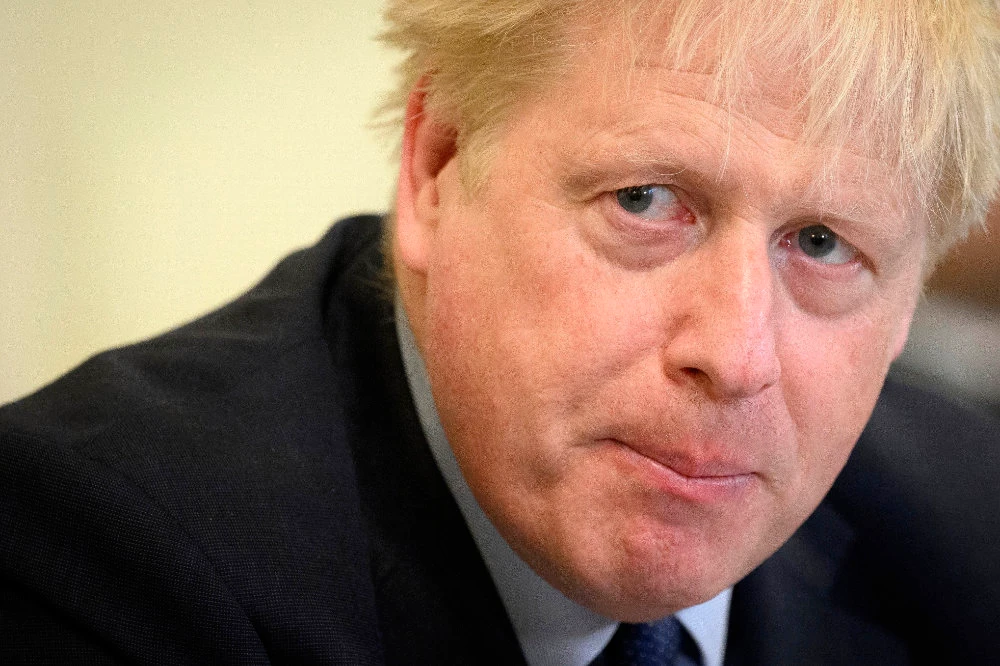

Monday night witnessed the beginning of the end of Boris Johnson’s UK prime ministership, despite him winning a confidence ballot in his leadership among Conservative MPs.
Johnson prevailed in a narrow technical sense by getting 211 votes, exceeding the 180-vote threshold needed for him to stay in power. However, he lost in a wider and more important political sense, in that he did not win by enough to end the questions about his leadership, which have long dogged him.
A higher-than-expected 148 MPs voted against him — that is more than 40 percent of Conservative MPs. This is a worse result than Theresa May experienced in her 2018 confidence vote and she resigned within the next six months.
One other illustration of how disappointing the result was for the prime minister is shown by the fact that as many as four in five of the 211 Conservative MPs who backed him may have been on the so-called government payroll. Some 160 to 170 MPs currently hold government roles, such as ministers and parliamentary private secretaries.
A large majority of these payroll MPs will likely have backed Johnson, so possibly as many as 80 percent of the 211 MPs who voted for him can be said to have done so chiefly out of duty. This raises the possibility that only a few dozen non-payroll MPs also voted in favor, implying that he has lost the confidence of the majority of Conservative backbenchers.
Bad as the result was for Johnson, however, it could have been even worse were it not for the fact that there is no clear and obvious successor within the Conservative Party’s parliamentary ranks. This was underlined on Monday in a YouGov survey of more than 500 party members, which found preferences evenly split.
In that poll, Defense Secretary Ben Wallace was supported by 12 percent of members, Foreign Secretary Liz Truss 11 percent, former Foreign Secretary Jeremy Hunt 10 percent, former Defense Secretary Penny Mordaunt 8 percent, Finance Minister Rishi Sunak and Levelling Up Secretary Michael Gove 7 percent, Home Secretary Priti Patel 6 percent, House of Commons Foreign Affairs Committee chair Tom Tugendhat and Education Secretary Nadhim Zahawi 5 percent, and Justice Secretary Dominic Raab 4 percent.
So Johnson’s win was a Pyrrhic victory and is likely to be the beginning of the end of his reign, which may now be over in a matter of weeks or months, rather than years. The danger now is paralysis in government while Johnson remains in power, whereby policy is tactical — designed to curry favor with one sector of the population or another — rather than strategic.
Only a few dozen non-payroll MPs voted in favor, implying that he has lost the confidence of the majority of Conservative backbenchers.
Andrew Hammond
Such a weak government would be bad for the UK, given there is a clear need for a post-Brexit vision for the country. This point was highlighted in an important Ernst & Young report released last month, which looked at investor sentiment across Europe. It found that the UK remains a leading European investment destination, but confidence is fragile and other countries are becoming more attractive, particularly France as a result of President Emmanuel Macron’s reforms. There was a big increase in the attractiveness of France last year, with its rating rocketing by 24 percent.
In terms of the next steps for Johnson, he may now have a Cabinet reshuffle, while next week he expects to lay out a new “plan for growth.” However, the Conservative Party faces two difficult by-elections on June 23 in seats it currently holds but which it may lose.
Under the current party rules, there will be no further confidence votes for a year. However, Monday’s larger-than-expected opposition to Johnson is a damaging blow and the terms of office of several of his Conservative predecessors ended relatively soon after similar contests, including John Major and Margaret Thatcher in the 1990s, despite them also technically winning.
Johnson’s supporters will argue that he achieved at least two big wins. Firstly by getting the UK out of the EU in 2020. And secondly with his landmark general election victory in 2019, for which the Conservatives redrew, at least temporarily, the UK political map by winning a number of long-standing Labour strongholds, especially in the Midlands and North of England.
However, it is not just the prime minister’s critics who argue that, for much of the past two-and-a-half years of the coronavirus crisis, his approach has been chaotic and incoherent. When he scored his huge electoral win in December 2019, it was widely forecast that he could remain in office for much of the 2020s, but the rollercoaster ride that his premiership is proving means his term could end this year.
So, the chances of him being the Conservative leader at the next general election have decreased and he will now be politically wounded for the rest of his prime ministership. It has always been dangerous to write him off politically, but the only question now is surely how soon his tenure in Downing Street will come to an end.
• Andrew Hammond is an Associate at LSE IDEAS at the London School of Economics.


