
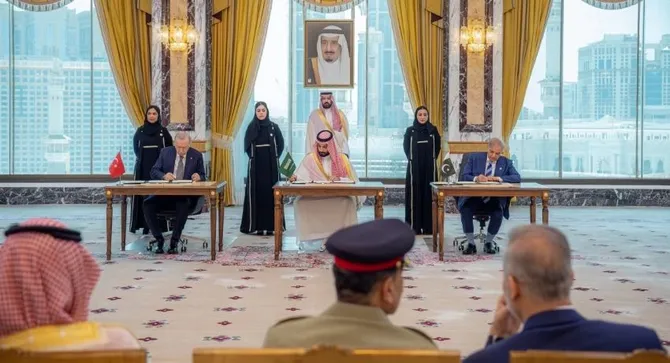

The signing of the Makkah Joint Defense Agreement by Saudi Arabia, Pakistan and Turkiye this month triggered several reactions. Some countries welcomed it, others had a more reserved approach and some were outright alarmed at seeing three important Muslim countries come together. Since the agreement was announced, hundreds of articles have been published and hundreds of interviews given to analyze its implications for regional and even global security. However, few have examined its effects on the grassroots level.
The agreement has awakened a new consciousness among the people of the region. For the first time, they feel they have the power of self-determination. A new movement has already been born in Lebanon and it has the potential to spread across the region. This is very important. People believe they can own their security and their fate. They do not need to be attached to a foreign power, whether that is the US, Russia or China. This comes after a century of relying on foreign powers for protection.
During and after the First World War, US President Woodrow Wilson spoke about self-determination as being the cornerstone of global peace. But the Middle East did not enjoy self-determination. This was more of a slogan to cover for Western dominance. The Levant, for example, had to endure the Sykes-Picot Agreement and the Balfour Declaration. After the Second World War, the region had to choose either the Soviet camp or the American one. Even after the fall of the Soviet Union, the region still had to have external protection. Today, the countries of the region are realizing their own power if they come together. They no longer need to rely on foreign powers.
States in the region have finally realized that security stems from themselves, not from a foreign power.
Dr. Dania Koleilat Khatib
It is also about a new mentality in the region. It is based on cooperation, balance and stability. The region has long been torn between competing ideologies and competing camps. The states and people of the region always had to choose a camp. In the 1950s, it was the pan-Arab, pro-Soviet or pro-West camp. More recently, it has been either the pro-West or the Iranian camp.
The Makkah Agreement changes things. This alliance is based on coming together to achieve prosperity and security for all. States in the region have finally realized that competition and confrontation lead to nowhere. They have also realized that the security they seek stems from themselves, not from a foreign power.
“The region is witnessing a transformation. The agreement between Saudi Arabia, Turkiye and Pakistan opens the door for a new era of regional relations that will deliver prosperity and security to its people, and we don’t want Lebanon to be left behind,” said Amine Bashir, a Lebanese lawyer and activist. He is starting, along with other like-minded activists, the “Justice and Freedom Movement.”
According to Bashir, the Makkah Agreement opens a new chapter in the region and Lebanon should seize the opportunity to realize its own self-determination. He added the new movement is not taking the side of one axis over another, simply because it does not view the Makkah Agreement as involving an axis. The pact is not aimed against anyone but is rather focused on benefiting its members. The agreement sets the concept of balanced partnerships. Hence, it is in the interest of Lebanon to have a position within this framework.
What is interesting about this movement is that it comes from the grassroots, from activists in touch with ordinary people. This tells you a lot about the Makkah Agreement and why it is set to be a success. It is not about regional leaders meeting up and signing a piece of paper. It is about the will of the people. People in the region are fed up with empty slogans that lead them nowhere. They want to see concrete results. This pact transcends fake ideologies or ethnicities. It talks to every one of us. It talks about how people can live in dignity and peace, how they can prosper by relying on themselves and how they can craft a better future for their children.
This pact transcends fake ideologies or ethnicities. It talks about how people can live in dignity and peace.
Dr. Dania Koleilat Khatib
For Lebanon, the Makkah Agreement is very important. In its manifesto, the Justice and Freedom Movement states that it believes that the upcoming phase will witness a shift from a policy of axes to a policy of partnerships and from dependency on foreign powers to independence and self-reliance. It is a platform that can give Lebanon leverage when negotiating with Israel. In the activists’ view, Lebanon should be part of this framework in order to be able to talk with Israel on an equal footing and not be forced to accept humiliating conditions. Bashir said Lebanon has a chance — instead of being pulled by competing axes — to be part of an attempt to create stability in the region.
This nascent movement is only an example of how people think. The same way those in Lebanon think that the Makkah Agreement could be their salvation, I am sure many Iraqis, Syrians, Jordanians and others think the same. The fact this agreement transcends leaderships and trickles down to the grassroots means it is sustainable. Popular acceptance of the Makkah Agreement will give it momentum to grow bigger and stronger. Again, it is not only about three leaders meeting and signing a piece of paper, it is about the people of the region wanting to take their fate into their own hands.
- Dr. Dania Koleilat Khatib is a specialist in US-Arab relations with a focus on lobbying. She is co-founder of the Research Center for Cooperation and Peace Building, a Lebanese nongovernmental organization focused on Track II.


