


Societies’ approach to immigrants goes beyond the complex issue of migration itself. It is a reflection on them as a whole. It reflects on their humanity, their openness to accept the other, and their readiness to see the opportunities and the enrichment that comes with the arrival of new and diverse people.
However, we cannot ignore or deny that the arrival of migrants, especially in large numbers, does present significant challenges. Evidently, as the 21st century marches on, the debate over migration is dominating the political discourse, but mainly in a malign and destructive way, rather than with a constructive approach that combines compassion and effective policies. Those who flee civil wars, persecution, natural disasters and extreme poverty desperately need our understanding and support, not our judgments and pontifications.
Countries can legitimately evaluate how many migrants they can absorb, and within what timeframe. But they also need to be reminded that migrants are human beings who are entitled to the same rights as anyone else, to aspire to a better life, to fulfill their potential and to have their culture respected. This is sadly not the experience of many millions of them, as they experience constant hostility and incitements against them.
There is also another tragic side of migration that most of us would rather ignore or supress, which is the growing death toll en route as migrant numbers increase in many parts of the world. A new Associated Press (AP) investigation has documented at least 56,800 migrants dead or missing worldwide since 2014. This figure is clearly shocking, not only because of the enormous number of fatalities among those who are attempting to escape extreme hardship, but also because the figure is nearly double the 28,500 suggested, until now, by the UN’s International Organization for Migration.
The AP report makes grim reading. But it should be read, particularly by those who viciously criticize migrants and even dare to suggest that they are no more than a bunch of lawbreakers on the run from their own countries. The plain truth is that they are simply victims of circumstances beyond their control, including the actions of those countries that refuse to admit them. They have embarked on dangerous voyages for their own salvation.
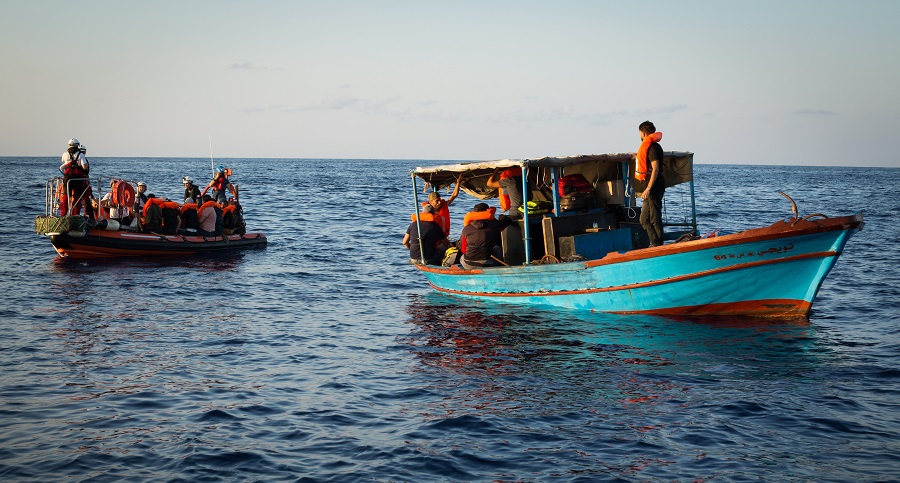
Tens of thousands never make it to their destination and die on the way, and in many cases are either buried in complete anonymity or lost at sea. The numbers are staggering: At least 18,400 dead or missing in Africa, and 22,000 in the Mediterranean and Europe; so many of them drowned while attempting the sea crossing in overcrowded and unseaworthy vessels.
The vast majority of migrants are legal ones, and are part of an orderly movement of people for economic reasons
Yossi Mekelberg
Worse, because of the chaotic nature of migration in times of extreme hardship, and the illicit character of this particular brand of migration, which is cynically exploited by unscrupulous smugglers, the number of fatalities is bound to be even higher than the reported figures. But, due to decreasing funds for projects aiming to identify these people, we will probably never get the full picture of this sad phenomenon. It is symbolic of the general attitude to migrants, especially those who come from the developing world, that they are looked on as lesser human beings, not only when they are alive, but also when they face their maker in such tragic circumstances.
It might be the case that this AP tally will cause a few shock waves to pass through certain quarters of the international community, including international organizations, governments and the general public, but their concern most likely won’t last for long. In most cases, the initial upset caused by such reports is soon replaced by a reversion to apathy or, worse, a heaping of blame on the migrants themselves for attempting to leave their countries in the first place.
This protracted and heart-breaking tragedy has been playing out for years, typically in the Mediterranean Sea, but still we have yet to see any genuine effort by the EU or any of its members to take sufficient action that will ensure the safety of those on board the boats, or to rescue survivors of craft that have sunk or just fallen apart.
Furthermore, while much attention has been given to what is happening in Africa and Europe, Latin America’s refugee crisis has been brewing for years. Political and economic crises are causing large numbers of people to try to escape these trouble spots. However, nobody took much notice of the caravans of Central American refugees until the subject recently became part of the midterm party political debate in the US.
Such large-scale movements of people will continue. At the end of 2017, 258 million people were living in a country other than their country of birth. What is urgently needed is to put a stop to politicians exploiting the issue for short-term political gain, and instead to take an integrated approach to this complex issue. The vast majority of migrants are legal ones, and are part of an orderly movement of people for economic reasons that serve both the migrants and the economies that provide them with work permits. Others do it for family reasons, ancestry rights, educational studies, and for other purposes that are entirely legitimate and in good faith.
And then there are those who are despairing to the extent that they are ready to put their lives on the line and hand over much of what little personal wealth they may have to parasitic smugglers. For these unfortunate refugees, the international community needs to come up with immediate and long-term solutions.
First and foremost, putting an end to disorderly migration requires international efforts to resolve domestic conflicts and crises and nip them in the bud. This will dramatically reduce people’s motivation to take the extreme risks that are often involved in leaving their countries. Furthermore, the world’s affluent economies must accept that there needs to be a radical transformation of the economic system, whereby they will cease to consider developing countries as a source of natural resources and cheap labor that they can take advantage of.
Cracking down on the gangs of people smugglers is imperative too, as they exploit the desperation of so many millions and make their situation even worse.
And lastly, in line with international law and commitments, states have obligations to those who face concrete and immediate threats to support them either in their country of origin or to provide them secure ways to reach safe havens. This is not much to ask of the civilized international community in the 21st century.
- Yossi Mekelberg is professor of international relations at Regent’s University London, where he is head of the International Relations and Social Sciences Program. He is also an associate fellow of the MENA Program at Chatham House. He is a regular contributor to the international written and electronic media. Twitter: @YMekelberg


