
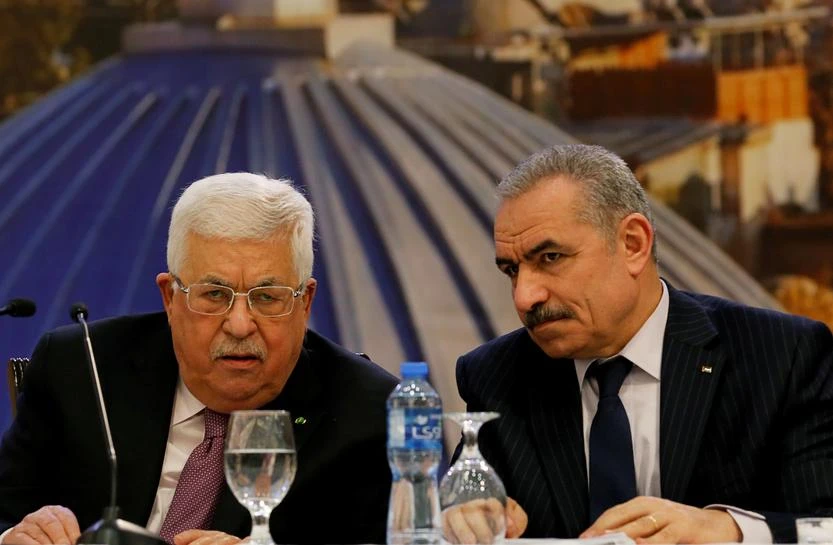

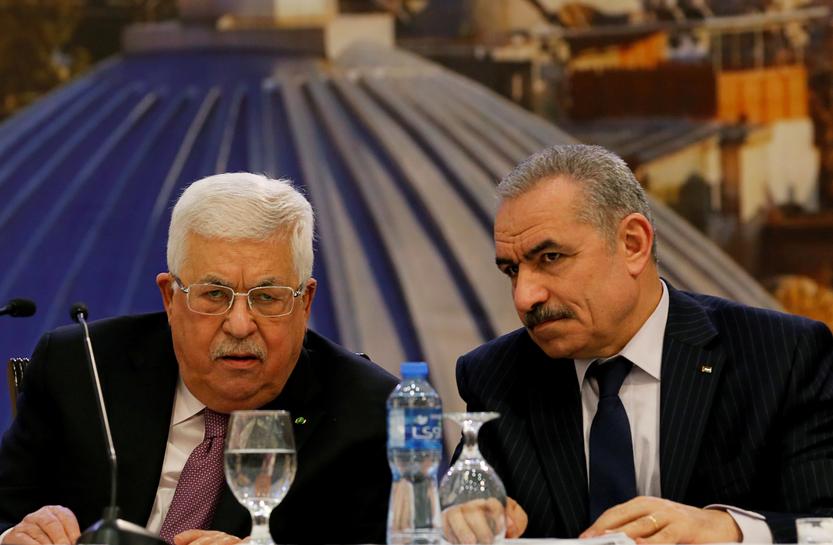
During a virtual meeting with European legislators on Nov. 3, the words of Palestinian Authority (PA) Prime Minister, Mohammed Shtayyeh, were: “If we are going to live another four years with President (Donald) Trump, God help us, God help you, and God help the whole world.”
While some may agree with Shtayyeh’s assessment, such utterances by a top Palestinian official are hardly reassuring.
This was not the first time that Shtayyeh had used the phrase with reference to Trump. Nor was it the only instance when the Palestinian leadership had employed such inconsequential political discourse to counter Trump’s pro-Israel bias throughout his first term. His bias allowed Tel Aviv to entrench its military occupation in Palestine, while denying Palestinians the meager financial handouts secured under previous political agreements.
In response to the Trump administration’s announcement that it intended to move the US Embassy from Tel Aviv to Jerusalem, followed by the decision to cancel all US aid to the PA in August 2018, Palestinian President Mahmoud Abbas invoked something similar in a speech before the PLO’s Central Committee when referring to Trump.
In January 2018 the committee was summoned for a meeting under the banner of “Jerusalem, Eternal Capital of the State of Palestine.”
The urgency and timing of this meeting indicated that Abbas was ready with a counter-strategy in response to the US and Israel’s ongoing violations of international law, the Oslo Accords, and all similar agreements.
Nearly two years have passed since Abbas delivered his absurd speech, yet no actual steps have been taken to ensure Jerusalem becomes the “eternal capital of the State of Palestine.”
If one is to review the Palestinian leadership’s strategy since Trump’s arrival in the White House four years ago, one is left confused by the chaotic and unproductive nature of Palestinian political discourse.
Still, four years were insufficient for the PA to change course and produce and champion a new political strategy not predicated on begging and pleading with Washington to return to the long-defunct "peace process." Why?
Abbas’ ongoing dilemma is that the authority and his very position as "president" are themselves an outcome of a US-sponsored political "vision" in the region.
Even the PA security forces were largely trained and funded by the US. It would not be hyperbole to claim that the entire political lexicon according to which the PA has operated since 1994 — but especially since the start of Abbas’ leadership in 2005 — was predicated on US diktats and sustained by US dollars.
Consequently, one can appreciate the impossible position in which Abbas and the Palestinian political elites found themselves when Washington cut them off politically and financially.
Without an alternative to Washington’s political involvement and generosity — however biased toward Israel — the PA persisted in a state of suspended animation.
Speech after fiery speech and statement after heated statement, Abbas wanted the Palestinians, and the rest of the world, to believe the PA was progressing beyond Washington and its peace process. Ultimately, yet unsurprisingly, they went nowhere.
The state of arrested development that has afflicted Palestinian politics in the last four years can also be attributed to another factor: The hope that a Democratic presidency would eventually be restored and that only then could the "peace process" gambit return to business as usual.
But the "let’s wait and see" strategy was not supposed to last this long. The PA was assured by top Democratic officials that the Trump presidency would not last long. Abbas was receiving assurances from former US Secretary of State John Kerry that soon enough all would return to normal.
Abbas was told through close associate Hussein Agha — who met Kerry in London in January 2018 — to “hold on and be strong.”
“Tell President Abbas that he should stay strong in his spirit and play for time, that he not break and not yield to Trump’s demands,” the Israeli newspaper Maariv reported Kerry as saying to Agha — a report that was confirmed by PA officials.
However, Kerry had not anticipated that the Trump administration would last until the end of its term, that the US president would move forward with all of his threats, and that the so-called deal of the century would attempt to revise the entire geopolitical map of the Middle East.
Yet, the PA hung on. Not only did it fail to formulate an alternative strategy, it even failed to unify the rank of Palestinian groups or stick to a consistent political line that was followed by meaningful action.
It merely “condemned,” “rejected” and “criticized,” repeating cliches, and insisting on a “two-state solution” that was never a serious or realistic option.
No matter which party claims the White House, Washington will remain committed to Israel.
Ramzy Baroud
The PA has remained politically paralyzed for four years in the hope that it would eventually return to the previous paralysis of the peace process under a Democratic administration. Such a befuddled agenda exposes the tragic state of Palestinian politics under the leadership of Abbas.
Considering Washington’s military and economic influence, it is understandable that US politics matter on the world stage. However, it makes no sense for a government, any government, to hedge all its bets on the outcome of US elections. In the case of Abbas and the PA, such a non-strategy reeks of desperation, while reflecting weakness and political bankruptcy.
To be deserving of such a title, the Palestinian leadership must wean itself off its total dependence on US validation and handouts.
Judging by the many years of blind and unconditional US support of Israel, no matter which party claims the White House, Washington will remain committed to Israel, funding its occupation and defending it at every turn.
- Ramzy Baroud is a journalist and the Editor of The Palestine Chronicle. He is the author of five books. His latest is “These Chains Will Be Broken: Palestinian Stories of Struggle and Defiance in Israeli Prisons” (Clarity Press, Atlanta). Twitter: @RamzyBaroud


