

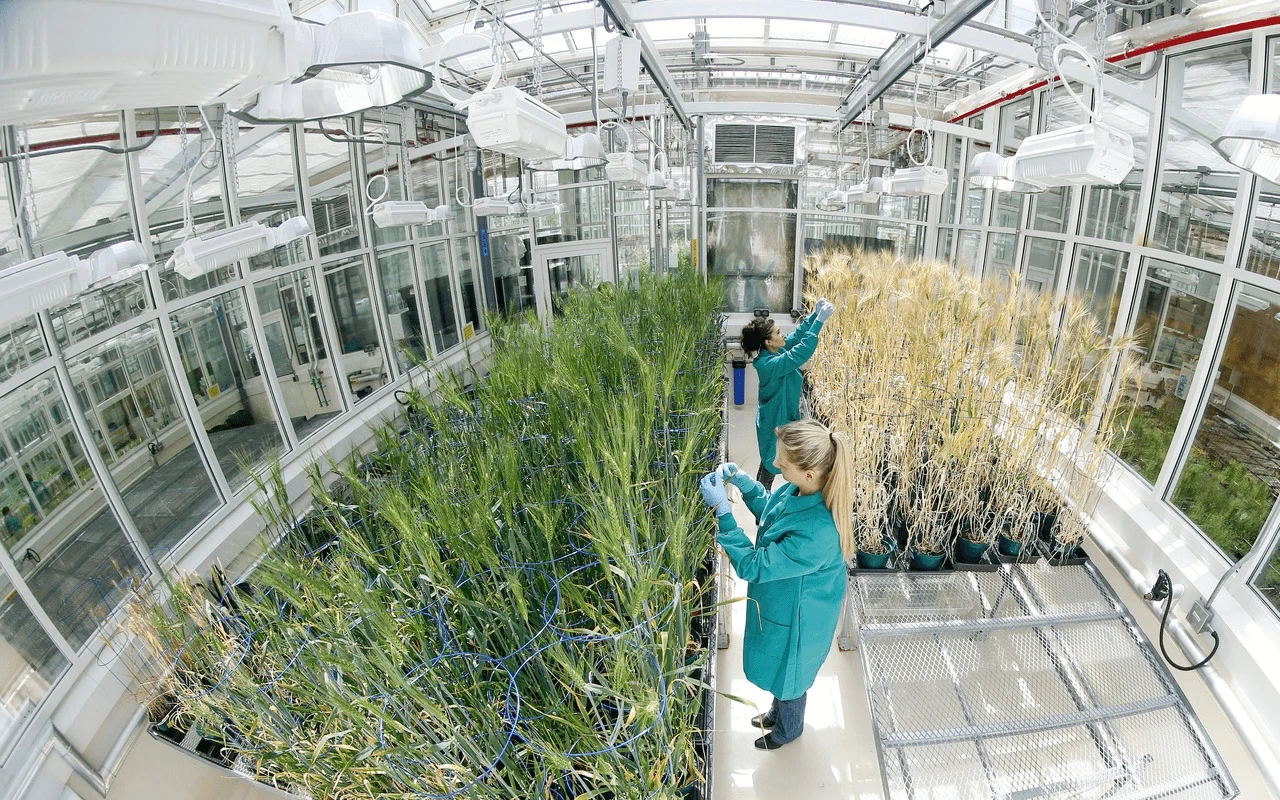

Agriculture is among the sectors hardest hit by a warming climate, and it is also one of our most important tools for adapting to it. The question is not whether we can grow more food, but whether we can grow more with less.
More than 730 million people are still hungry. We must feed them, along with a growing global population, on degraded soils, with shrinking water supplies and in a hotter climate.
My argument is simple. Food security will not be achieved by using more land, water or fertilizer. It will come from scientific innovation that enables farmers to produce more with fewer resources. Saudi Arabia is well placed to help lead that shift.
In Saudi Arabia, rising temperatures can cut crop yields by as much as a quarter, while salty soils further undermine productivity. Most of the water used here comes from underground reserves that are not replenished.
But this pressure is also an advantage. Countries facing extreme heat, water scarcity and poor soils have every reason to develop farming technologies that minimize waste. And what works here can work elsewhere as these conditions increasingly affect farmland worldwide.
The solution lies in understanding how plants grow.
Plants regulate their growth through tiny chemical signals, natural messages that tell roots when to spread and shoots when to grow. My team at King Abdullah University of Science and Technology discovered one of these signals and went on to design synthetic versions that replicate its effects. We call it MiZax.
MiZax is not a fertilizer that feeds the plant. It is a signal that helps the plant make better use of what it already has.
MiZax has undergone rigorous field trials across a range of strategic crops, including potatoes, wheat, rice and millet, with encouraging results. I have been surprised by how efficiently it delivers multiple benefits. In a potato pilot in Qassim, production rose by almost half. In field trials with King Abdulaziz University, wheat yields increased by 55-95 percent and pearl millet yields by 60-120 percent.
In Taiwan, rice growers cut their fertilizer use in half. Trials at Estidamah in Riyadh have also demonstrated MiZax’s potential for growing saffron, one of the world’s most valuable crops, and improving its quality under conditions once considered too harsh for cultivation. MiZax is not a silver bullet, but these results have paved the way for commercial deployment.
Through a strategic partnership, KAUST and SEQUENCIVE established namya, a joint venture to commercialize and deploy MiZax locally and internationally. The venture was recently launched under the patronage of Minister of Environment, Water and Agriculture Abdulrahman Al-Fadley.
Its first product, Plantiva, takes MiZax from the laboratory to the market. Plantiva is designed to enhance crop productivity and resource efficiency across different crops and growing conditions.
Science only feeds people when it leaves the laboratory, yet too many promising ideas stall between the research bench and the farm gate. Scientists and industry often hesitate to take risks by exploring new ideas and validating innovative concepts, while farmers cannot afford to put their livelihoods on the line for unproven solutions.
Saudi Arabia is now building a bridge across that gap. At KAUST, we test ideas in Saudi fields and work with farmers and universities. SEQUENCIVE, our commercialization partner, helps turn research into practical, market-ready solutions.
Vision 2030 has made food security a national priority, with the aim of building Saudi-made solutions, companies and skills.
This changes the Kingdom’s role. Saudi Arabia is no longer simply looking abroad for answers to its agricultural challenges. It is developing technologies that could one day help farmers in other water-stressed regions.
What needs to happen next is clear. We need steady, long-term investment in agricultural research because discoveries in plant biology take years to mature.
Policymakers must create stronger incentives and support mechanisms to bridge the gap between scientific discovery and practical application. We also need to train young Saudi scientists who can carry this work from the laboratory to the field, while bringing researchers, farmers and investors together as partners.
If we invest in these priorities today, we can nourish tomorrow.
• Salim Al-Babili is professor of plant science and associate vice president for research at KAUST.


