


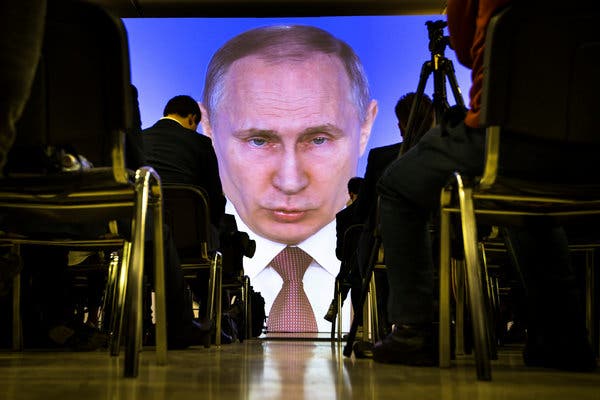
Things should not be looking up for Russian President Vladimir Putin, but sadly they are. The Russian government recently lowered its economic growth forecast for next year. The economy is slowly but surely feeling the pain from economic sanctions. Putin has also been plagued by internal unrest.
Multiple protests in Moscow over the summer have seen tens of thousands of activists on the streets. Last weekend’s local elections were a disaster for Putin’s United Russia party. Opposition parties now have their eyes on the next parliamentary elections in 2021. However calm and collected Putin looks on the outside, deep inside he must be anxious if not concerned.
This is why the messages coming from the US and France about a rapprochement are so alarming and puzzling. In the past few weeks, French President Emmanuel Macron has gone out of his way to suggest that it is time for the EU to mend ties with Russia.
Speaking to a group of French ambassadors recently, Macron reportedly told them that “pushing Russia away from Europe is a profound strategic error, because we will push Russia either into an isolation that increases tensions, or into alliances with other great powers such as China.” If France thinks that it can align Russia with Europe to join forces against China, it is hopelessly naive.
It goes without saying that this sort of talk makes many in Europe nervous. Eastern European countries that share a border and a complicated (and often deadly) history with Russia worry that Macron’s equivocation when it comes to Russian sanctions will only invite further aggression.
Normally, these smaller Eastern European countries rely on major European powers such as France to counter countries like Russia. Now, many of them feel that the carpet is being pulled out from under them.
But it is not only smaller European countries that are puzzled by Macron’s newfound enthusiasm for rapprochement with Russia. It was only 18 months ago that Russian spies used a nerve agent as part of an assassination attempt on British soil. Needless to say, many in London are listening to their French friends with bewilderment.
Even Germany, whose cozy economic and energy relationship with Russia is usually a concern for those wanting to take a hard line against Moscow, has expressed skepticism over French desires.
There are wrong signals being sent form the other side of the Atlantic too. Recent comments and actions by US President Donald Trump have not made the situation any better. During the recent G7 meeting, he suggested on multiple occasions that Russia should be allowed to re-join the international grouping after being expelled in 2014 for invading Ukraine.
The recent decision to transfer $750 million that the US Department of Defense had allocated for boosting frontline defense in Europe to help build a wall on America’s southern border sends the wrong message to friend and foe alike. Those in the Kremlin probably cannot believe their luck.
Recently ousted National Security Adviser John Bolton was a staunch defender of NATO, and was known to take a very hard line against Russia in the White House. It remains to be seen if his replacement will continue to take that line.
Any notion of the US or Europeans easing economic pressure on Russia, bringing it back into the international fold and pretending everything can go back to normal is geopolitically short-sighted.
Luke Coffey
The recent policy decisions and public comments made by leaders in Paris and Washington show a transatlantic community that is fracturing on the issue of how best to respond to Russian aggression.
Although the Trump administration has done some very good things to bolster NATO — such as more US troops in Europe and getting Europeans countries to spend more on defense — it now runs the risk of undermining the progress of the past few years.
Policymakers in Washington and Paris need to remember that five years ago it was Russia that invaded Ukraine, not the other way around. Ukraine is the victim. Russia is the aggressor. In a single day this week, Russian and Russia-backed fighters launched 18 attacks against Ukrainian forces, resulting in the deaths of two soldiers. This is the reality of a cease-fire in eastern Ukraine that exists in name only.
Whether it is killing Ukrainian soldiers, occupying parts of Georgia and Ukraine, propping up despots in Venezuela and Syria, or providing diplomatic cover for Iran’s malign behavior, Russia has done nothing to demonstrate it is ready to normalize relations with the West. Now is the time for the international community to be increasing pressure on the Kremlin, not easing it.
The attitude displayed by Paris and Washington sends a clear message to Moscow: The cost of invading and annexing part of your neighbor’s territory is low. Any notion of the US or Europeans easing economic pressure on Russia, bringing it back into the international fold and pretending everything can go back to normal is geopolitically short-sighted. Now is the time for strength and consistency by the transatlantic community, not equivocation and timidity.
- Luke Coffey is director of the Douglas and Sarah Allison Center for Foreign Policy at the Heritage Foundation. Twitter: @LukeDCoffey


