
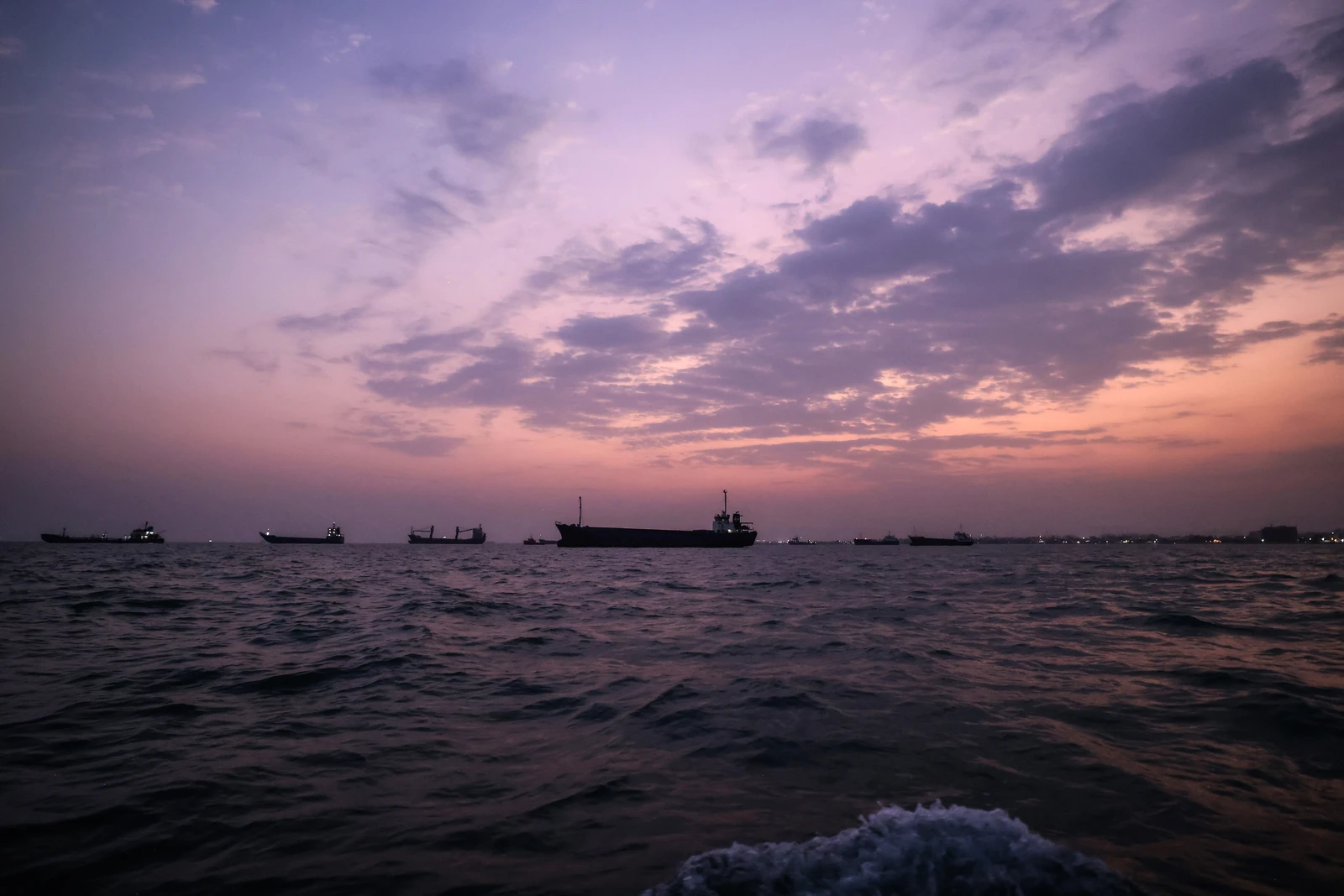

Back in 1904, when Adm. Sir John “Jacky” Fisher became Britain’s First Sea Lord, he set about modernizing the Royal Navy. He looked across Britain’s global empire, understood that he had finite resources and a limited number of ships, and had to think creatively and strategically about how to organize the force.
His assessment could be summed up in a few memorable sentences. “Five keys lock up the world. Singapore, the Cape, Alexandria, Gibraltar, Dover. These five keys belong to England,” he reportedly said. Fisher believed that control of these crucial maritime chokepoints was central to Britain’s ability to exercise global sea power.
More than 120 years later, the British Empire no longer exists and none of today’s keys “belong to England.” Instead, today’s deeply interconnected global economy relies on the shared use of maritime spaces often described as part of the global commons. Within this system, five new keys stand out for their ability to lock up the world in the 21st century: the Strait of Malacca, the Strait of Gibraltar, the Suez-Bab Al-Mandab corridor, the Strait of Hormuz and the Turkish Straits.
Some featured, either directly or indirectly, on Fisher’s original list. Others are new additions, reflecting changes in global commerce and technology. But there can be little doubt that a major disruption at any one of them can have ramifications far beyond the region in which it is located.
A major disruption at any one of these keys can have ramifications far beyond the region in which it is located
Luke Coffey
The scale of commerce passing through these five waterways is remarkable. One recent study estimated that the Strait of Malacca accounts for about 20 percent of global maritime trade by value, while the Strait of Gibraltar and the Suez-Bab Al-Mandab corridor each account for about 15 percent. The Strait of Hormuz is important for a different reason. Its significance comes less from containerized trade than from the extraordinary concentration of oil and gas, upon which global markets depend.
The Turkish Straits remain vital as well. Russia’s invasion of Ukraine has demonstrated their military and strategic importance, but their economic significance should not be overlooked. They provide the Black Sea’s only maritime connection to the Mediterranean and global markets. Oil and other commodities from the Eurasian heartland pass through them, as do grain and agricultural products shipped from Russian and Ukrainian ports to consumers around the world.
There are notable differences between the world Fisher confronted in 1904 and the one policymakers face today. Fisher’s keys were geographically dispersed, stretching from the Cape of Good Hope in the Southern Hemisphere to the Dover Strait in the English Channel. Today’s five keys, by contrast, form a remarkable band across the Northern Hemisphere covering less than 40 degrees of latitude. Three of the five are concentrated in the broader Middle East, serving as another reminder of why the region remains so strategically important to the global economy. The other two — the Strait of Gibraltar and the Strait of Malacca — form the bookends of this band of maritime commerce.
Two major shipping routes are deliberately excluded from this list: Russia’s Northern Sea Route and the Panama Canal. Moscow has long promoted the Northern Sea Route, which follows Russia’s Arctic coastline, as an emerging connection between Asian and European markets. Despite years of ambitious claims, however, the numbers remain remarkably modest. Transit between European and Asian markets remains a tiny fraction of the volumes moving through established routes such as Suez.
Alongside these five maritime keys, a global ‘bypass’ is emerging across the Eurasian landmass: the Middle Corridor
Luke Coffey
Viewed from the US, the Panama Canal’s strategic and economic importance is unparalleled. About 70 percent of cargo transiting the canal by tonnage either originates in or is destined for the US. Even so, Panama does not have the same systemic impact on global shipping as the five keys identified here.
Alongside these five maritime keys, a global “bypass” is emerging across the Eurasian landmass: the Middle Corridor. This route connects Asian markets with Europe through Central Asia, across the Caspian Sea and through the South Caucasus, while bypassing both Russian and Iranian territory. Billions of dollars are being invested in expanding railways, ports and other transport infrastructure along the route. It will never fully replace maritime shipping. The economics and sheer carrying capacity of container ships make that unrealistic. But for certain goods, particularly higher-value or time-sensitive products, the Middle Corridor can provide a workable alternative while helping governments and businesses diversify their supply chains.
There is another major difference between Fisher’s world and ours: the means by which a key can be locked.
In Fisher’s time, warships ruled the waves. Naval power was used to secure maritime routes, deny them to an adversary or reopen them during war. Today, an actor does not necessarily need to even have a navy at all to threaten international shipping. Like with Iran, drones and other unmanned systems, aircraft and increasingly sophisticated long-range missiles can threaten vessels from hundreds of kilometers inland. In some cases, these capabilities are in the hands of nonstate actors like the Houthis.
Then there is an added complication of shipping insurance. Sometimes, just the threat of missiles or drones can produce economic effects far beyond the military resources required to launch them. A strait does not necessarily have to be physically closed to become commercially unusable. If the threat to shipping becomes sufficiently severe, insurance premiums can soar and underwriters deny coverage.
Times have changed. The chokepoints have changed. The reasons for their importance have changed too. But one thing has not: the geopolitical consequences when the lanes of global trade are disrupted.
Fisher’s five keys reflected the strategic realities of the British Empire at the beginning of the 20th century. Today’s five keys reflect the realities of an interconnected global economy in the 21st century. Like-minded partners and allies must work together to preserve freedom of navigation and ensure that the five new keys of shipping remain open.
Luke Coffey is a senior fellow at the Hudson Institute. X: @LukeDCoffey


