
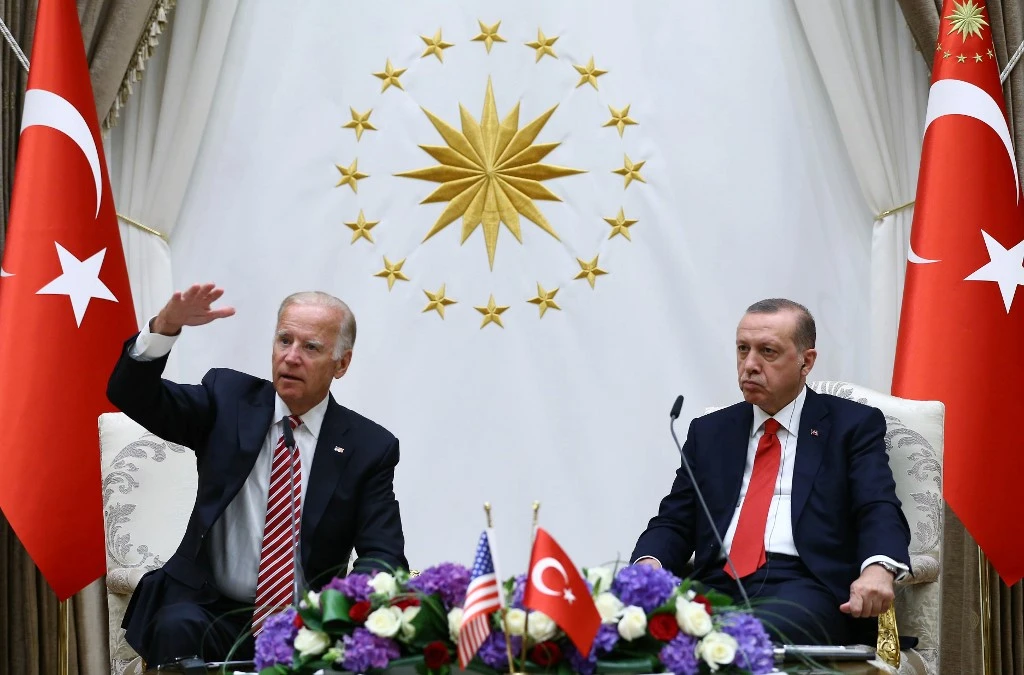

Turkish President Recep Tayyip Erdogan was among the last leaders to congratulate Joe Biden for winning the US presidency. The Turkish president also thanked the current American president for fostering bilateral relations. Erdogan has had a special relationship with President Donald Trump and has enjoyed direct access to him.
Turkey will present another conundrum for the incoming Biden administration. The Biden administration needs Turkey as an ally though it disapproves of many of Turkey’s policies. As politics is the art of the possible, the US administration might be compelled to work with unsavory allies. Therefore, it will have to accommodate Erdogan on some fronts while confronting him on others. Keeping the balance in the relationship will, however, prove to be tricky and challenging.
Some of the Biden campaign promises have been to restore the role of the US on the world scene, mend the relationship with NATO allies, and stand up to Russia. If Biden is to deliver on any of those points, he will need to work with Turkey. However, Biden has already expressed his dislike of Erdogan. A video from 2019 emerged prior to the US elections in which Biden said that the US should support Erdogan’s domestic opponents. This statement created discomfort on the American and Turkish sides. An Erdogan spokesperson slammed the “interventionist” comment saying the US is not supposed to interfere in the internal affairs of another country, let alone a NATO ally.
The discomfort in the relationship between the two countries started with Barack Obama, as his administration relied on the Kurds to fight Daesh. The YPG militia was the backbone of the forces that fought the terrorist group. However, Turkey saw no difference between the YPG militia and the PKK, the terrorist group that has been conducting attacks in Turkey for decades. Its frustration grew with the US’s increasing reliance on Kurdish fighters, for fear that the empowerment of the Kurds in Syria might embolden their kinsmen at home.
Balancing the Turkish-Kurdish relationship represents a real challenge for Biden.
Dr. Dania Koleilat Khatib
On this front, Erdogan had a better understanding with Trump. The latter who did not believe in sustained operations to maintain stability was eager to fulfill his campaign promise and withdraw from “endless wars,” hence from Syria. Following a phone call last year from the Turkish president, Trump withdrew from northeast Syria, paving the way for a Turkish incursion into the Kurds’ heartland. Trump doubled down on his position claiming the Kurds were not “angels” and that they “didn’t help” the US in Normandy during the Second World War.
Biden expressed strong opposition to Trump’s decision, claiming it would undermine US credibility. The Kurds were not the only point of contention with the Obama administration. Erdogan blamed the Obama administration for the failed Gulen coup. Biden’s comment about supporting the opponents of Erdogan is likely to increase this mistrust. To add to that, Biden — unlike Trump — might not shield Turkey from sanctions proposed by the US Congress, such as sanctioning Halkbank for dealing with Iran.
Balancing the Turkish-Kurdish relationship will represent a real challenge for Biden. On the one hand, he needs to show loyalty to the Kurds and he needs them to prevent a re-emergence of Daesh; on the other hand, he will need Turkey to contain Russia in Syria. Though a Biden administration wants Turkey to leave the northeast they would not want Turkey to leave the northwest at the mercy of Bashar Assad, who would probably not show any if he were given the chance to conquer Idlib.
Also, the US under Trump has been passing the buck to Europe and asking it for greater involvement in Libya and in the Eastern Mediterranean. Biden will probably need a more hands-on approach if he wants to deliver on his campaign promise to restore US leadership in world affairs. Hence it will be difficult to ignore Turkey.
Turkey is an essential element of NATO. This is why it was offered membership in 1952 despite it not being a European country. It is strategically located as it neighbors Russia across the Black Sea. Working with Turkey becomes more important as Democrats are advocates of working with allies, engaging in diplomacy, and keeping a light footprint. However, Turkey’s acquisition of the S-400 air defense system from Russia created a bad impression in policy circles in Washington. The head of the Senate Subcommittee on Europe and Regional Security Cooperation hinted that the US might consider Souda Bay in Greece as an alternative to the air base at Incirlik in Turkey if relations with Erdogan remain strained.
The important question is what arrangement Biden should reach with Erdogan in order to have the smooth relations that both parties need. What are the sorts of incentives a Biden administration should offer Turkey? What is the kind of pressure the US should exert on Erdogan to make sure Turkey remains in the NATO camp and is sincere in countering Russia, instead of accommodating Putin and clinching side deals with him? There are no straightforward answers as the different issues need to be compartmentalized and dealt with separately. Nevertheless, Turkey might agree to make concessions on some fronts if it is compensated on other fronts.
Erdogan is a pragmatist and he knows that he will no longer have direct access to the Oval Office as he had with Trump, and soon he will realize that he needs to back down on his maximalist claims.
Biden will have a very challenging task to bring Turkey back to the Western fold but failure to do that might push Ankara into the anti-Western camp, namely Russia and China and Iran.
- Dr. Dania Koleilat Khatib is a specialist in US-Arab relations with a focus on lobbying. She is the co-founder of the Research Center for Cooperation and Peace Building (RCCP), a Lebanese NGO focused on Track II. She is also an affiliated scholar with the Issam Fares Institute for Public Policy and International Affairs at the American University of Beirut.


