

This week saw the culmination of years of consultation on the EU’s future, but it is recent events in Ukraine that are catalyzing the political and economic direction of the bloc.
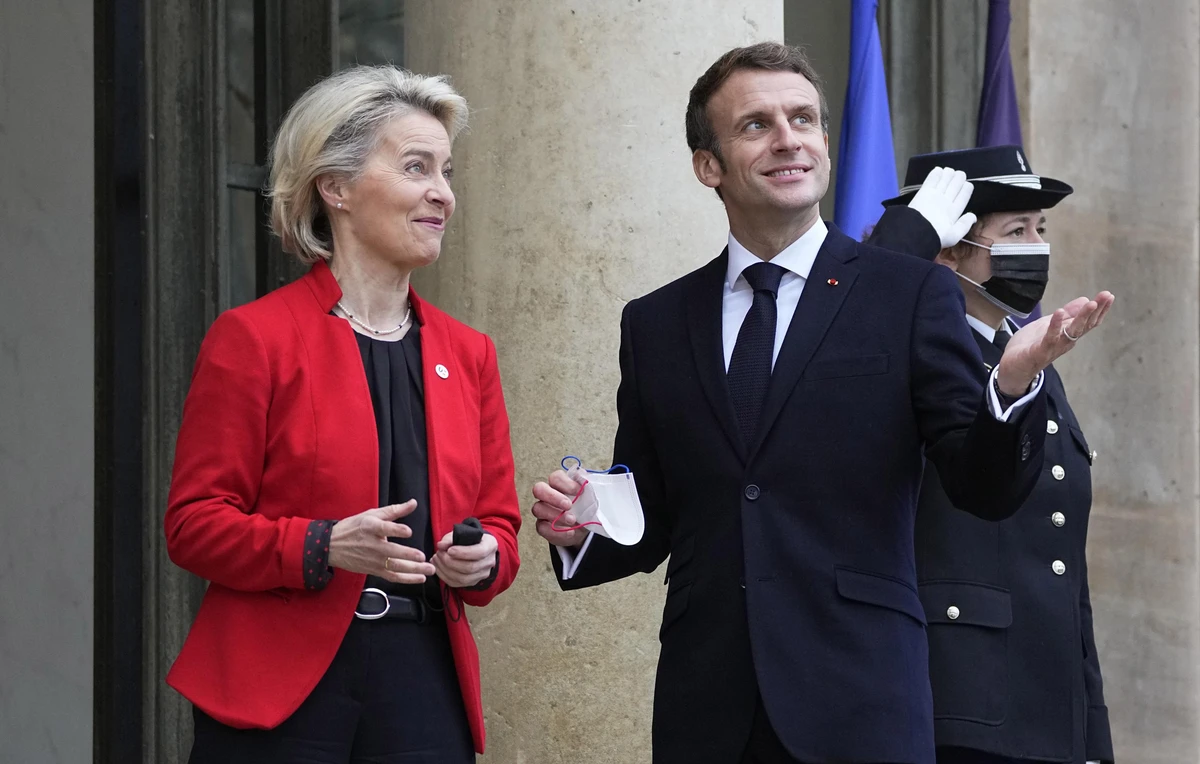
On Monday, a cross section of Europe’s top political brass, including French President Emmanuel Macron and European Commission President Ursula von der Leyen, spoke about the need for the EU to reset given the challenges on its eastern doorstep. Von der Leyen said “the unthinkable has returned to our continent” and stressed that the reset will shape the medium to long-term future of the bloc in the post-Ukraine, post-pandemic, post-Brexit era.
While the full implications of the Ukraine war might not be clear for years, what is already evident is that the current system of EU institutions and processes needs reforming to address the fallout. And the implications are key not only for EU foreign and security policy, but also its broader agriculture, migration, energy and industrial policies.
More than 300 reform proposals were considered at Monday’s conference, including rethinking the bloc’s practice of needing a unanimous vote to pass measures. A growing number of European leaders, including Italian Prime Minister Mario Draghi just last week, have called for a more “pragmatic federalism” that would see member states lose their ability to veto decisions agreed by a supermajority, in a move toward qualified majority voting.
Von der Leyen, along with key national leaders like Macron, is adamant that change is needed and that “standing still is falling back.” While reform has long been in the making, including following Brexit and the COVID-19 pandemic, it is the Russian invasion of Ukraine that is having the most dramatic consequence on EU policy by throwing the political kaleidoscope into flux.
This was highlighted by one of the big ideas proposed on Monday by Macron, who asserted that the EU, “given its level of integration and ambition, cannot be the only way to structure the European continent.” He favors a new type of “political European community” that would allow countries that may join in the future, like Ukraine, and others that have previously left it, including the UK, to deliver “European core values” in areas such as energy, transport and investment in infrastructure.
Meanwhile, Von der Leyen stressed that the bloc now needs to transform into a more muscular global actor. This is not a new idea for her, given her previous support for an EU army back in the days when she was defense minister in Angela Merkel’s German government. However, she emphasized how much the Ukraine conflict is “fundamentally challenging” Europe’s peace architecture. What began seven decades ago as a trade bloc binding former warring nations together is today an economic heavyweight with strong potential in broader foreign affairs.
To be sure, the bloc is still a long way from becoming the strategically autonomous goliath championed by some in Europe, but it may have crossed the Rubicon in 2022, including financing for the first time the purchase of lethal weapons for a third-party country (Ukraine) and imposing unprecedented sanctions on Russia following its invasion.
It is not just Ukraine driving this, but also the fact that Brexit has eliminated a long-standing obstacle to greater European cooperation, given that successive UK governments had long been opposed to deeper defense integration at the EU level. Added to this can be the uncertainty in transatlantic ties during the US presidency of Donald Trump, which some across the continent fear could be repeated given the significant possibility he will run again in 2024.
The Russian invasion is having the most dramatic consequence on EU policy by throwing the political kaleidoscope into flux.
Andrew Hammond
It is not just Brussels but also individual nations that are transforming their military thinking. Germany, for example, has announced significant new investment in its military and has reversed its historic policy that prevented it from sending lethal weapons to conflict zones. It is now equipping Kyiv with 1,000 anti-tank weapons and 500 anti-aircraft Stinger missiles.
Meanwhile, Finland and Sweden, two traditionally militarily nonaligned EU countries, are also delivering arms to help the Ukrainian army resist the Russian invasion. They are also expected to this weekend announce their intention to join NATO, with public opinion in both countries swayed toward joining the military alliance since Russia invaded Ukraine. Moreover, Denmark has announced it will hold a June referendum to reconsider the 30-year-old opt-out clause that has so far kept it away from the EU’s common defense policy.
Taken together, these examples underline why the Ukraine crisis has the potential to dramatically reshape the EU. Decisions taken in the coming weeks could be momentous and will help define the economic and political character of the bloc for many years to come.
- Andrew Hammond is an Associate at LSE IDEAS at the London School of Economics.


