
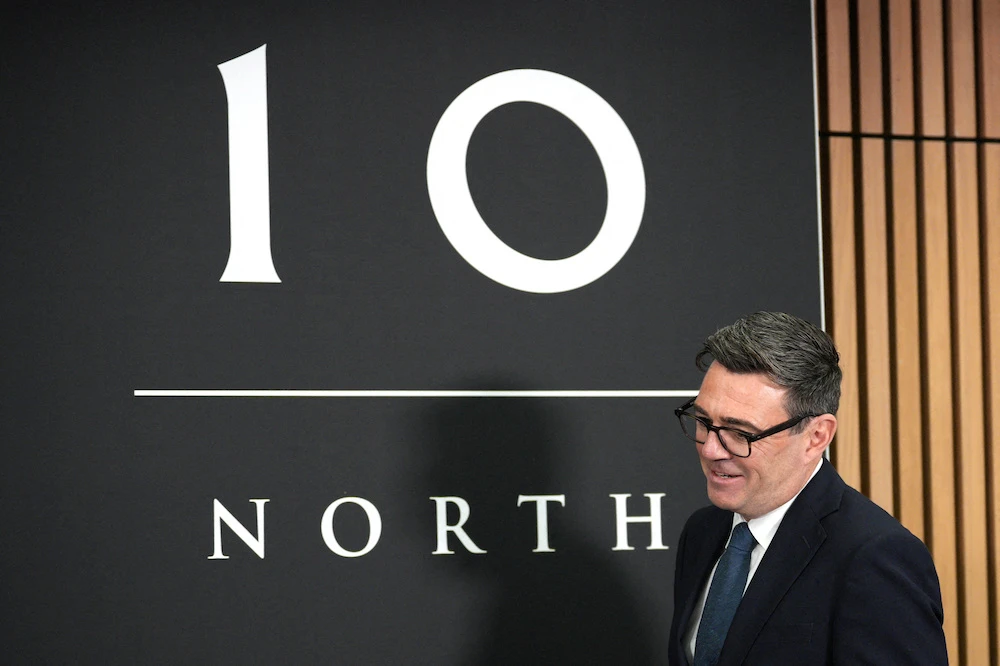

Andy Burnham’s first few days in Downing Street involved extensive introductory phone calls with world leaders. However, the UK’s new prime minister wants the focus of his period in office to be on domestic policy, including tackling the cost-of-living crisis.
The overriding priority for his new government is reigniting economic growth. It has been estimated that, as of the third quarter of 2024, UK real per capita gross domestic product was about 28 percent below what the postwar trend growth of 1955 to 2008 would have yielded. So, while the 2016 Brexit referendum is sometimes seen as the key crossroads moment in UK politics in the 21st century, it was actually the 2007-2009 financial crisis — since when growth has flatlined — that has shaped much of the political and economic context since.
For this reason, Burnham wants domestic policy to take center stage, meaning he is likely to spend less time abroad than his predecessor, Keir Starmer. Starmer made 48 trips to 33 countries during his two years in office. In his first six months in office alone, he met more than 100 world leaders, traveling to 15 countries.
Burnham therefore appointed on Monday a very experienced politician as foreign secretary: Ed Miliband, who formerly led the Labour Party in opposition from 2010 to 2015. Miliband served as energy and net zero secretary in Starmer’s government and is strongly trusted by Burnham. His responsibilities will include taking charge of the UK’s preparations to host the G20 summit in Manchester in 2027 and the G7 summit in 2028.
While Burnham’s first phone call with a foreign leader was with US President Donald Trump, his team is being encouraged to focus more international policy time on key emerging markets, including the Gulf, which might help kickstart UK growth. One Burnham adviser is Jim O’Neill, the economist who in 2001 coined the “BRIC” acronym to refer to the then-rising economic powers of Brazil, Russia, India and China.
O’Neill previously had a ministerial brief under Conservative Party Prime Ministers David Cameron and Theresa May as commercial secretary to the Treasury. He played a key role in helping to reinvigorate trade with China and other emerging market giants.
The relationship between O’Neill and former Manchester mayor Burnham goes back years. O’Neill, who grew up in Gatley, Greater Manchester, served as a nonexecutive director of Manchester United Football Club from 2004 to 2005 and has previously been linked with a possible takeover of the club. Like Burnham, he is a strong advocate of devolution for UK city regions.
It is not clear how Andy Burnham will actualize what he has called the biggest change moment for UK politics in more than a generation.
Andrew Hammond
Another key appointment Burnham made on Monday was that of ex-Defense Secretary John Healey as chancellor of the exchequer. It was Healey’s resignation last month that arguably landed the fatal blow to the Starmer government.
In his new Treasury role, Healey will seek to secure much more money for defense and security to meet the UK’s NATO-driven commitment of 3 percent of GDP by 2030 — a challenging pledge. Under Starmer, Healey clashed with then-Chancellor Rachel Reeves, who he has now replaced, asserting in his resignation letter as defense secretary that the Treasury had been “unwilling” to “commit the resources that the nation needs to defend the country at this time of rising threats.”
The appointment of Healey, who served as a junior finance minister under Tony Blair, was the biggest surprise of all Burnham’s appointments, given the widespread speculation that Home Secretary Shabana Mahmood, who has stayed in post, would get the job. Government borrowing costs rose and the pound initially depreciated after Healey’s appointment, alongside Burnham’s statement that he would use “any flexibility” he could find within the existing fiscal rules as he prepares a 10-year plan for the country.
The markets are closely watching Burnham’s next steps, including how he seeks to realize his goal of ending what he asserts is four decades of “neoliberalism” in the UK since the era of Margaret Thatcher. It is not clear how he will actualize what he has called the biggest change moment for UK politics in more than a generation, which will see the “reindustrialization” of the nation outside of London and the southeast of England.
Overall, the UK’s new Burnham era has started with much energy. Yet, while more details of his policy plans are emerging, it may not be until his 10-year plan for change is released in the autumn that the prime minister’s overarching governing philosophy will become clear.
- Andrew Hammond is an associate at LSE IDEAS at the London School of Economics.


