
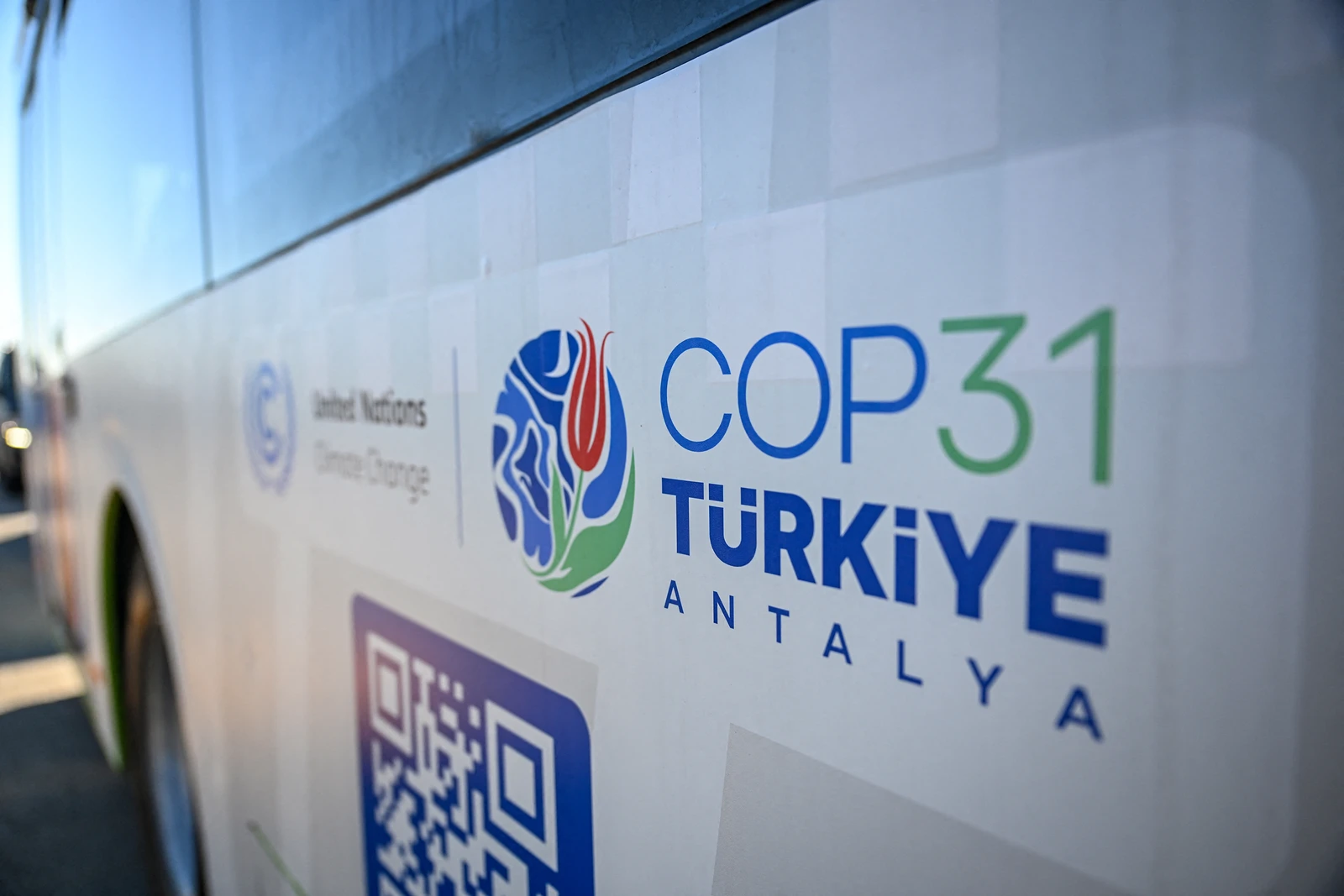

Turkiye has this year been given the opportunity to host two major events that it views as significant for its foreign policy ambitions. In July, the NATO Summit was held in Ankara, while Antalya is currently hosting the UN’s COP31 climate change summit.
For Ankara, both of these events are significant beyond security and the climate. They offer significant opportunities for Turkiye’s international visibility. COP31 is particularly significant because it is the first time the country has hosted a climate summit, whereas the NATO Summit was previously held in Istanbul in 2004.
At COP31, Qatari Emir Sheikh Tamim bin Hamad Al-Thani, Syrian President Ahmed Al-Sharaa, Pakistani Prime Minister Shehbaz Sharif and Iranian President Masoud Pezeshkian were among the few leaders to attend. Unlike the NATO Summit, which US President Donald Trump attended in person, the Trump administration has not sent an official US delegation to COP31 due to its decision to withdraw from international climate commitments and its rejection of the direction of UN climate negotiations. Russia and China have both sent delegations.
Turkiye did not invite an Israeli delegation to COP31, arguing that climate justice cannot be separated from peace
Dr. Sinem Cengiz
COP31 has also brought together Iranian and European leaders. Turkish President Recep Tayyip Erdogan held a separate meeting with Pezeshkian, in which he once again called for diplomacy to end the war. Erdogan is one of the very few regional leaders who has held direct talks with the Iranian leadership since the beginning of the US-Iran war.
Turkiye did not invite an Israeli delegation to COP31, arguing that climate justice cannot be separated from peace. In a way, it used its role as host to reinforce its position on Gaza. Erdogan has stated that what is taking place in Gaza is not only a genocide but also an ecocide, given Israel’s destruction of the Strip.
This is not the first time Turkiye has used international platforms to advance its position against Israeli policies. In 2024, it blocked NATO-Israel cooperation following the outbreak of the Gaza war. This included joint meetings and exercises. Ankara argued that NATO should not engage with Israel as a partner until the conflict was over.
Meanwhile, the attendance of Al-Sharaa at both COP31 in Antalya and the NATO Summit in Ankara was not simply a matter of diplomatic protocol. It showed Turkiye’s strong interest in supporting Syria’s reintegration into the international system. Syria faces serious water scarcity and infrastructural issues, so COP31 also provided an opportunity for Syrian officials to engage with others to garner support for their country’s postwar recovery.
Both Armenian Prime Minister Nikol Pashinyan and Azerbaijani President Ilham Aliyev were also present in Antalya. Erdogan held a meeting with Pashinyan that was part of the normalization track Yerevan and Ankara have been pursuing for some time.
The hosting of high-profile summits allows middle powers to enhance their status-seeking goals in the international arena
Dr. Sinem Cengiz
Erdogan posed for a picture side by side with Aliyev, whose trip came just a few days after the Turkish president had visited Baku. Turkiye-Azerbaijan ties had been strained recently over Turkiye’s reaction to a headscarf ban in schools imposed in Azerbaijan. However, the two leaders’ diplomacy has helped them ride out the storm and Aliyev’s attendance at COP31 was crucial to show that the two leaders had overcome the issue. Erdogan also expressed gratitude to Azerbaijan for its support in preparing for COP31.
Besides diplomatic traffic, COP31 has also witnessed the signing of cooperation agreements. One was Saudi Arabia and Turkiye’s signing of an electricity agreement as part of their renewable energy cooperation. Turkish officials stated that the investments aimed to strengthen grid infrastructure and boost system flexibility.
The hosting of high-profile summits allows middle powers to enhance their status-seeking goals in the international arena. Therefore, as a middle power, Turkiye has benefited from the platform of COP31 and used it to act as an intermediary between various states with different interests. Erdogan has long sought to position Turkiye as a rising diplomatic and military power that can mediate wars. On the sidelines, Erdogan said Turkiye is working toward de-escalation in the dispute between Iran and the US and is ready to support a new dialogue process on the Ukraine-Russia war.
Of course, hosting major international events often comes with criticism from different circles, including domestic opposition parties, civil society organizations and international organizations. The Turkish leadership has faced criticism from opposition political parties and civil society groups concerning its domestic political issues and environmental policies.
Despite these criticisms, hosting the NATO Summit and COP31 and welcoming world leaders to Turkiye remains significant for the leadership in Ankara, as both events provide opportunities to demonstrate that Turkiye is an influential diplomatic actor. They also offer the Turkish government an opportunity to turn these diplomatic achievements into domestic political narratives relating to international prestige. Therefore, I think COP31 matters to the Turkish leadership beyond a mere climate commitment.
Moreover, these major international events have taken place while the region is on tenterhooks over a potential new escalation between the US and Iran. In this regard, Turkiye offers a venue for high-level diplomatic meetings that can bring together conflicting parties for an informal engagement. As a result, Turkiye has effectively turned both the NATO Summit and COP31 into a foreign policy opportunity and a means to enhance its international status.
Dr. Sinem Cengiz is a Turkish political analyst who specializes in Turkiye’s relations with the Middle East.
X: @SinemCngz


