

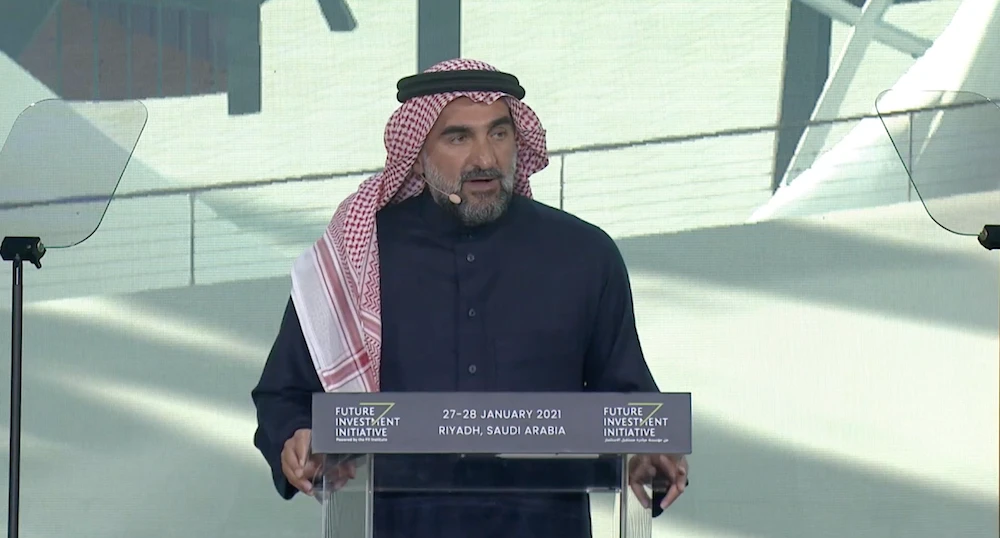

The importance of adhering to environmental, social and governance (ESG) principles weaved itself through nearly every panel at last week’s Future Investment Initiative (FII) conference. This was not surprising, as the theme of the conference was “The Neo-Renaissance,” taking its inspiration from the blossoming arts, culture and economy of the 16th and 17th centuries, as the world was recovering from another pandemic, the plague.
Neo-Renaissance implies building back better and what is more important to achieving that goal than making the world a place where we take care of the environment and the socially weak, while ensuring we adhere to the principles of good governance.
ESG is not just the right thing to do, it is also good business. ESG-compatible investments are the fastest-growing asset class. Deloitte expects that, by 2025, 50 percent of professionally managed money in the US will adhere to ESG principles.
ESG is also seen as a major risk among the financial community. A recent poll by Deloitte included 57 financial institutions, from banks to insurers and asset managers. They all listed ESG compliance as one of their top risks going forward. Insurers have learned the hard way that environmental and social risks, such as extreme weather patterns, can cost them dearly. The rest of the financial industry is more concerned about changes in regulations and backlashes from the investor community if they fail to conform to ESG principles. Millennials and young people from Generation Z feel particularly strongly about ESG. It was, after all, Swedish schoolgirl Greta Thunberg who captured their imagination and advanced the climate change debate by leaps and bounds.
One of the issues of ESG investing is standards and metrics, or rather the lack thereof. The UN, the World Economic Forum, the International Financial Reporting Standards and even the International Monetary Fund are on the case, integrating taxonomies and reporting into the institution’s financial sector assessment process using various tools.
Saudi Public Investment Fund Gov. Yasir Al-Rumayyan made a very good point when he highlighted that an agreed set of metrics was lacking, especially as far as social indicators were concerned. This is really important because, while the world at large has understood the importance of measuring environmental impacts, things look a bit murkier when it comes to the social element of the equation.
However, the growing inequalities between the rich and the poor nationally and globally, as well as movements such as Black Lives Matter, should have taught us something: We cannot build sustainable societies when the divide between rich and poor keeps on growing.
This holds true within countries as well as between the developed and developing worlds. If anything highlights this, it is the debate on the importance of giving developing countries access to coronavirus disease (COVID-19) vaccines, while developed countries have bought up so many doses that they can vaccinate their populations many times over. As Dr. Anthony Fauci, the chief medical officer to US President Joe Biden, reminds us, where populations are not vaccinated the virus can mutate and come back to haunt vaccinated populations. In other words, neglecting the weak will come back to haunt the strong. This holds true not just as far as COVID-19 vaccines are concerned, but also when it comes to other social disparities.
This brings us to a big issue as far ESG accounting is concerned: At times, the “E” (environment) clashes with the “S” (society). Building standards and heating are a good example, as it is perfectly legitimate for a government to mandate the upgrade of the insulation and heating standards of its existing housing stock. In terms of carbon dioxide emissions, that is perfect. However, what happens to the 75-year-old pensioner on a small state pension who has saved all of his life to afford his property? He cannot afford the retrofit and, given his age, he does not qualify for a mortgage. What is he to do? Should he freeze in winter or forgo food? Stark as this may sound, this is a question many pensioners in the developed world will soon face.
We see similar issues on a global level. Close to a billion people still live in energy poverty. Lofty principles of cutting hydrocarbons from the energy mix may sound good and principled but, when affordability comes into the fray, the ample, affordable and reliable supply of gas matters.
We cannot build sustainable societies when the divide between rich and poor keeps on growing.
Cornelia Meyer
The debate will have to shift from eliminating oil and gas from the energy mix to how to eliminate carbon dioxide emissions at source via carbon capture, utilization and storage (CCUS) or the circular carbon economy. Otherwise, we risk denying the poorest people in the least-developed countries access to affordable energy, which effectively means depriving them of education and development.
ESG is really important and it is also the way to go in terms of business. We have to be careful, though, to remain compassionate for the poor, whether within countries or among the family of nations. The question remains, what is ESG good for if we do not protect the economically weak? In other words, the “S” in ESG really matters.
- Cornelia Meyer is a Ph.D.-level economist with 30 years of experience in investment banking and industry. She is chairperson and CEO of business consultancy Meyer Resources. Twitter: @MeyerResources


